

Saved Bookmarks
This section includes 7 InterviewSolutions, each offering curated multiple-choice questions to sharpen your Current Affairs knowledge and support exam preparation. Choose a topic below to get started.
| 1. |
How the following conversions can be carriedout ? Ethanol to but-1-yne |
Answer» SOLUTION :
|
|
| 2. |
How the following conversions can be carried out ?Ethanol to but-1-yne |
Answer» SOLUTION :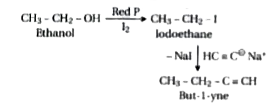
|
|
| 3. |
How the following conversions can be carried out ?Chloroethane to butane |
| Answer» SOLUTION :`underset("Chloroethane")(2CH_(3)CH_(2)Cl)overset(" 2Na ")underset(" DRY ETHER ")rarr underset("n-butane")(CH_(3)CH_(2)CH_(2)CH_(3))` | |
| 4. |
How the following conversions can be carriedout ? Chloroethane to butane |
| Answer» Solution :`underset("Choroethane") (2CH_(3)CH_(2)- Cl ) + 2Na overset("DRY ether, "Delta ) to underset("Butane") (CH_(3) CH_(2) - CH_(2)CH_(3) + 2NaCl) ` | |
| 5. |
How the following conversions can be carried out ?Chlorobenzene to p - nitrophenol |
Answer» SOLUTION :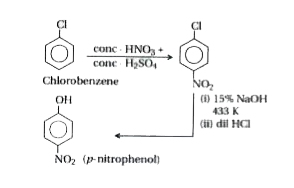
|
|
| 6. |
How the following conversions can be carriedout ? But-l-ene to n-butyliodide |
| Answer» Solution :`underset("But -1- ene") (CH_(3)CH_(2)CH = CH_(2)) underset(("ANTI - Markovnikov addition ")) overset("HBr /Peroxide") to underset("1 - BROMOBUTANE") (CH_(3)CH_(2)CH_(2) CH_(2) BR) underset(("Finkelstein reaction ")) overset("NaI, acetone") to underset("n -Butyl iodide") (CH_(3)CH_(2)CH_(2)CH_(2)I) ` | |
| 7. |
How the following conversions can be carriedout ? Chlorobenzene to p-nitrophenol |
Answer» SOLUTION :
|
|
| 8. |
How the following conversions can be carried out ?But -1-ene to n-butyliodide |
Answer» SOLUTION :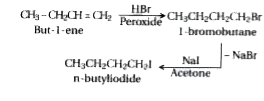
|
|
| 9. |
How the following conversions can be carried out ?Benzyl alcohol to 2-phenylethanoic acid |
Answer» SOLUTION :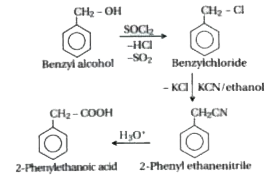
|
|
| 10. |
How the following conversions can be carriedout ? Benzyl alcohol to 2-phenylethanoic acid |
Answer» SOLUTION :
|
|
| 11. |
How the following conversions can be carried out ?Benzene to diphenyl |
Answer» SOLUTION :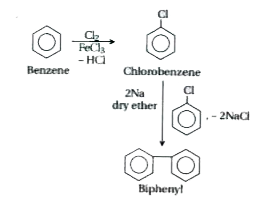
|
|
| 12. |
How the following conversions can be carriedout ? Benzene to diphenyl |
| Answer» SOLUTION :BENZENE to DIPHENYL | |
| 13. |
How the following conversions can be carried out ?Benzene to 4-bromonitrobenzene |
Answer» SOLUTION :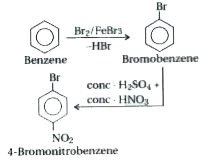
|
|
| 14. |
How the following conversions can be carriedout ? Benzene to 4-bromonitrobenzene |
Answer» SOLUTION :
|
|
| 15. |
How the following conversions can be carried out ?Aniline to phenylisocyanide |
Answer» SOLUTION :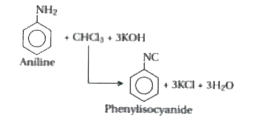
|
|
| 16. |
How the following conversions can be carriedout ? Aniline to phenylisocyanide |
Answer» SOLUTION :
|
|
| 17. |
How the following conversions can be carried out ?Aniline to chlorobenzene |
Answer» SOLUTION :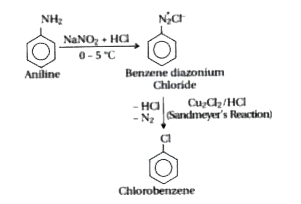
|
|
| 18. |
How the following conversions can be carriedout ? 2-methyl-1-propene to 2-chloro-2-methylpropane |
| Answer» SOLUTION :`underset("2 - Methyl - 1- PROPENE") (CH_(3) - overset(CH_(3)) overset(|) C = CH_(2)) underset(("Markovnikov additon ")) overset(HCl) to underset("2- CHLORO -2- methylpropane") (CH_(3) - underset(Cl) underset(|) overset(CH_(3))overset(|) C - CH_(3)) ` | |
| 19. |
How the following conversions can be carriedout ? Aniline to chlorobenzene |
Answer» SOLUTION :
|
|
| 20. |
How the following conversions can be carried out ?2-Methyl-1-propene to 2-chloro-2-methyl-propane |
Answer» SOLUTION :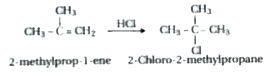
|
|
| 21. |
How the following conversions can be carried out ?2-Chloropropane to 1-propanol |
Answer» SOLUTION :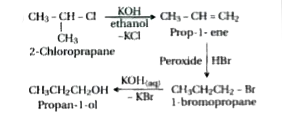
|
|
| 22. |
How the following conversions can be carriedout ? 2-chloropropane to 1-propanol |
| Answer» Solution :`underset("2-Chloropropane") (CH_(3) - underset(Cl)underset(|) (CH) - CH_(3)) underset(("Dehydrohalogenation ")) overset(KOH (alc.), Delta ) to underset("Propene") (CH_(3)- CH= CH_(2)) underset (("ANTI -Markovnikovadditon ")) overset("HBr, Peroxide") to underset("1 -Bromopropane") (CH_(3)CH_(2)CH_(2)Br) underset(("Nucleophilic SUBSTITUTION ")) overset(KOH (aq) , Delta ) to underset("1 - Propanol") (CH_(3)CH_(2)CH_(2)OH) ` | |
| 23. |
How the following conversions can be carried out ?2-Chlorobutane to 3,4 - dimethylhexane |
Answer» SOLUTION :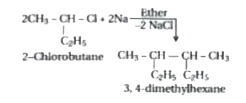
|
|
| 24. |
How the following conversions can be carriedout ? 2-Chlorobutane to 3, 4-dimethylhexane |
| Answer» Solution :`UNDERSET("2 - Chlorobutane") (2HC_(3) - underset(Cl) underset(|) CH - CH_(2)CH_(3)) + Na underset(("WURTZ reaction ")) OVERSET("Dry ETHER") to CH_(3)CH_(2) - underset("3,4 - Dimethylhexane")(underset(CH_(3))underset(|) CH - underset(CH_(3))underset(|) CH - ) CH_(2)CH_(3) + 2NaCl ` | |
| 25. |
How the following conversions can be carried out ?1-Bromopropane to 2-bromopropane |
Answer» SOLUTION :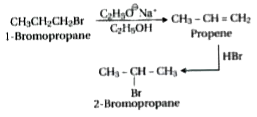
|
|
| 26. |
How the following conversions can be carried out ?2-Bromopropane to 1-bromopropane |
Answer» SOLUTION :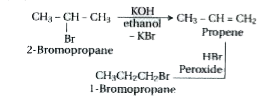
|
|
| 27. |
How the following conversions can be carriedout ? 2-Bromopropane to 1-bromopropane |
| Answer» SOLUTION :`underset("2 -Bromopropane") (CH_(3) - underset(Br) underset(|) CH - CH_(3)) underset(("DEHYDROHALOGENATION ")) overset(KOH (alc.) ,Delta ) to underset("Propene") (CH_(3) - CH = CH_(2)) underset(("Anti -Markovnikov addition ")) overset("HBR, peroxide") to underset("1- Bromopropane") (CH_(3) - CH_(2) - CH_(2) - Br ) ` | |
| 28. |
How the following conversions can be carriedout ? 1-Bromopropane to 2-bromopropane |
| Answer» SOLUTION :`underset("1 - Bromopropane " ) (CH_(3)CH_(2)CH_(2)Br) underset("Dehydrohalogenation ") OVERSET("KOH (alc.) , D") to underset("Propene") (CH_(3) CH = CH_(2)) underset("Markovnikov ADDITON ") overset("HBr") to underset("2 - Bromopropane " ) (CH_(3)- CHBr - CH_(3)) ` | |
| 29. |
Howthe followingconversions are effected ? (i) Phenol toSalicylaldehyde (ii) Phenol tophenolphthalein (iii)glycolto1,4 dioxane |
|
Answer» Solution :(i) Riemer Tiemann Reaction :On treatingphenol with ` CHCI_(3)/ NaOH, a - CHO_(3)`GROUP is introducedat orthoposition . This reaction proceedsthroughthe formation of substituted benzeal chlorideintermediate ` (##SUR_CHE_XII_V02_QP_E01_039_S01.png" width="80%"> (II) Phthalein reaction : On HEATING phenolwith phthalicanhydrideis presence of con. ` H_(2)SO_(4)`phenolphtaleinis obtained  (iii) When distilledwith Conc. ` H_(2)SO_(4)` glycol FORME dioxane  (##SUR_CHE_XII_V02_QP_E01_039_S03.png" width="80%"> |
|
| 30. |
How the density of an unit cell is calculated ? |
|
Answer» Solution : The density of an unit cell is calculated by, Density `(d) = (Z xx M)/(N_A xx a^3 xx 10^(-30)) g/(cm^3)` Where Z = Number of atoms per unit cell M = Mol. MASS `N_A` = Avogadro.s number a = Edge length of unit cell in PICOMETERS as measured by X-ray diffraction, d = density of unit cell in `g//cm^3` |
|
| 31. |
How the biodegradable polymers are decomposed ? |
|
Answer» By HYDROLYSIS |
|
| 32. |
How the average rate of chemical reaction is decribed? |
|
Answer» By increasing the CONCENTRATION of products |
|
| 33. |
How the adsorption of a gas is related to the critical temperature |
| Answer» Solution :LARGER is the critical TEMPERATURE of a gas, larger is its EASE of liquefication, and thus larger will be the adsorption | |
| 34. |
How test benzaldehyde react with a concentrated solution of sodium hydroxide? Give the equation and name the reaction. |
Answer» SOLUTION :CANNIZARO REACTION: 
|
|
| 35. |
How solubility of gas in liquid varies with (i) temperature (ii) pressure. |
| Answer» SOLUTION :Solubility of gas DECREASES with increase in temperature and increases with increase in pressure. | |
| 36. |
How solubility of a gas in liquid changes with increase in temperature? |
| Answer» SOLUTION :DECREASES | |
| 37. |
How slag is formed in metal extraction ? |
Answer» Solution :FLUX combines with INFUSIBLE IMPURITY to FORM FUSIBLE slag . 
|
|
| 38. |
How proteins are classified on the basis of structure ? |
|
Answer» |
|
| 39. |
How proteins are classified depending on their three dimensional shape ? |
|
Answer» Globular Proteins- Globular proteins are USUALLY coiled and COMPACT and nearly spherical in SHAPE. Most of the proteins are globular proteins. |
|
| 40. |
How potassium permanganate is prepared from MnO_2. |
|
Answer» SOLUTION : (a) PREPARATION of `KMnO_4`: Potassium permanganate is prepaered by the FUSION of `MnO_2`with an alkali metal hydroxidizing like `KNO_3` . It froms dark green `K_2 MnO_4` which disproportinates in a neutral of acidic solution to give peremanganate (i) `3MnO_2 + 4KOH + O_2 OVERSET ( KNO_3) to 2K_2 MnO_4 + 2H_2O` (ii) `3MnO_(4)^(2-) + 4H to 2MnO_4+ MnO_2 + 2H_2O` |
|
| 41. |
How physical state of halogen changes with increase in atomic number ? |
|
Answer» Solution :Fluorinerarr GAS Chlorine RARR gas Bromine rarr LIQUID Iodine rarr solid |
|
| 42. |
How PCl_(3), PCl_(5) and SOCl_(2) reacts with carboxylic acids ? |
| Answer» SOLUTION :`{:((i), 3RCOOH "CARBOXYLIC acid",+ PCl_(3) "Phosphorus trichloride", to RCOCl "Acid chloride", + H_(5)PO_(3),),((ii),RCOOH"Carboxylic acid", PCl_(5)"Phosphorus pentachloride", to RCOCl "Acid chloride",POCl_(3),CHL),((iii),R-COOH"Carboxylic acid",+ SOCl_(2) "Thionlyl ehloride",to R-CO-Cl"Acid chloride",+ SO_(2),+HCl):}` | |
| 43. |
How ozone is formed from atmospheric oxygen in the atmosphere/ What is the use of it in the atmosphere? |
| Answer» Solution :Ozone is formed from atmospheric OXYGEN in the pressence of sun LIGHT. This ozone LAYER PROTECTS the earth.s surface from ultraviolet (UV) radiation. | |
| 44. |
How much work is required to break up 1 mole of water at 20°C into spherical droplets of radius 1 cm? Given that gamma(H_(2)O) =72.75 xx 10^(-3) Nm^(-1),density (H_(2)O)=19.015g/mole. |
|
Answer» Solution :SUPPOSING 1 mole of water to be spherical, volume of 1 mole of water `=(18.015)/(0.998 xx 10^(6))` `=1.8047 xx 10^(-5) m^(3)` `therefore r= root(3)((3 xx V)/(4pi)) ((3 xx 1.8047 xx 10^(-5))/(4 xx 3.14))^(1//3) = 1.6272 xx 10^(-2) m` Surface AREA `=4pir^(2) = 4 xx 3.14 xx (1.6272 xx 10^(-2))^(2)` `=3.3273 xx 10^(-3) m^(2)` Volume of each droplet= `4/3 xx pi xx (1 xx 10^(-3))^(3) ~~ 4 xx 10^(-6) m^(3)` Number of droplets `=(1.8047 xx 10^(-5))/(4 xx 10^(-6)) =5` Surface area of 5 droplets `=5 xx 4pir^(2)` `=5 xx 4 xx 3.14 xx (1 xx 10^(2))^(2)` `=6 xx 10^(-3) m^(2)` When a DROP of 1 mole of water breaks into 5 droplets, INCREASE in surface area `=(6 xx 10^(-3) -3.3273 xx 10^(-3)) m^(2)` `=2.6727 xx 10^(-3) m^(2)` Work DONE to break up 1 mole of water=surface tension `xx` increase in area `=72.75 xx 10^(-3) xx (2.6727 xx 10^(-3)) J` `=1.94 xx 10^(-4) J (1 J = 1 Nm)` |
|
| 45. |
How much will the reduction potential of Zn//Zn^(2+) change if the solutionof Zn^(2+)is diluted 10 times ? |
|
Answer» INCREASES by 0.03 V |
|
| 46. |
How much will the reduction potential of a hydrogen electrode change when its solution initially at pH=0 is neutralised to Ph =7: |
|
Answer» Increaase by `0.059V` |
|
| 47. |
How much will the reduction potential of a hydrogen electrod echange when its solution initially at pH=0 is neutralized to pH=7? |
|
Answer» Increases by 0.059 V `E_(RED)=E_(red)^(@)-(0.0591)/(2)"log"(1)/([H^(+)])` `=E_(red)^(@)+0.0591log[H^(+)]` `E_(red)^(@)=0`. When `pH=0,[H^(+)=]10^(@)=1M` `thereforeE_(red)=0` when pH=7,`[H^(+)]=10^(-7)M` `E_(red)=0.0591" log "10^(-7)(0.0591)(-7)` `=-0.4137` THUS, `E_(red)` decreases by 0.41 V. |
|
| 48. |
How much will the K.E. of an electron in H -atom change if the atom emits a photon of wavelength of the electron wave before emission of photon of the aforsaid wavelength . |
|
Answer» |
|
| 49. |
How much water should be added to 2% W/V, 5 liter NaOH solution so as to make its concentration to 0.5 N ? |
|
Answer» 5 lit i.e., 100 mL `to` 2 gram NaOH 1000 mL `to` 20 gram NaOH To GET 0.5 N solution, W = NORMALITY `xx` eq. weight `xx` volume `= 0.5xx40xx1=20` gram `therefore` There is no need to add water. |
|