

Saved Bookmarks
This section includes 7 InterviewSolutions, each offering curated multiple-choice questions to sharpen your Current Affairs knowledge and support exam preparation. Choose a topic below to get started.
| 1. |
How many of the following intermediates heve at least one contributing structure in which all atoms have their octet complete ? |
|
Answer» |
|
| 2. |
How many of the following have standard heat of formation is zero. (i) Br_(2(l))(ii) CO_(2(g)) (iii) C_("graphite") (iv) Cl_(2(l)) (v) Cl_(2(g)) (vi) F_(2(g)) (vii) F_((g)) (viii) l_(2(g)) (ix) S_(("monoclinic")) (x) N_(2(g)) (xi) P_(("Black")) (xii)P_((red)) (xiii) CH_(4) |
|
Answer» <BR> Solution :`Br_(2)(L), C("gaphite"),F_(2)N_(2)(g) : Cl_(2)(g)` are exist in most stable FORM so, it's STANDARD HEAT of formation is zero. |
|
| 3. |
How many of the following have d^(2)sp^(3) hybridization? [Ni(NH_(3))_(6)]^(2+),[Co(NH_(3))_(6)]^(3+),[Fe(CN)_(6)]^(4-) [Cr(NH_(3))_(6)]^(3+),[Co(en)_(3)]^(3+),[Co(EDTA)]^(2-) [CoF_(6)]^(3-),[Co(H_(2)O)_(6)]^(2+) |
|
Answer» `[Co(NH_(3))_(6)]^(3+) , [Fe(CN)_(6)]^(4-) `, `[Cr(NH_(3))_(6)]^(3+) , [Co("EN")_(3)]^(3+) , [Co(EDTA)]^(2-)` |
|
| 4. |
How many of the following have greater 7_(eff) than silicon atom: Na, Mg, AI, P, CI, S, N, O, C, F |
|
Answer» |
|
| 5. |
How many of the following has 2.8 B.M. magnetic moment ? (a) [Ni(NH_(3))_(6)]Cl_(2)""(b) K_(4)[NiCl_(6)] (c ) K_(3)[Mn(CN)_(6)]""(d) [NI(CO)_(4)] (e ) [Ni(CN)_(4)]^(2-)""(f) Hg[Co(SCN)_(4)] (g) K_(3)[Fr(CN)_(6)] |
|
Answer» |
|
| 6. |
How many of the following halides are singnificantly hydrolysed under the normal conditions: BF_3 , NCl_3, NBr_3 ,BCl_3, PCl_5, C Cl_4, NF_3, SiCl_4 |
|
Answer» |
|
| 7. |
How many of the following give yellow oily liquid with NaNO_(2)+HCl,CH_(2)CH_(2)NH_(2),CH_(3)NHCH_(3),CH_(3)CH_(2)NHCH_(3),CH_(3)CH_(2)NHCH_(2)CH_(3),CH_(3)-underset(CH_(3))underset(|)N-CH_(3),C_(6)H_(5)-underset(CH_(3))underset(|)N-CH_(3),C_(3)H_(7)NHCH_(3). |
|
Answer» `H_(3)C-NH-CH_(3),H_(3)C-CH_(2)NHCH_(3),H_(3)C-CH_(2)NHCH_(2)CH_(3)C_(3)H_(7)NHCH_(3)` |
|
| 8. |
How many of the following ethers cannot be prepared by Willismson's synthesis CH_(3)OCH_(2)CH_(3), C_(6)H_(5)OCH_(2)CH_(3),(C_(6)H_(5))_(2)O, (CH_(3))_(3)COCH_(3),(CH_(3))_(3)COCH_(2)CH_(3),(CH_(3))_(3)COC(CH_(3))_(3), (C_(2)H_(5))_(2)O,C_(6)H_(5)CH_(2)OC_(6)H_(5) |
|
Answer» `(C_(6)H_(5))_(2)O, (CH_(3))_(3)COC(CH_(3))_(3)`. |
|
| 9. |
How many of the following ethers canot be prepared by Williamson's sythensis? CH_(3)OCH_(2)CH_(3),C_(6)H_(5)OCH_(3),C_(6)H_(5)OCH_(2)CH_(3),(C_(6)H_(5))_(2)O, (CH_(3))_(3)COCH_(3),(CH_(3))_(3)COCH_(2)CH_(3),(CH_(3))_(3)COC(CH_(3))_(3),(C_(2)H_(5))_(2)O,C_(6)H_(5)CH_(2)OC_(6)H_(5). |
|
Answer» `(C_(6)H_(5))_(2)O,(CH_(3))_(3)COC(CH_(3))_(3)`. |
|
| 10. |
How many of the following ethers can not be prepared by Williamson's synthesis ? CH_(3)-O-CH_(2)CH_(3),(C_(2)H_(5))_(2)O,(CH_(3))_(3)C-O-CH_(3),(CH_(3))_(3)C-O-CH_(2)CH_(3),(CH_(3))_(3)C-O-C(CH_(3))_(3), C_(6)H_(5)-O-CH_(3),C_(6)H_(5)-O-CH_(2)CH_(3),(C_(6)H_(5))_(2)O,C_(6)H_(5)CH_(2)-O-C_(6)H_(5) |
|
Answer» |
|
| 11. |
How many of the following ethers CANNOT be prepared by Williamson's synthesis? CH_(3)OCH_(2)CH_(3),C_(6)H_(5)OCH_(3), (C_(6)H_(5))_2O, (CH_(3))_(3)COCH_(3),(C_(2)H_(5))_2O, (CH_(3))_(3)C-O- C(CH_3)_(3) |
|
Answer» |
|
| 12. |
How many of the following compounds would give turbidity with lucas reagent without heating (1) Benzyl alcohol (2) Allyl alcohol (3) Cyclohexanol (4) 20,ethyl -2-proponol (5) Neopentanol (6) Phenol (7) O-cresol (8) Cylopropyl methyl carbionol (9) P-Nitro benzyl alcohol |
|
Answer» |
|
| 13. |
How many of the following does not react with dil HCl, Cu, Ag, Na_(2)CO_(3), NaHCO_(3),Na_(2)HPO_(4), Na_(3)PO_(4), Mg, K, KHO, KH_(2) PO_(3), NH_(3), KCl |
|
Answer» |
|
| 14. |
How many of the following compounds will liberate NH_(3) on heating? (NH_(4))_(2)SO_(4),(NH_(4))_(2)CO_(3),NH_(4)Cl,NH_(4)NO_(3),(NH_(4))_(2)Cr_(2)O_(7) |
|
Answer» |
|
| 15. |
How many of the following compounds splitting energy (Delta) is greater than pairing energy (P) ? (a) Fe(Co)_(5),""(b) [Co(H_(2)O)_(6)]^(3+) (c ) [Mn(NH_(3))_(6)]^(2+),""(d) [Ir(H_(2)O)_(6)]^(3+) (e ) Na_(2)[Fe(CN)_(5)NO],""(f) [Ni(CO)_(4)], (g) [PtCl_(4)]^(2-)""(h) [Co(H_(2)O)_(3)F_(3)] |
|
Answer» |
|
| 16. |
How many of the following compounds will change blue litmus into red ? (a) Ethanol(b)Ethanoic acid ( c) Ethanal(d)Propanone (e ) Phenol(f) Squaric acid (g) Propyne(h)Picric acid |
|
Answer» |
|
| 17. |
How many of the following compounds undergo aldol condensation? Methanal, 2-methylpentanal, benzaldehyde, benzophenone, cyclohexanone. |
|
Answer» |
|
| 18. |
How many of the following compounds have significant involvement of d orbital in p bonding ? H_2PO_2, BCl_3, H_2S_4O_6,XeO_6, XeOF_4, Fe(CO)_5,SF_6, NH_4Cl, ClO_2, NO_2. |
Answer» 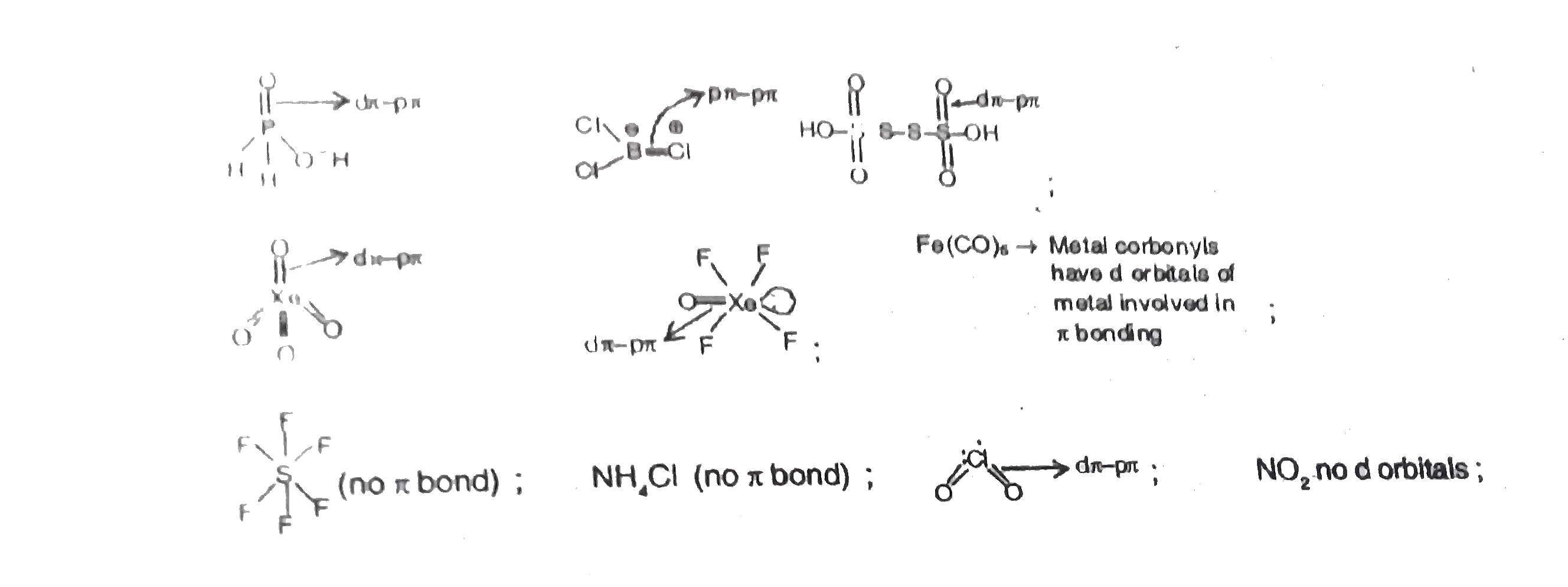
|
|
| 19. |
How many of the following compounds have optical isomers? (i) [Co(en)_(3)Br_(3), (ii) [Co(NH_(3))_(3)Br_(3)] (iii) [Co(en)_(2)Br_(2)]Br, (iv) [Co(en)(NH_(3))_(2) Br_(2)]Br |
|
Answer» <BR> Solution :`[Co(NH_(3))_(3)Br_(3)]` shows OPTICAL isomerism. |
|
| 20. |
How many of the following compounds have polymeric structure? Boron Nitride, Boric acid, Borazole, Borax, Berylium hydride, Gypsum, Graphite. |
|
Answer» |
|
| 21. |
How many of the following compounds gives nitrogen on heating NH_(4) Cl, (NH)_2Cr_(2)O_(7),Ba_(3)N_(2),NH_(4)OH,NH_(4)NO_3 |
|
Answer» |
|
| 23. |
How many of the following compounds decolorise Br_(2) water solution ? |
|
Answer» |
|
| 24. |
How many of the following compounds can be used as an acylating agent ? (i) CH_(3)COCl, (ii) (CH_(3)CO)_(2)O (iii) CH_(3)COOH,(iv) CH_(2)CH_(2)COCl. |
|
Answer» |
|
| 25. |
How many of the following compounds are soluble in sodium bicarbonate? Acetyl chloride. acetic anhydride, acetamide, trifluoro- ethanoL benzoic acid, salicylic acid, benzene sulphonic acid, 2 ,4, 6-trinitrophenol |
| Answer» | |
| 27. |
How many of the following compounds are possible products when chlorine is passed through hypo solution (i) S (ii) HCl (iii) Na_(2)S (iv) Na_(2)SO_(4) (v) Na_(2)S_(4)O_(6) (vi) HClO_(4) |
|
Answer» |
|
| 28. |
How many of the following compounds are found to exist? BiF_(5), TlCl_(3), PbO_(2), SnCI_(2), Tl_(2)O_(3), PbI_(4), As_(2)O_(3) |
|
Answer» |
|
| 30. |
How many of the following complexes are expected to have d^(2)sp^(3) hybridisation ? [Mn(CN)_(6)]^(3-),""[MnCl_+(6)]^(3-), [Fe(CN)_(6)]^(3-),[FeF_(6)]^(3-),""[CoF_(6)]^(3-), [Co(C_(2)O_(4))_(3)]^(3-),""[MnBr_(4)]^(2-) |
|
Answer» |
|
| 31. |
How many of the following cation belongs to group IIA,III,IV and V only Hg_(2)^(2+),Pb^(2+),Sb^(3+),Mg^(2+),As^(3+),Cu^(2+),Cr^(3+),Cr^(3+),Zn^(2+),Sn^(2+) |
|
Answer» `Pb^(2+),CU^(2+),CR^(3+),Zn^(2+)` |
|
| 32. |
How many of the following complexes are correctly matched with given properties ? (a)[Ni(NH_3)_6]^(2+)-Octahedral outer orbital complex and two unpaired electrons. (b)[Cr (NH_3)_6]^(3+)-Octahedral inner orbital complex and one unpaired electron. ( c)[Zn(NH_3)_6]^(2+)-Octahedral outer orbital complex and diamagnetic. (d)[Pt (NH_(3))_4]^(2+)-Square planar and diamagnetic (e)[Co (SCN)_4]^(2-)-Tetrahedral and three unpaired electrons. (f)[NiBr_2(PPh_3)_2]-Square planar and diamagnetic. |
Answer» 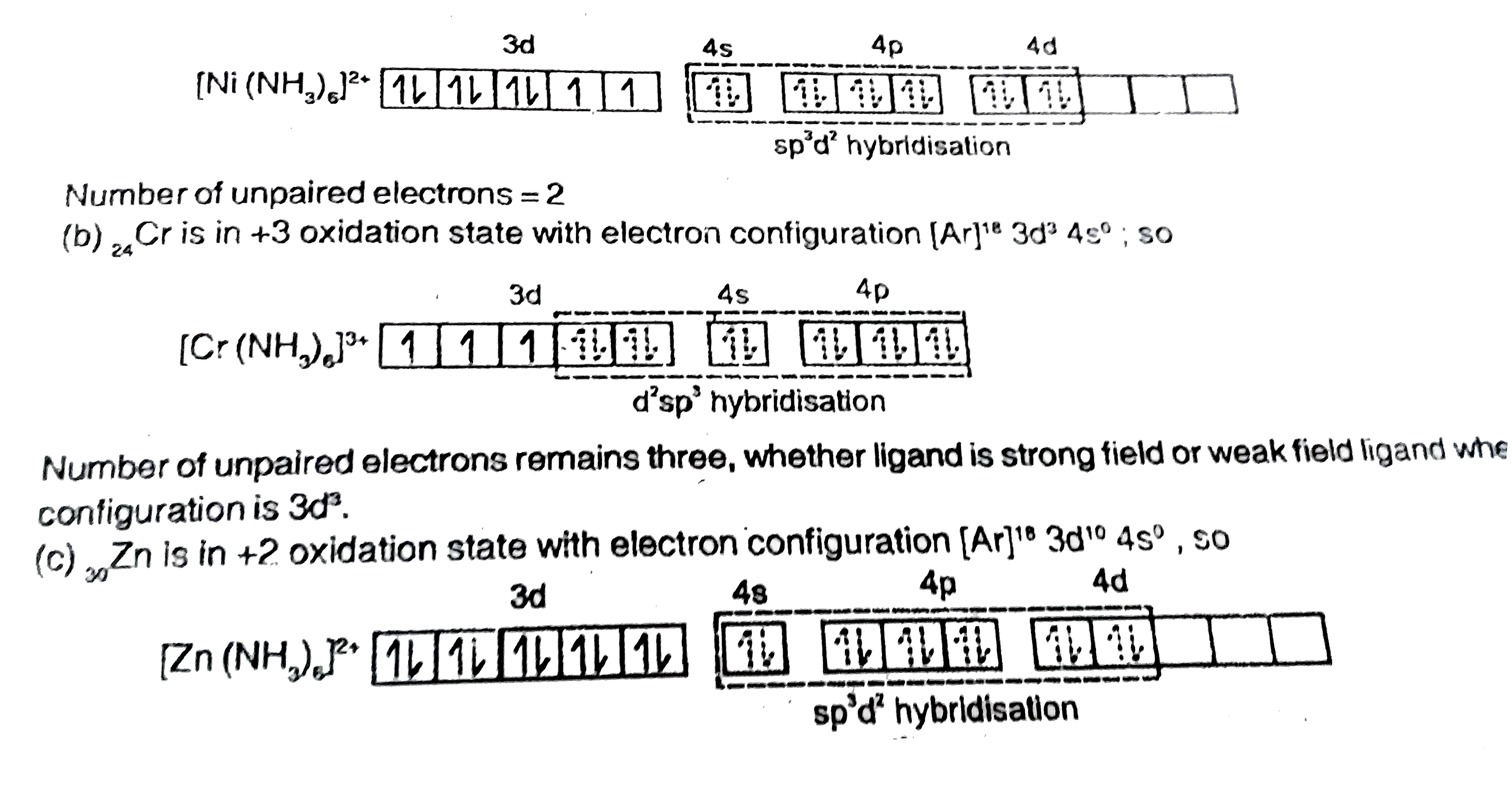 All electrons are paired , so complex ion is diamagnetic (d)`._78 Pt (II)` has `5d^8` configuration , square planar and all electrons are paired , so diamagnetic (e)`._27Co^(2+)` has `3d^7` configuration, `SCN^-` is weak field ligand So the complex is tetrahedral and paramagnentic with THREE unpaired electrons. (F)`._25 NI^(2+)` has `3d^5` configuration , tetrahedral and two unpaired electrons. |
|
| 33. |
How many of the following clements exclusively occur in combined state? Gold, iron, zinc, aluminium, platinum, sodium, magnesium |
|
Answer» |
|
| 34. |
How many of the following cations belongs to group IIA in qualitative salt analysis Sn^(2+), Hg_(2)^(+2), Pb^(+2), Zn^(2+), Cu^(+2), Cr^(+3), As^(+3), Mg^(+2), Sb^(+3) |
|
Answer» |
|
| 35. |
How many of the following carbonyl compound will give two products after reaction with NH_(2)OH : |
|
Answer» |
|
| 36. |
How many of the following carbons belongs to IIA, III, IV and V only in qualitative salt analysis Hg_(2)^(2+), As^(+3), Zn^(+2), Mg^(+2), NH_(4)^(+), Sr^(+2), Pb^(+2), Ni^(+2) |
|
Answer» |
|
| 37. |
How many of the following carbides on reaction with water will produce a product capable of forming silver mirror, on treatment with Tollen's reagent? Be_(2)C, CaC_(2), Mg_(2)C_(3), Al_(4)C_(3), CH_(4), SiC |
|
Answer» |
|
| 38. |
How many of the following cannot displace H_(2) from dil.HCl? Cu,Zn,Ni,Fe,Ag,Au,Pt,Hg,Cd |
| Answer» SOLUTION :N//A | |
| 39. |
How many of the following cannot displace H_2 from dil. HCl ? Cu,Zn,Ni,Fe,Ag,Au,Pt,Hg,Cd |
|
Answer» |
|
| 40. |
How many of the following can show geometrical isomerism VI. CHCl=C=CHCl VII. pH-N=N-Ph VIII. MeCH=N-NH_(2) |
|
Answer» |
|
| 41. |
How many of the following can not show tautomerism? Acetophenone, Acetadehyde, Benzaldehyde, Propanal, Benzophenone, Butan-2-one, Ethylacetoacetate, p-Benzoquinone, Acetophenone. |
|
Answer» |
|
| 42. |
How many of the following can give yellow ppt. with I_(2)//OH^(-)? |
Answer» 
|
|
| 43. |
How many of the following are water soluble ? Agf,AgCl,AgB,Agl,CaF_2,CaCl_2,CaBr_2,Cal_2 |
|
Answer» |
|
| 44. |
How many of the following are thermosetting polymers polyester, SBR, bakelite,polyvinyl acetate, urea-formaldehyde resin, melamine-formaldehyde resin, nylon 6, 6, polypropylene, Thiokol |
|
Answer» |
|
| 45. |
How many of the following are thermosetting polymers ? |
|
Answer» |
|
| 46. |
How many of the following are square palanar? (a) Ni(dmg)_(2)""(b) [Ni(CN)_(4)]^(2-) (c ) [Ni(CN)_(4)]^(4-)""(d) [Ni(CO)_(4)] (e ) [Ni(Cl)_(4)]^(2-)""(f) K_(2)Cr_(2)O_(7) (g) K_(2)CrO_(4)""(h) KMnO_(4) (i) K_(2)MnO_(4)""(j) CrO_(2)Cl_(2) |
|
Answer» |
|
| 48. |
How many of the following are synthetic rubbers ? Buna-S, polystyrene, Buna-N, isoprene, neoprene, thiokol, PVC, terylene. |
|
Answer» |
|
| 49. |
How many of the following are state function: (i) Internal energy (ii) Heat (iii) Enthalpy (iv) Entropy (v) Pressure (vi) Temp. (vii) volume (viii) work (ix) specific heat capacity (x) molar heat capacity |
|
Answer» |
|
| 50. |
How many of the following are sp^(3) hybridized? [ZnCl_(4)]^(2-),Ni(DMG)_(2),[Ni(CN)_(4)]^(2-),[Ni(CO)_(4)] [NiCl_(4)]^(2-),[PtCl_(4)]^(2-),[Pd(NH_(3))_(4)]^(2+),[FeCl_(4)]^(-1) |
|
Answer» |
|