

Saved Bookmarks
This section includes 7 InterviewSolutions, each offering curated multiple-choice questions to sharpen your Current Affairs knowledge and support exam preparation. Choose a topic below to get started.
| 1. |
How many cyclic isomers of C_(5)H_(10) are possible? |
|
Answer» 4 |
|
| 2. |
How many cyclic compounds are possible of C_5H_10 except steroio-isomer. |
|
Answer» |
|
| 3. |
How many cyclic compounds are possible of C_(5)H_(10) except steroio- isomer |
|
Answer» |
|
| 4. |
How many cyanide ions in K_4 [Fe (CN)_6]are involved in satisfying the primary valency of the central metal ion ? |
| Answer» SOLUTION :TWO or 2. | |
| 5. |
How many cyanide ions are involved in the following chemical equation Au+CN^(-)+H_(2)O+O_(2) to [Au(CN)_(2)]^(-)+OH^(-) |
|
Answer» |
|
| 6. |
How many coulombs of electricity will be required to deposit 0.6354g of Cu in electrolytic cell containing copper sulphate solution ? (Atomic weight of copper 63.54) |
|
Answer» 96.5 coulomb `THEREFORE 1,930 C-= 0.6354` g of Cu. |
|
| 7. |
How many coulombs of electricity are required for the reduction of 1 mole of MnO_(4) ^(-) to Mn^(2+)? |
|
Answer» 96500 C |
|
| 8. |
How many Coulombs of electricity required to oxidise one mole of Al to Al^(3+)? |
| Answer» SOLUTION :`3xx96500C` | |
| 9. |
How many coulombs of electricity are required for the oxidation of one mole of water to dioxygen ? |
|
Answer» `1.93xx10^(4)C` No. of coulombs electricity required `=2xx96500" C"` `=1.93xx10^(5)" C"` |
|
| 10. |
How many coulombs of electricity are required for the reduction of 1 mol of MnO_4^(-) " to " Mn^(2+) ? |
|
Answer» 96500 C |
|
| 11. |
How many coulombs are required to produce 40.5 g of Al from molten Al_(2)O_(3)? |
|
Answer» Solution :`Al_(2)O_(3)hArr2Al^(3+)+3O^(2-)` `Al^(3)+3etoAl` `27g.3F` 27 G of Al is produced from ELECTRICITY `=3xxF` 40.5 g of Al will be produced from electricity `=(3F)/(27)xx40.5` =4.5 F `=4.5xx96500` =434250 C |
|
| 12. |
How many coulombs of electricity are required for the oxidation of one mol of water to dioxygen ? |
|
Answer» `1.93 XX 10^5C` |
|
| 13. |
How many coulombs of electricity are consumed when 100 mA current is passed through a solution of AgNO_(3) for 30 minutes during electrolysis ? |
|
Answer» 108 |
|
| 14. |
How many coulombs are required to produce 40.5 g of Al from molten Al_(2)O_(3) ? |
|
Answer» Solution :`Al_(2)O_(3)hArr2Al^(3+)+3O^(2-)` `Al^(3+)+3etoAl` 27 G F 27 g of Al is PRODUCED from electricity `=3xxF` 40.5 g of Al will be produced from electricity `=(3F)/(27)xx40.5` =4.5 F `=4.5xx96500` =434250 C |
|
| 15. |
How many coulombs are required for the oxidation of 0.01 mol of H_(2)O to O_(2) ? |
|
Answer» `1.93 xx 10^(3) C` `H_(2)O HARR H^(+)+OH^(-)` At anode `"" 2OH^(-) to H_(2)O+[O]+2e^(-)` At cathode `"" 2H^(+)+2e^(-) to 2[H]` `THEREFORE W+[O]:W+2[H^(+)] therefore 16:2 therefore 8:1` |
|
| 16. |
How many coulombs are required for oxidation of 1 mol H_(2)O to O_(2) ? |
|
Answer» `3.88xx 10^(5) C ` |
|
| 17. |
How many coulombs are required for the oxidation of 1 mole of H_(2)O_(2) to O_(2) ? |
|
Answer» `93000C` |
|
| 18. |
How many coulombs are reqauired for the oxidation of 1 mol of H_(2)O to O_(2) ? |
| Answer» SOLUTION :2 COULOMBS | |
| 19. |
How many coulomb of charge are consumed when 100 mA current is passed through a solution of AgNo_(3) forhalf an hour during electrolysis ? |
|
Answer» 108 C |
|
| 20. |
How many coulomb of charge is required for deposition of 2/3 mole of Al in electrolysis of molten Al_(2)O_(3)? |
|
Answer» |
|
| 21. |
How many coulomb of electricity are consumed when 100 mA current is passed throught a solution of AgNO_3 for 30 minute during an electrolysis experiment: |
|
Answer» 108 |
|
| 22. |
How many coulombs are required for the oxidation of 1 mol of H_(2)O_(2)? |
|
Answer» `9//65xx10^(4)C` |
|
| 23. |
How many coordination isomeric (Pt(NH_(3))_(2)CI_(2)) exists with +2 state of Pt |
|
Answer» |
|
| 24. |
How many compounds show conductivity HCl(aq), HCl (molten), AlCl_(3) (molten), AlF_(3) (molten), Graphite, Na(s) AlCl_(3) (aq) |
|
Answer» 4 `AlF_(3)` molten `to Al^(+3) +F^(-)` Graphite `to` delocalised of `.PI.` electron `Na(s) to` METALLIC solid (free electron) `AlCl_(3)(aq) to Al^(+3)+Cl^(-)` |
|
| 25. |
How many compounds show optical isomerism of molecular formula C_5H_12O? |
|
Answer» 2 |
|
| 26. |
How manycompounds liberate NH_(3) on heatingfromthe following ? (NH_(4))_(2)SO_(4),(NH_(4))_(2)CO_(3),NH_(4)CI,NH_(4)NO_(3),(NH_(4))_(2)Cr_(2)O_(7) |
|
Answer» i. `2(NH_(4))_(2)SO_(4) overset(Delta) to underset("Ammoniumpyrrosulphate")((NH_(4))_(2) S_(2)O_(7)) + 2NH_(3) +H_(2)O` `3(NH_(4))_(2) S_(2)O_(7) overset(Delta)(to)2NH_(3) + 6SO_(2) + 2N_(2) + 9H_(2)O` iii. `NH_(4)CI overset(Delta) to NH_(3) + HCI` `NH_(4)NO_(3)` and` (NH_(4))_(2)S_(2)O_(3)` on heating gives `N_(2)O`and `N_(2)` respectively as shown iv 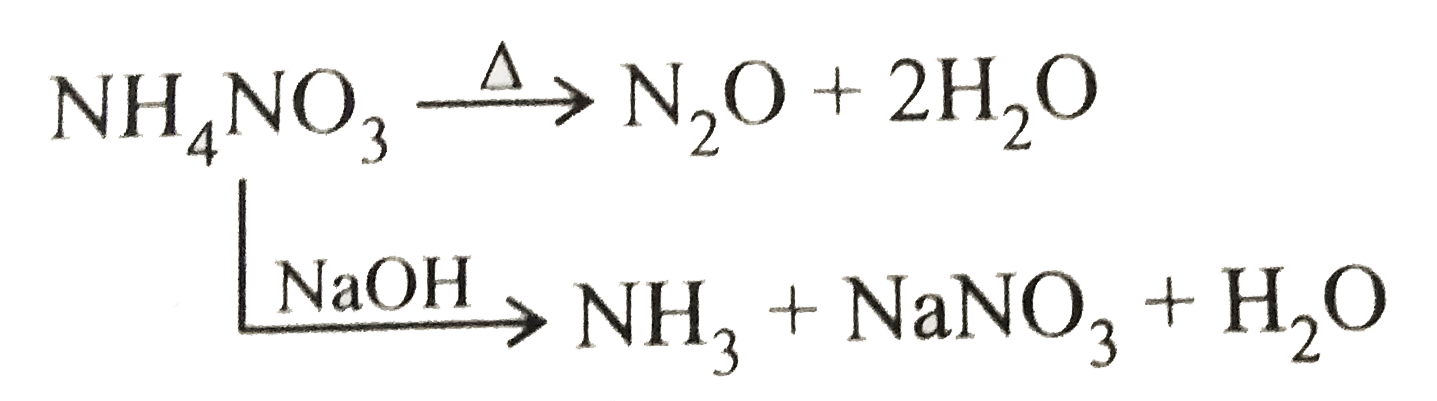 V. `(NH_(4))_(2)S_(2)O_(7) overset(Delta)(to) N_(2) + Cr_(2)O_(3) + 4H_(2)O` |
|
| 27. |
How many compound(s) or iron (s) can be oxidised by H_(2)O_(2) among the following (i) AsO_(3)^(2) (ii) SO_(4)^(2-) (iii) Fe_(2) (SO_(4))_(3) (iv) NH_(2) - NH_(2) (v) H_(2)S (vi) PbS (vii) O_(3) |
|
Answer» |
|
| 28. |
How many compounds liberate NH_(3) on heating from the following ? (i) (NH_(4))_(2)SO_(4) "" (ii) (NH_(4))_(2)CO_(3) "" (iii) NH_(4)Cl (iv) NH_(4)NO_(3) "" (v) (NH_(4))_(2)Cr_(2)O_(7) |
|
Answer» |
|
| 29. |
How many compounds out of the following are more reactive than ethyl acetate towards hydrolysis. |
|
Answer» |
|
| 30. |
How many compounds have zero dipole-moment ? (a)CH_3Cl , (b)CHCl_5 , ( c)C Cl_4 , (d)CH_3OH (e)CH_3OCH_3 , (f)CO_2 , (g)CH_4 , (h)CH_3COCH_3 |
|
Answer» |
|
| 31. |
How many compounds from the following list are isomers of D-glucose? D-Mannose, D-Fructose, D-Glucose, D-Idose, D-Galactose, D-Arabinose, D-Ribose |
|
Answer» |
|
| 32. |
How many compounds gives Cannizzaro reaction and aldol condensation respectively |
|
Answer» 3,2 |
|
| 33. |
How many compounds given below are not reduced by catalytic hydrogenation? CH_3 COOC_2 H_5 ,CH_3 CN,CH_3 COCI,CH ,CH_3CONHCH_3,(CH_3)_2 C_2 |
|
Answer» |
|
| 34. |
How many compounds from following exhibit d-orbital resonance. |
Answer» 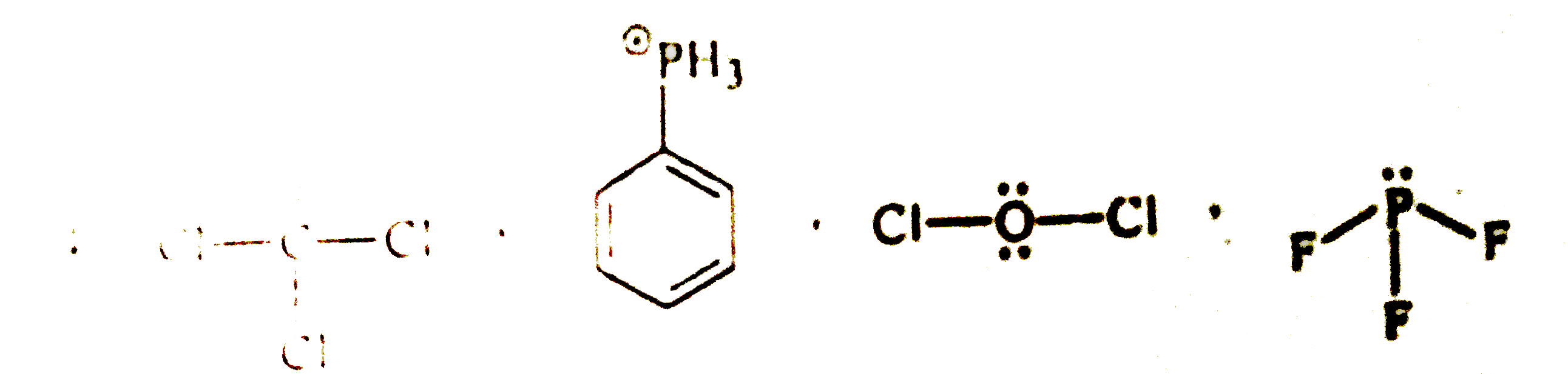
|
|
| 36. |
How many compounds among the following have a stereoisomer that is achiral ? (a) (i) 2,3-dichlorobutane (ii) 2,3-dichloropentane (iii) 2,3-dichloro-2,3-dimethylbutane (b) (i) 1,2-dimethylcyclobutane (ii) 1,3-dibromocyclobutane (iii) 1,3-dichlorocyclopentane (iv) 1,2-dimethylcyclopentane (c) (i) 2,4-dibromopentane (ii) 2,3-dibromopentane (iii) 1,4-dimethylcyclohexane |
|
Answer» |
|
| 37. |
How many compounds among the following may exhibit tautomerism? |
|
Answer» 1 |
|
| 38. |
How many compounds A through G are enol tautomer of 2-butanone? |
|
Answer» |
|
| 39. |
How many compound give CO_2 gas on reaction with NaHCO_3 ? |
|
Answer» |
|
| 40. |
How many complexes among the following are paramagnetic [Mn(CN)_(6)]^(3-),[Cr(H_(2)O)_(6)]^(3+),[Co(en)_(3)]^(3+), [V(CO)_(6)],[Ni(NH_(3))_(6)]^(2+),[Ni(dmg)_(3)], [Pt(Cl)_(2),(NH_(3))_(2)].[Cu(NH_(3))_(4)]^(2+),[Cu(CN)_(4)]^(3-) |
|
Answer» |
|
| 41. |
How many colloidal systems exist in nature in which liquid is dispersed phase? |
|
Answer» |
|
| 42. |
How many compound which is given below is isomer of D-Glucose ? D-Mannose, D-Fructose, D-Gulose, D-Idose, D-Galactose, D-Arabinose, D-Ribose. |
|
Answer» |
|
| 43. |
How many Cl^(-) ions are there around Na^(+) ion in NaCl crystal |
|
Answer» 3 |
|
| 45. |
How many Cl - atoms are present in Bithional added in soaps for (antiseptic properties) |
|
Answer» |
|
| 46. |
How many chrial centres are in (G) (L-ascorbic acid) ? |
|
Answer» 1 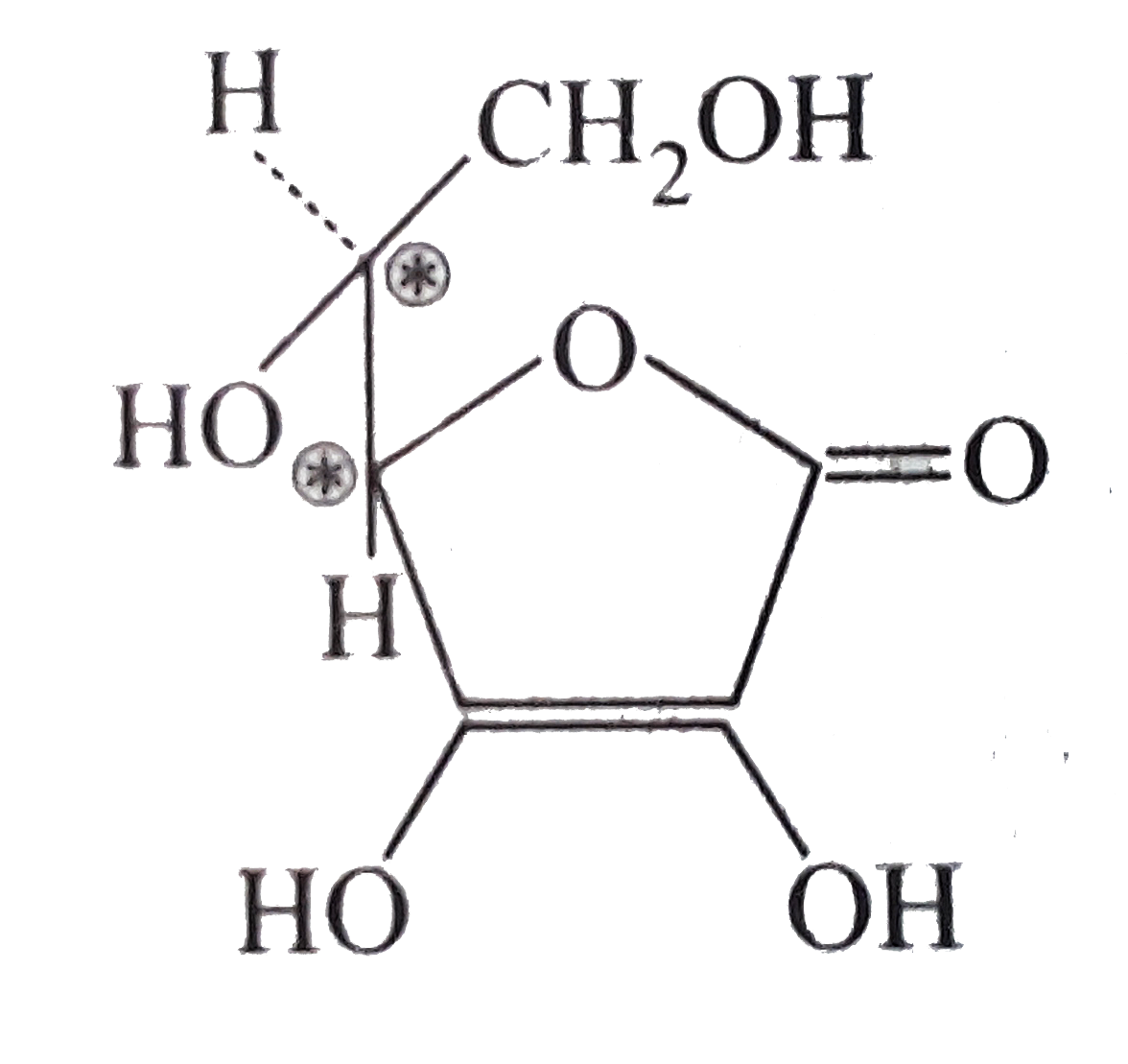 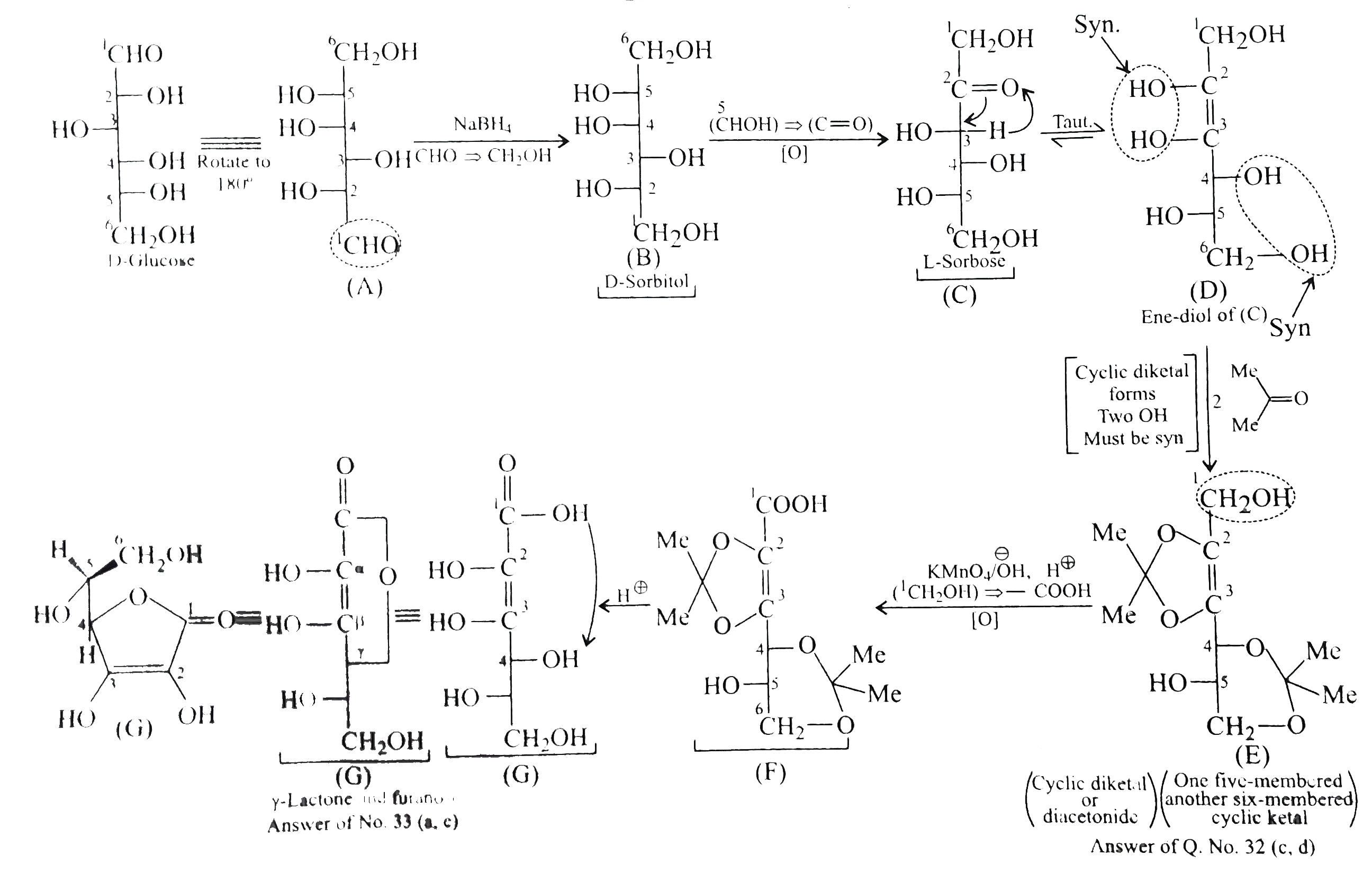
|
|
| 47. |
How many chlorobenzenes are possible for compound having molecular formula C_7H_7Cl ? |
Answer» 
|
|
| 48. |
How many chloride ions are there around sodium ion in sodium. |
|
Answer» 3 |
|
| 49. |
How many chiral structure isomers of alcohols are possible by molecular formula C_5H_10O? |
Answer» 
|
|