Saved Bookmarks
This section includes 7 InterviewSolutions, each offering curated multiple-choice questions to sharpen your Current Affairs knowledge and support exam preparation. Choose a topic below to get started.
| 1. |
Glucose will show mutarotationwhensolvent is : |
|
Answer» Acidic |
|
| 2. |
Give the structures of the products you would expect when each of the folloing alcohol reacts withHCl-ZnCl_2(b) HBr (c) SOCl_2 (i) Butan-1-ol(ii) 2-Methylbutan-2-ol |
|
Answer» Solution :`underset("Butan-1-ol" (1^@))(overset(4)CH_3 - overset(3)CH_2-overset(2)CH_2-overset(1)CH_2 -OH) underset("(Lucas reagent)")(underset("Heat")overset(HCL-ZnCl_2)to underset("1-Chlorobutane")(overset(4)CH_3-overset(3)CH_2 -overset(2)CH_2-overset(1)CH_2-Cl+ H_2 O )` <BR>(B) `underset("Butan-1-ol")(CH_3-CH_2-CH_2-OH) underset("heat")overset(SOCl_2)to underset("1-bromobutane")(overset(4)CH_3-overset(3)CH_2 - overset(2)CH_2 - overset(1)CH_2- Br +H_2 O)` (C) `CH_3-CH_2- CH_2 - CH_2-OH underset("Heat")overset(SOCl_2)to underset("1-chlorobutane")(overset(4)CH_3-overset(3)CH_2-overset(2)CH_2-overset(1)CH_2-Cl + SO_2 + HCl)` (ii) Reaction of 2-Methylbutane-2-ol 
|
|
| 3. |
Give the structures of the product of obtained by addition HBr is presence of peroxide to allyl chloride (CH_(2)= CH-CH_(2)Cl) |
|
Answer» Solution :`overset(1)(CH_(2))= overset(2)(CH)- overset(3)(CH_(2)) - CL underset("peroxides")overset(HBR)rarr CH_(3)-CH-underset(underset(Br)(|))(C )H_(2)-Cl` Due to the inductive effect of CHLORINE, the initial radical formed on the first carbon atom more STABLE and hence the product. |
|
| 4. |
Glucose when treated with CH_(3)OH in presence of dry HCl gas gives alpha and beta methylglucosides because it contains |
|
Answer» an aldehydic group |
|
| 5. |
Give the structures of the products you would expect when each of the following alcohol reacts with HBra.butan-1-olb.2-methylbutan-2-ol |
|
Answer» SOLUTION :Butan-1-o1 does not REACT with `HCl-ZnCl_2` at room temperature. But on heating it foems 1-chlorobutane, `CH_3-CH_2-CH_2-CH_2Cl` 2- Methylbutan-2-o1 is a `3^@` alcohol and it reacts IMMEDIATELY GIVING turbidity in the solution. 
|
|
| 6. |
Glucose will how mutarotation in __________ solvent |
|
Answer» ACIDIC |
|
| 8. |
Give the structures of the monomers of the following polymers : Nylon 6 |
Answer» SOLUTION :NYLON 6 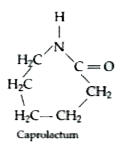
|
|
| 9. |
Give the structures of the monomers of the following polymers : Glyptal |
Answer» SOLUTION :GLYPTAL 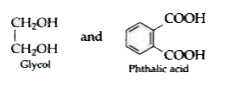
|
|
| 10. |
Give the structures of the four optically active structural isoamers of C_(4)H_(8)O_(3) (A to D) and evolve CO_(2) with ag. NaHCO_(3) Find structure of (A), the isomer that reacts withh LIAIH_(4) to give an achiral product and (B) gives an iodofom test. |
Answer» SOLUTION :
|
|
| 11. |
Glucose when reduced with HI and red phosphorus gives |
|
Answer» n-hexane |
|
| 12. |
Give the structures of the major organic products from 3-ethyl-2-pentene using (i) HBr in the presence of peroxide and (ii) HCl in the presence of peroxide. |
|
Answer» Solution :(i) `CH_(3)CH_(2) - overset(overset(C_(2)H_(5))(|))(C )= CH-CH_(3) + HBr overset("PEROXIDE")rarr CH_(3)CH_(2)- overset(overset(C_(2)H_(5))(|))(CH)-overset(overset(BR)(|))(C )HCH_(3)` This is anti-Markovnikoff addition (ii) `CH_(3)CH_(2)- overset(overset(C_(2)H_(5))(|))(C )=CH-CH_(3) + HCl overset("Peroxide")rarr CH_(3)CH_(2)- underset(underset(Cl)(|))overset(overset(C_(2)H_(5))(|))(C )-CH_(2)CH_(3)` This is Markovnikoff addition, since peroxide EFFECT is not observed in HCl |
|
| 13. |
Glucose when heated with CH_(3)OH in presence of dry HCl gas,alpha - and beta - methyl glucosides are formed . This is because it contains …………........... |
|
Answer» An ALDEHYDE group |
|
| 14. |
Give the structures of the following : |
Answer» SOLUTION :
|
|
| 15. |
Glucose when oxidised with con.HNO_(3), give ……….. |
| Answer» SOLUTION :glucaric ACID (or) saccharicsugar | |
| 16. |
Give the structures of A,B and C in the following reactions: (i) CH_(3)CH_(2)I overset(NaCN)to A underset("Partial hydrolysis")overset(OH^(-))to B overset(NaOH+Br_(2))toC (ii) C_(6)H_(5)N_(2)Cl overset(CuCN) to A overset(H_(2)O //H^(+))to B underset(Delta)overset(NH_(3))toC (iii) CH_(3)CH_(2)Br overset(KCN)to A overset(LiAlH_(4))toB underset(0^(@)C)overset(HNO_(2))toC (iv) C_(6)H_(5)NO_(2) overset(Fe//HCl)to A underset(273K)overset(NaNO_(2)+HCl)to B overset(H_(2)O //H^(+))toC (v) CH_(3)COOK underset(Delta)overset(NH_(3))to A overset(NaOBr)to B overset(NaNO_(2)//HCl)toC (vi) C_(6)H_(5)NO_(2) overset(Fe//HCl)to A underset(273K)overset(HNO_(2))to B overset(C_(6)H_(5)OH)toC. |
|
Answer» Solution :(i) `underset("Iodoethane")(CH_(3)CH_(2)I) underset(-NaI)overset(NaCN)to underset("Propanenitrile (A)")(CH_(3)CH_(2)CN) underset(("PARTIAL hydrolysis"))overset(OH^(-))to underset("Ethanamide (B)")(CH_(3)-overset(O)overset(||)(C)-NH_(2)) underset(("Hofmann bromamide reaction"))overset(NaOH+Br_(2))to underset("Methanamine (C)")(CH_(3)-NH_(2))` (ii) `underset("Benzenediazonium chloride")(C_(6)H_(5)N_(2)Cl) underset(("Sandmeyer reaction"))overset(CuCN)to underset("Benzonitrile")(C_(6)H_(5)CN) underset("Hydrolysis")overset(H_(2)O //H^(+))to underset("Benzoic acid (B)")(C_(6)H_(5)COOH) [C_(6)H_(5)COONH_(4)] underset(-H_(2)O)overset(Delta)to underset("Benzamide (C)")(C_(6)H_(5)CONH_(2))` (iii) `underset("Bromoethane")(CH_(3)CH_(2)Br) overset(KCN) to underset("Propanenitrile (A)")(CH_(3)CH_(2)CN) underset(("Reduction"))overset(LiAlH_(4)) to underset("Propan-1-amine (B)")(CH_(3)CH_(2)CH_(2)NH_(2)) underset(("Diazotisation"))overset(HNO_(2),0%)to [CH_(3)CH_(2)CH_(2)overset(+)(N)-=NCl^(-)] underset(-N_(2),-HCl )overset(H_(2)O)to underset("Propanol (C)")(CH_(3)CH_(2)CH_(2)OH)` (iv) `underset("Nitrobenzene")(C_(6)H_(5)NO_(2)) underset(("Reduction"))overset(Fe//HCl)to underset("Aniline (A)")(C_(6)H_(5)NH_(2)) underset(273K)overset(NaNO_(2)+HCl) to underset("Benzenediazonium chloride (B)")(C_(6)H_(5)overset(+)(N)-=HCl^(-)) underset(Delta)overset(H_(2)O //H^(+))to underset("Phenol (C)")(C_(6)H_(5)OH)` (V) `underset("Ethanoic acid")(CH_(3)COOH) underset(Delta)overset(NH_(3))to underset("Ethanamide (A)")(CH_(3)CONH_(2)) underset(("Hofmann bromamide reation"))overset(NaOBr)to underset("Methanamide (B)")(CH_(3)CH_(2)) overset(NaNO_(2)//HCl)to underset("Methanol (C)")(CH_(3)OH)`. 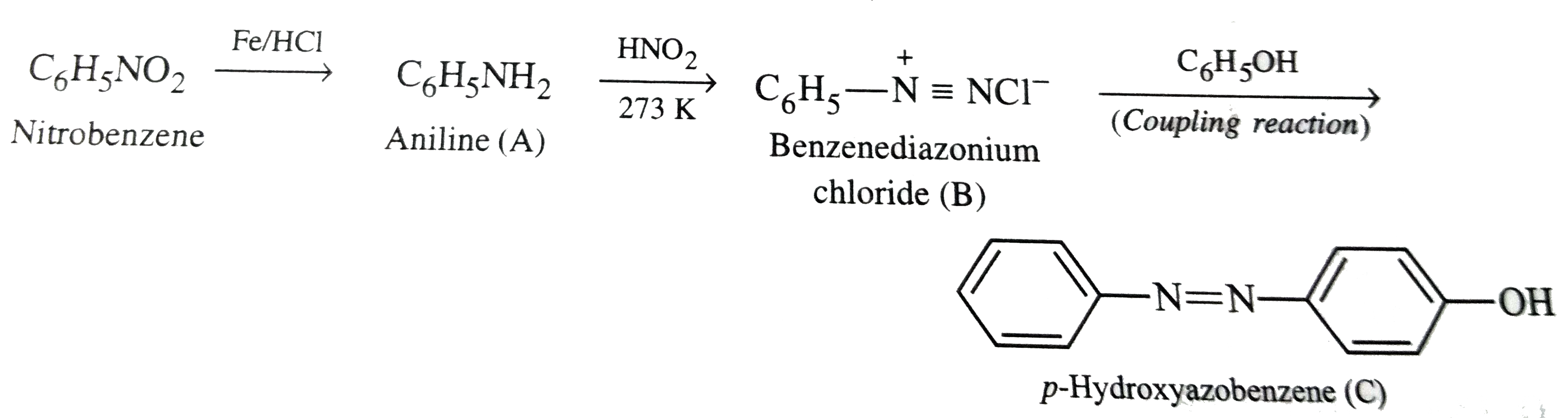
|
|
| 17. |
Glucose when heated with CH_3OH in presence of dry HCl gas alpha- and beta- methyl glycosides are formed . This is because it contains : |
|
Answer» An aldehydic group |
|
| 18. |
Give the structures of final products expected from the following reactions: (i) Hydroboration of propene followed by oxidation with H_2O_2 in alkaline medium. (ii) Dehydration of (CH_3)_3C-OH by heating it with 20% H_3PO_4 at 358k. (iii) Heating of With HI. |
|
Answer» SOLUTION :(i) `H-underset(H)underset|oversetHoverset|C-undersetHunderset|oversetHoverset|C-undersetHunderset|oversetHoverset|C-O-H` PROPAN 1-ol (II) `CH_2-oversetOoverset(||)C-CH_3` (III) 
|
|
| 19. |
Glucoseunderset((i)(P//HI))overset((i)(HCN//H_(3)O^(oplus)))rarrP P is : |
|
Answer» n-heptanoic ACID |
|
| 20. |
Give the structures of chromate and dichromate ions. How chromates and dichromates can be inter converted? |
Answer» Solution :`CrO_(4)^(2-)` (chromate ion) is tetrahedral where `Cr_(2)O_(7)^(2-)` (dichromate ion) consists of TWO TETRAHEDRA sharing one corner with Cr-O-Cr bond angle `126^(@)`  Depending upon the pH of a solution the chromate ion and dichromate ion inter covertible as `UNDERSET(("Orange"))(2CrO_(4)^(2-))+ 2H^(+) rarr underset(("YELLOW"))(Cr_(2)O_(7)^(2-)) + H_(2)O` `underset(("Yellow"))(Cr_(2)O_(7)^(2-)) + 2OH^(-) rarr underset(("Orange"))(2CrO_(4)^(2-)) + H_(2)O` |
|
| 21. |
Glucose + Tollen's reagent to Silver mirrorthe above process shows |
|
Answer» PRESENCE of -COOh group 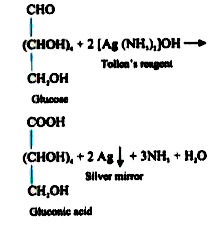 This reaction indicates the presence of -CHO group in GLUCOSE. |
|
| 22. |
Give the structures of A, B and C in the following reactions : (i) C_(6)H_(5)N_(2)^(+)Cl^(-) overset(CuCN)(rarr)A overset(H_(2)O""//H^(+))(rarr)B underset(Delta)overset(NH_(3))(rarr)C (ii) C_(6)H_(5)NO_(2) overset(Sn+HCl)(rarr)A underset(273K)overset(NaNO_(2)+HCl)(rarr)B underset(Delta)overset(H_(2)O""//H^(+))(rarr)C |
|
Answer» Solution :(i) `A=C_(6)H_(5)CN""B=C_(6)H_(5)COOH""C=C_(6)H_(5)CONH_(2)` (ii) `A=C_(6)H_(5)NH_(2)""B=C_(6)H_(5)N_(2)^(+)Cl^(-)""C=C_(6)H_(5)OH` |
|
| 23. |
Glucose solution is optically active and it rotates the plane polarised light in ……………… direction and so it called…………….. . |
| Answer» SOLUTION :CLOCKWISE , DEXTROSE | |
| 24. |
Give the structures of A, B and C in the following reactions : CH_(3)CH_(2)Br overset(KCN)(rarr)A overset(LiAlH_(4))(rarr)B underset(0^(@)C)overset(HNO_(2))(rarr)C |
|
Answer» Solution :A, B and C are identified in the reactions as under : `underset("Bromoethane")(CH_(3)CH_(2)Br) overset(KCN)(rarr) underset("Propanenitrile (A)")(CH_(3)CH_(2)CN) overset(LiALH_(4))(rarr) underset("Propan-1-amine (B)")(CH_(3)CH_(2)CH_(2)NH_(2)) underset("(Diazotisation)")overset(HNO_(2), 0^(@)C)(rarr)[CH_(3)CH_(2)CH_(2)overset(+)(N) equiv NCl^(-)] underset(-N_(2)-HCL)overset(H_(2)O)(rarr)underset("Propanol (C)")(CH_(3)CH_(2)CH_(2)OH)` |
|
| 25. |
Glucose reacts with Tollen's reagent to give |
|
Answer» Monocarboxylic ACID |
|
| 26. |
Glucose reacts with methyl alcohol to give |
|
Answer» `ALPHA`-METHYL glucopyrnoside |
|
| 27. |
Give the structures of A, B and C in the following reactions : CH_(3)CH_(2)I overset(NaCN)(rarr) A underset("Partial hydrolysis")overset(OH^(-))(rarr)B overset(NaOH+Br_(2))(rarr)C |
|
Answer» Solution :A, B and C are identified in the REACTIONS as under : `underset("Iodoethane")(CH_(3)CH_(2)I) overset(NaCN)(rarr) underset("Propanenitrile (A)")(CH_(3)CH_(2)CN) underset("(Partial hydrolysis)")overset(OH^(-))(rarr)underset("ETHANAMIDE (B)")(CH_(3)-overset(overset(O)(||))(C)-NH_(2)) underset("(HOFFMANN bromamide REACTION)")overset(NaOH+Br_(2))(rarr) underset("Methanamine (C)")(CH_(3)-NH_(2))` |
|
| 28. |
Glucose reacts with hydroxylamine to give _____. |
|
Answer» Glucose oxime |
|
| 29. |
Give the structures of A, B and C in the following reactions : CH_(3)COOH underset(Delta)overset(NH_(3))(rarr)Aoverset(NaOBr)(rarr)B overset(NaNO_(2)//HCl)(rarr)C |
|
Answer» Solution :A, B and C are identified in the reactions as under : `underset("Ethanoic ACID")(CH_(3)COOH) underset("Delta")overset(NH_(3))(rarr) underset("Ethanamide (A)")(CH_(3)CONH_(2))underset(underset("bromamide reaction)")("(Hoffmann-"))overset(NaOBr)(rarr) underset("Methanamine (B)")(CH_(3)NH_(2))overset(NaNO_(2)//HCl)(rarr) underset("METHANOL (C)")(CH_(3)OH)` |
|
| 30. |
Give the structures of A, B and C in the following reactions : (a) CH_(3)-COOH overset(NH_(3)//Delta)(to) A overset(Br_(2)//KOH(aq))(to) B overset(CHCl_(3)+alc.KOH)(to) C (b) C_(6)H_(5)N_(2)^(+)BF_(4)^(-) underset(Delta)overset(NaNO_(2)//Cu)(to) A overset(Fe//HCl)(to) B overset(CH_(3)COCl//"pyridine")(to) C (c) C_(6)H_(5)CONH_(2) overset(Br_(2)//aq.KOH)(to) A underset(0-5""^(@)C)overset(NaNO_(2)+HCl)(to) B overset(KI)(to) C (d) CH_(3)-Cl overset(KCN)(to) A overset(LiAlH_(4))(to) B underset(Delta)overset(CHCl_(3)//Alc.KOH)(to) C (e) C_(6)H_(5)COO^(-)NH_(4)^(+) overset(Delta)(to) A overset(Br_(2)//KOH)(to) B underset("Pyridine")overset(CH_(3)COCl)(to) C (f) C_(6)H_(5)N_(2)^(+)BF_(4)^(-) underset(Delta)overset(NaNO_(2)//Cu)(to) A overset(Sn//HCl)(to) B overset(CHCl_(3)+alc.KOH)(to) C (g) ArNH_(2) underset(0-5""^(@)C)overset(NaNO_(2)//HCl)(to) A overset(CuCN)(to) B |
Answer» SOLUTION :
|
|
| 31. |
Glucose reacts with acetic anhydride to form |
|
Answer» monoacetate 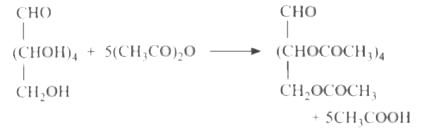
|
|
| 32. |
Give the structures of A, B and C in the following reactions : C_(6)H_(5)NO_(2) overset(Fe//HCl)(rarr)A underset(273K)overset(HNO_(2))(rarr)B overset(C_(6)H_(5)OH)(rarr)C |
|
Answer» Solution :A, B and C are identified in the reactions as under : `underset("Nitrobenzene")(C_(6)H_(5)NO_(2)) OVERSET(Fe//HCl)(rarr)underset("Aniline (A)")(C_(6)H_(5)NH_(2))underset(273 K)overset(HNO_(2))(rarr)underset(underset("CHLORIDE (B)")("Benzenediazonium"))(C_(6)H_(5)-overset(+)(H)equivNCl^(-))underset("(Coupling reaction)")overset(C_(6)H_(5)OH)(rarr) (##U_LIK_SP_CHE_XII_C13_E03_044_S01.png" width="80%"> |
|
| 33. |
Glucose reacts with acetyl chloride to form pentaacetyl glucose, it indicates presence of : |
|
Answer» FIVE primary alcoholic GROUPS |
|
| 34. |
Give the structures of A, B and C in the following reactions : C_(6)H_(5)N_(2)Cl overset(CuCN)(rarr)A overset(H_(2)O""//H^(+))(rarr)B underset(Delta)overset(NH_(3))(rarr)C |
|
Answer» SOLUTION :A, B and C are identified in the REACTIONS as under : |
|
| 35. |
Glucose reacts with acetic anhydride to from : |
|
Answer» Monoacetate |
|
| 36. |
Give the structures of A, B and C in the following reactions : C_(6)H_(5)NO_(2) overset(Fe//HCl)(rarr)A underset(273K)overset(NaNO_(2)+HCl)(rarr)B underset(Delta)overset(H_(2)O""//H^(+))(rarr)C |
|
Answer» Solution :A, B and C are identified in the reactions as under : `underset("Nitrobenzene")(C_(6)H_(5)NO_(2))OVERSET(Fe//HCL)(rarr) underset("Aniline (A)")(C_(6)H_(5)NH_(2))underset(273 K)overset(NaNO_(2)+HCl)(rarr)underset(underset("chloride (B)")("Benzenediazonium"))(C_(6)H_(5)overset(+)(N)equivNCl^(-))underset(DELTA)overset(H_(2)O""//H^(+))(rarr) underset("Phenol (C)")(C_(6)H_(5)OH)` |
|
| 37. |
Glucose overset(NH_(2)OH)rarrAunderset("excess")overset(AcOAc)rarrBunderset(H_(2)O,/_\)overset(Ag_(2)O)rarrC. Number of carbon in C are ………… . |
|
Answer» |
|
| 38. |
Give the structures of A and B in the following sequence of reactions: (a) CH_(3)COOH underset(Delta)overset(NH_(3))to A overset(NaOBr)to B (b) C_(6)H_(5)NO_(2) overset(Fe//HCl)to A underset(0^(@)-5^(@)C) overset(NaNO_(2)+HCl)to B (c ) C_(6)H_(5)N_(2)^(+)Cl^(-) underset(Delta)overset(CuCN)to A overset(H_(2)O//H^(+))to B |
|
Answer» Solution :(a) `A=underset("Ethanamide")(CH_(3)CONH_(2)),""B=underset("Methanamine")(CH_(3)NH_(2))` (b) `A=underset("Aniline")(C_(6)H_(5)NH_(2)),""B=underset("BENZENCE diazonium chloride")(C_(6)H_(5)N_(2)Cl)` (c ) `A=underset("Phenyl cyanide")(C_(6)H_(5)CN), "" B=underset("BENZOIC acid")(C_(6)H_(5)COOH)` |
|
| 39. |
Glucose reacts with __________ |
|
Answer» SCHIFF's REAGENT |
|
| 40. |
Give the structures and IUPAC names of the products expected from the following reactions : Reaction of propanone with methyl magnesium hromide followed by hydolysis. |
| Answer» SOLUTION :`UNDERSET("2-Methylpropan-2ol")(CH_(3)- underset(CH_(3))underset(|)OVERSET(CH_(3))overset(|)C-OH)` | |
| 41. |
Glucose overset(HI) rarr A then the homologue of A is |
| Answer» Answer :C | |
| 42. |
" Glucose " overset(HCN)(to) overset("hydrolysis")(to) overset("Hl.heat")(to)A. A is |
|
Answer» Heptanoic acid |
|
| 43. |
Give the structures and IUPAC names of the products expected from the following reactions : Hydration of propene in the presence of dilute sulphuric acid. |
| Answer» SOLUTION :`UNDERSET("Propane-2-ol")(CH_(3)-underset(OH)underset(|)CH-CH_(3))` | |
| 44. |
Glucose overset(H_2O)underset("Enzyme") rarr C_2H_5OH + CO_2 +Energy The above reaction is an examples of |
|
Answer» HYDROLYSIS |
|
| 45. |
Give the structures and IUPAC names of the products expected from the following reactions : Catalytic reduction of butanal. |
| Answer» SOLUTION :`UNDERSET(Butan-1-ol)(CH_(3)- CH_(2)-CH_(2)-CH_(2)-OH)` | |
| 46. |
Glucose or sucrose are soluble in water but cyclohexane or benzene (simple six membered ring compounds) are insoluble in water. Explain. |
| Answer» Solution :Glucose containing FIVE and sucrose containing eight-OH GROUPS form H-bonds with water. Due to this extensive intermolecular H-bonding glucose and sucrose are soluble in water inspite of the fact that their molecular masses (180 g `mol^(-1)` and 342 g `mol^(-1)`, respectively) are high. In contrast, benzene (molecular mass = `78 g mol^(-1)` )and cyclohexane (molecular mass `=84 g mol^(-1)`) have low molecular masses. Even then they are insoluble in water. It is because these compounds do not contain -OH groups and hence do not form H-bonds with water. | |
| 47. |
Give the structures and IUPAC names of the products expected from the following reactions: (a) Catalytic reduction of butanal. (b) Hydration of propene in the presence of dilute sulphuric acid. (c) Reaction of propanone with methylmagnesium bromide followed by hydrolysis. |
Answer» SOLUTION :
|
|
| 48. |
Glucose or sucrose are soluble in water but cyclohexane and benzene are insolule in water. Explain. |
| Answer» Solution :GLUCOSE CONTAIN 5 - OH groups and sucrose contain EIGHT - OH groups, because of this they form INTERMOLECULAR hydrogen bonding, so they are SOLUBLE in water. But benzene and cyclohexane doesn.t contain - OH groups hence doesn.t from intermolecular hydrogen bonding, so they are not soluble in water. | |
| 49. |
Glucose or sucrose are soluble in water but cyclohexane or benzene (simple six membered ring compounds) are insoluble in water.Explain. |
|
Answer» Solution :Glucose contains five and sucrose contains eight `-OH` groups. These `-OH` groups form H-bonds with water. Due to this extensive intermolecular H-bonding, glucose and sucrose are soluble in water irrespective of the fact that their molecular masses are `180 "G MOL"^(-1)` and `342 "g mol"^(-1)` respectively. In contrast , benzene (molecular mass `= 78 "g mol"^(-1)`) and cyclohexane (molecular mass `=84 "g mol"^(-)`) are simple molecules having low molecular masses. Even than they are insoluble in water. The reason being that these COMPOUNDS do not contain`-OH` groups and hence do not form H-bonds with water. ALTERNATIVELY,like DISSOLVES like is the general rule of solubility. THerefore, benzene and cylohexane which are non - polar molecules do not dissolve in polar water molecules while glucose and sucroe being polar molecules dissolve in polar water molecules. |
|
| 50. |
Give the structures and IUPAC names of the products expected from the following reactions. a) Catalytic reduction of butanal b) Reaction of propanone with methylmagnesium bromide followed by hydrolysis. |
|
Answer» Solution :a) Catalytic reduction of butanal give `CH_3CH_2CH_2CH_2OH`. IUPAC name is Butanol-I b) Reduction of PROPANONE with methylmagnesium halide, FOLLOWED by hydrolysis GIVES `(CH_3)_3COH`. IUPAC name is Methylpropanol-2 |
|