Saved Bookmarks
This section includes 7 InterviewSolutions, each offering curated multiple-choice questions to sharpen your Current Affairs knowledge and support exam preparation. Choose a topic below to get started.
| 1. |
For an endothermic reaction, Delta S is positive. The reaction is : |
|
Answer» FEASIBLE when `T DELTA S GT Delta H` |
|
| 2. |
For an endothermic reaction |
|
Answer» `TRIANGLEH`is -ve |
|
| 3. |
For an elementary reaction with respect to 2A_((g))+B_((g))toC_((g)), initial rate with respect to A is 0.04" M.s"^(-1). when volume of vessel is doubled, final rate B will be ("in M.s"^(-1)) |
|
Answer» `0.04` |
|
| 4. |
For an elementary reaction: nA rarr Product Find the value of n: [where a is initial] amount of A and x is amount reacted in tine t] |
| Answer» Answer :A | |
| 5. |
For an elementary reaction. A + 2B rightarrow C if volume of the vessel is reduced to 1/3 of its original volume the rate of the reaction will |
|
Answer» INCREASE 27 times |
|
| 6. |
For an elementary reaction : A + 2B rarr C when 1 MA was taken with 10^(-4)M B, time taken for B to reduce to half was found to be 10 seconds. Calculate t_(1//2) when 1 M A is reacted with 10^(-5)M B. [t_(1//2)=time for B to reduce to 50% of original] |
|
Answer» 10 seconds |
|
| 7. |
For an elementary reaction, its order is never _________ since it is a _________ step process. |
|
Answer» INTEGRAL, SINGLE |
|
| 8. |
For an elementary reaction 2A+B to 3C the rate of disappearance of C at time t is 1.3xx10^(-4)"mol L"^(-1)s^(-1). Calculate atthis time (i) rate of the reaction. (ii) rate of disappearance of A. |
|
Answer» Solution :(i) Rate of the REACTION `= =(1)/(3)(d[C])/(dt)= +(1)/(3)xx1.3xx10^(-4)=4.33xx10^(-5)"mol L"^(-1)s^(-1)""…(1)` (ii) Rate of disappearance of A Rate of reaction `= -(1)/(2)` Rate of disappearance of A or Rate of disappearance of A, `(d[A])/(dt)= -2xx` Rate or reaction Substituting the value of rate of reaction from (1) Rate of disappearance of `A=-2xx4.33xx10^(-5)"mol L"^(-1)s^(-1) ` `=-8.66xx10^(-5)"mol L"^(-1)s^(-1)` `=8.66xx10^(-5)"mol L"^(-1)s^(-1)` (Ignoring the NEGATIVE sign) |
|
| 9. |
For an elementary reaction 2A+B to 3C the rate of appearance of C at time 't' is 1.3xx10^(-4)"mol L"^(-1)s^(-1). Calculate at this time (i) rate of the reaction. (ii) rate of disappearance of A. |
|
Answer» Solution :RATE of reaction `= =(1)/(3)(d[C])/(DT)= +(1)/(3)xx1.3xx10^(-4)=4.33xx10^(-5)"mol L"^(-1)s^(-1)` Rate of disappearance of `A=(d[A])/(dt)` Rate of reaction `=-(1)/(2)(d[A])/(dt)` Substituting the values, we GET `4.33xx10^(-5)= -(1)/(2)(d[A])/(dt) or (d[A])/(dt)= -2xx4.33xx10^(-5)` `= -8.66xx10^(-5)=8.66xx10^(-5)` (Removing - sign) |
|
| 10. |
For an elementary reaction 2A+BtoC+D the active massof B is kept constant but that of A is tripled. The rate of reaction will |
|
Answer» DECREASE by `3` times |
|
| 11. |
For an element X if XCl_3, X_(2)O_(5)and Ca_(3)X_(2)is possible but XCl_(5)is not possible, then what is X ? |
|
Answer» B |
|
| 12. |
For an electrophilic aromatic substitution reaction : |
|
Answer» CHLORINE is o-p directing GROUP and also electron RELEASING group |
|
| 13. |
For an electron if the uncertainty in velocity is Delta v, the uncertainty in its position (Delta x) is given by: |
|
Answer» `H/2pim DELTAV` |
|
| 14. |
For an electron having s=1//2, the spin anglar momentum is |
|
Answer» `(SQRT(3)H)/(4PI)` for s=1/2 Spin angular momentum `=sqrt(1/2(1/2+1)). h/(2pi)` `=sqrtS(1/2xx3/2). h/(2pi)=(sqrt(3).h)/(4pi)` |
|
| 15. |
For an electrolytic solution of 0.05 mole "litre"^(-1), the conductivity has been found to be 0.0110 S cm^(-1).The molar conductivity (in Scm^(2) "mole"^(-1)) is |
|
Answer» 0.055 |
|
| 16. |
For an electrochemical cell : Mg(s)+Ag^(+)(aq)toAg(s)+Mg^(2+)(aq), give the cell representation. Also write the Nernst equation for the above cell at 25^(@)C. |
|
Answer» Solution :`Mg(s)|Mg^(2+)(aq)||AG^(+)(aq)|Ag(s)` `Mg(s)+2Ag^(+)(aq)toMg^(2+)(aq)+2Ag` `E_("CELL")=E_("cell")^(@)-(RT)/(2F)"LN"([Mg^(2+)])/([Ag^(+)]^(2))` `=E_("cell")^(@)-(0.059)/(2)"LOG"([Mg^(2+)])/([Ag^(+)]^(2))` |
|
| 17. |
For an aqueous solution of NH_4 CI, prove that [H^+]=sqrt(K_(a).C) |
|
Answer» Solution :`NH_4 CI` is a SALT of a strong acid HCI and weak base `NH_4 OH`. `HCI_((aq))+NH_4 OH_((aq)) hArr NH_4 CI_((aq))+H_2O(I)` `NH_(4)^(+)` is a strong conjugate acid of the weak base `NH_4OH` and it has a tendency to react with `OH^-` from water to produce unionised `NH_4OH` shown below. `NH_(4)^(+)+H_2O(I) hArr NH_4 OH_((aq))+H_((aq))^(+)` There is no such tendency shown by `CI^-` and therefore `[H^+] gt [OH^-]` , the solution is acidic and the pH is less than 7. s discussed in the salty HYDROLYSIS of strong base and weak acid. In this case also, we can establish a RELATIONSHIP between the `K_n and K_b` as `K_H. K_b=K_w` Let us calculate the `K_h`value in terms of degree of hydrolysis (h) and the concentration of salt `K_h=h^2 C and [H^+]=sqrt(K_h. C)` `[H^+]=sqrt((K_w)/(K_b). C)` `pH=-log[H^+]` `=-log.(K_w. C)/(K_b)^(1/2)` `=-(1)/(2)logK_w-(1)/(2)LOGC+(1)/(2)logK_(b)` `pH=7-(1)/(2)pK_(b)-(1)/(2)logC`. |
|
| 18. |
For anaqueous solution of the same solute , in terms of concentration, |
|
Answer» 1 M =1 m |
|
| 19. |
For an aqueous solution, the characteristic species of acid is |
|
Answer» `H^(+)` ion |
|
| 20. |
for an aqueous solution of K^4[Fe(CN)_6], the value of van't Hoff factor , I is 5( approx). |
| Answer» | |
| 21. |
For an aqueous solution of NaCl the observed molecular weight of NaCl will be |
|
Answer» LESS than 58.5 |
|
| 22. |
For an aminoacid 'X', the isoelectric point is 6.1. Then 'X' is |
|
Answer» Acidic AMINO ACID |
|
| 23. |
For an amine RNH_2 , write the expression of k_b to indicate its base strength. |
| Answer» SOLUTION :`RNH_2 + H_2 O HARR RNH_3^(+) + OH `, `k_b =([RNH_3^(+)][ObarH])/([RNH_2])` | |
| 24. |
For an amine RNH_(2), write an expression for K_(b) to indicate its basic strength. |
|
Answer» Solution :`R-NH_(2)+H_(2)O RARR R-OVERSET(+)(N)H_(3)+OH^(-)` `""K=(overset(+)([R-NH_(3)])[OH^(-)])/([R-NH_(2)][H_(2)O])` where K is equilibrium constant or `""K[H_(2)O]-(overset(+)([R-NH_(3)])[OH^(-)])/([R-NH_(2)])"or"K_(b)=(overset(+)([R-NH_(3)])[OH^(-)])/([R-NH_(2)])` |
|
| 25. |
for an adiabatic process , which of the following is correct ? |
|
Answer» `PDeltaV= 0` |
|
| 26. |
For an adiabatic process, which of the following is correct. |
| Answer» Answer :D | |
| 28. |
For all spotaneous cell reactions, the value of Deta G should be ……….. . |
|
Answer» CONSTANT |
|
| 29. |
For alpha -amino acids having the structure R-underset(NH_(2))underset(|)(C)H-CO_(2)H Which of the followingstatements are true (A) Water solubility is maximum at a pH when concentration of anion and cation are equal (B)They give ninhydrin test (C)On reacting with nitrous acid give off N_(2) |
| Answer» ANSWER :B | |
| 30. |
For an acid catalysed reaction Aoverset(H^(+))(to)B half life period is independent of concentration of A at given pH. At same concentrationn of A half tiem is 10 min at p^(H)=2 and half life time is 100 min at P^(H)=3. If the rate law expression of reaction is r=K[A]^(x)[H^(+)]^(y) then calculate (x+y) |
|
Answer» `[((t1/2)_(1))/((t1/2)_(2))]=[((H^(o+))_(2))/((H^(o+))_(1))]^((n-1)),(10/100)=((10^(-3))/(10^(-2)))^((n-1)),(1/10)=(1/10)^((n-1))` `(10^(1)=(10)^((n-1)),1=n-1,n=2,r=K[A]^(1)[H^(o+)]^(2)` |
|
| 31. |
For an adiabatic change in a system, the condition which is applicable will be |
| Answer» Answer :D | |
| 32. |
For all practical purposes, influence of inductive effect is neglected after: |
|
Answer» SECOND CARBON atom |
|
| 33. |
For alkali metals, which one of the following trends is incorrect |
|
Answer» Hydration energy : LigtNagtKgtRb |
|
| 34. |
For alkylationof ammoniawhichof thefollowingis notused |
|
Answer» `CH_(3) - X` |
|
| 35. |
For alkali metals, which of the following trends is incorrect? |
|
Answer» Melting point : `Li gt NA gt KGT Rb` |
|
| 36. |
For Ag_(2)CO_(3), K_(sp)=6.2xx10^(-12). For AgCl, K_(sp)=2.8xx10^(-10). Solid Ag_(2)CO_(3) and solid AgCl are added to a beaker containing Na_(2)CO_(3)(aq). Under these conditions the [CO_(3)^(2-)]=1.00M. Calculate the [Cl^(-)] in solution when equilibrium is established. |
|
Answer» `1.1xx10^(-4)` |
|
| 37. |
For Ag^(+) metal ion, correct sequence regarding ligand strength is |
|
Answer» `F^(-) GT Cl^(-) gt BR^(-) gt I^(-)` |
|
| 38. |
For adsorption of a gas on solid surface, following isotherm was obtained. Where P is pressure of gas in atm, x represents amount of gas adsorbed and m represents mass of adsorbent, calculate the value of (x)/(m) of the gas at same temperature and at a pressure of 81 atm. |
|
Answer» |
|
| 39. |
For adsorption phenomenon, |
|
Answer» `DeltaH=+ve, DeltaS=-ve` |
|
| 40. |
For adsorption of gas on solid surface the plots of log x/m vs log P is linear with a slope equal to : |
|
Answer» K |
|
| 41. |
For acid catalysed hydrolysis of ester, rate law obtained is rate = k[ester][H^(+)] where k=0.01M^(-1)hr^(-1). What is the half-life of this reaction, if the initial concentrations are 0.02 M for the ester and 0.05 M for the catalyzing acid? |
|
Answer» 1429 hours |
|
| 42. |
For acetic acid the graph of ^^mrarrsqrt(C) at infinte dilution isnot useful for obtaining molar conductivity. Why ? ^^ ^@m NaCl, HCl and NaAC are 126.4, 425.9 and 91.0 S cm^2mol^(-1) and respectively calculate ^^ ^@m of Hac. OR Three electrolytic cellls A, B, C with contain ZnSO_4,AgNO_3 and CuSO_4 respectively. They are connected in series. In cell B, 1.45 g of Ag is deposited on cathode when 1.5 amp current is passed. How lon current might have passed ? What mass of Cu and Zn might have precipitated ? (Ag=108,Zn=65.4,Cu=63.5g//mol) |
|
Answer» OR 14.40 min, Cu = 0.427 G, ZN = 0.437 g |
|
| 43. |
For a zero-order reaction, with the initial reactant concentration a, the time for completion of the reaction is |
|
Answer» k/a |
|
| 44. |
For a zero order reaction will the molecularity be equal to zero?Explain . |
| Answer» Solution :No, molecularity can NEVER be ZERO a fractional number .Because when molecule experience COLLISION than only reaction take place and product from. | |
| 45. |
For a zero order reaction will the molecularity be equal to zero? Explain. |
| Answer» SOLUTION :No, the molecularity can never be equal to zero or a fractional NUMBER. | |
| 46. |
For a zero order reaction the plot of concentration of reactant vs time is (intercept refers to concentrationaxis ) |
|
Answer» LINEAR with +ve SLOPE and ZERO intercept 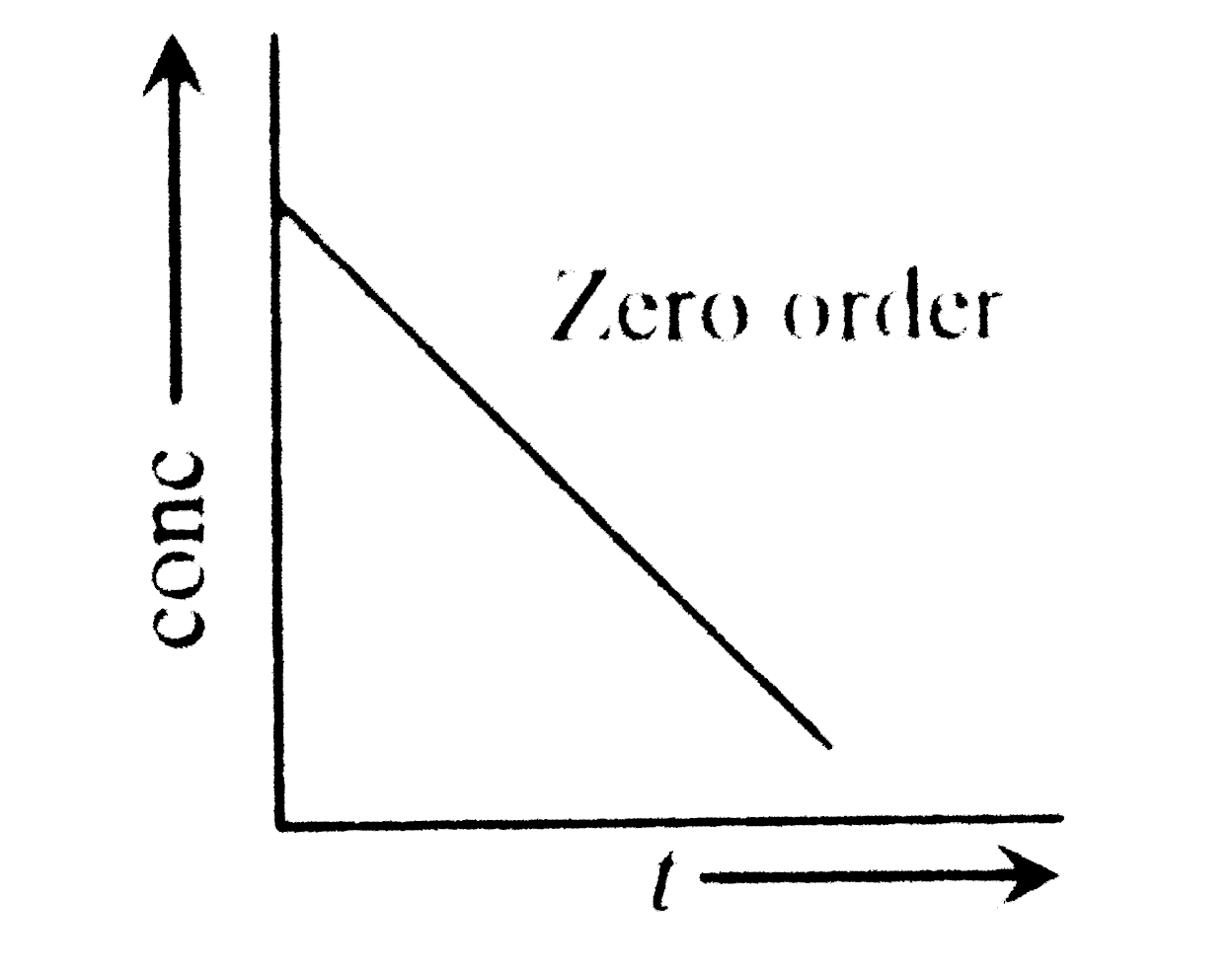 Linear , with `-`ve slope and non-zero intercept . |
|
| 47. |
For a zero order reaction, will the molecularity be equal to zero ? Explain. |
| Answer» SOLUTION :No because MOLECULARITY can NEVER be ZERO or FRACTIONAL. | |
| 48. |
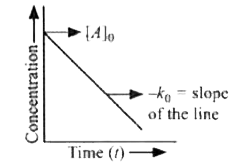
For a zero order reaction linear plot was obtained for [A] vs t. The slope of the line is equal to: |
|
Answer» `k_(0)` `[A] = k_(0)t +[A]` `:. ` PLOT of [A] vs . T gives slope = - `k_(0)` . |
|
| 49. |
For a zero order reaction : ArarrB a graph of rate vs . Time has slope equal to : |
|
Answer» K |
|