Saved Bookmarks
This section includes 7 InterviewSolutions, each offering curated multiple-choice questions to sharpen your Current Affairs knowledge and support exam preparation. Choose a topic below to get started.
| 1. |
Find the number of molecules(s) in which direction of back bonding is form surrounding atom to central atom. BF_(3),OF_(2),O Cl_(2),ul(N)(CH_(3))_(3),BF_(4)^(-) |
| Answer» | |
| 2. |
Find the number of molecules (s) in which shape of molecule is changed due to back bonding w.r.t under lined atom. ul(B)Cl_(3),ul(N)(CH_(3))_(3),ul(N)(SiH_(3))_(3),ul(P)(CH_(3))_(3),ul(B)(OCH_(3))_(3) |
| Answer» | |
| 3. |
Find the number of molecules in which pi-d o n a t io nispresentbetweenmetal and any ligandCr(C_(6)H_(6))_(2),K[PtCl_(3)(C_(2)H_(4))],"RMgX", R_(2)Zn, "cis-platin" . |
|
Answer» |
|
| 4. |
Find the number of molecules in which pi-donation is present between metal and any ligand Cr(C_(6)H_(6))_(2),K[PtCl_(3)(C_(2)H_(4))],"RMgX", R_(2)Zn, "cis-platin". |
|
Answer» |
|
| 5. |
Find the number of metals which are commercially reduced by self-reduction from the gives metalsAg, Cr, Mn, Sn, Zn, Fe |
|
Answer» |
|
| 6. |
Find the number of mole of hydroxide (OH^-) ion in 0.3 litre of 0.005 M solution of Ba(OH)_2. |
|
Answer» 0.0075 |
|
| 7. |
Find the number of ligands which behave prediminantly as pi-"donor" ligand (as wel as non-classical ligand) C_(2)H_(4),C_(6)H_(6),NO^(+),NO,CO,NH_(3),NH_(2)^(-),H_(2)O,OH^(-) |
|
Answer» |
|
| 8. |
Find thenumber of ion which are identified by dil. HCI fromthe following : (i) CO_(3)^(2-) (ii) SO_(3)^(2-) (iii)SO_(4)^(2-) |
|
Answer» |
|
| 9. |
Find the number of ions which have higher splitting energy value than the Mn^(+2) in octahedral complex considering same ligands for all ions. Cr^(+2), V^(+2), Fe^(+2), Co^(+2), Ni^(+2) , Cu^(+2) |
|
Answer» `Mn^(II) lt Fe^(II) lt Co^(II) ltNi^(II) lt CU^(II) gt Zn^(II)`. |
|
| 10. |
Find the number of geometrical isomers possible of the following compounds. |
|
Answer» |
|
| 11. |
Find thenumberof geometricalisomers of the given compound . C_(6)H_(5) - CH = CH - CH-CH = CH - CH = CH - COOH |
|
Answer» |
|
| 12. |
Find the number of geometrical isomer of Ma_(2)bcde which have identical ligands at maximum distance. (a, b, c, d and e are monodentate ligand) |
|
Answer» |
|
| 13. |
Find the number of diamagnetic complexes which show geometrical isomerism : (a) [NiF_(6)]^(2-),""(b) [Pt(NH_(3))_(2)Cl_(2)], (c ) [CoF_(3)(H_(2)O)],""(d) [Fe(en)_(2)Cl_(2)]Cl, (e ) [Ni(NH_(3))_(2)Cl_(2),""(f) [Ni(PPh_(3))_(2)Cl] |
|
Answer» |
|
| 14. |
Find the number of curves which are wrongly presented in the Elingham diagran. |
|
Answer» |
|
| 15. |
Find the number of correct statements ? (a) Pd(II) and Pt(II) form mostly the 4-coordination, square planar, diamagnetic co-ordination entities. (b) The free ions Pd^(+2), Pt^(+2)" and " Ni^(+2) are paramagnetic in ground states. (c ) Octahedral [Co(H_(2)O)_(6)]^(+2) is pink, that of tetrahedral [CoCl_(4)]^(2-) is blue (d) Delta_(0)=(4)/(9) Delta_(t) (e ) If a multidentate ligand happens to be cyclic and there are no unfavourable steric effects a further increase in stability occurs. This is termed as macrocyclic effect. |
|
Answer» |
|
| 16. |
Find the number of correct statement (i) Delta_(t)=0.44Delta_(0) and Delta_(SP)=1.3Delta_(0) (ii) Complex [Pt(NH_(3)(Br)(I)(Py)] has three geometrical isomers (iii) [Cr(C_(2)O_(4))(3)]^(3-) exhibit both Geometrical and optical isomerism (iv) EAN of ferrocene is 34 (v) IUPAC name of [Co(NH_(3))_(6)][CO(NH_(3))_(2)(NO_(2))_(4)]_(3) is Hexaamminecobalt (III) diammineetranitrito-N Cobalt (III) |
|
Answer» |
|
| 17. |
Find the number of compounds where d_(x^(2)-y^(2)) orbitals will not take part in hybridisation. (a) [Pt(NH_(3))Cl(H_(2)O)Br]" "(b) [XeO_(3)F_(2)] (c ) [Cu(NH_(3))_(4)]^(2+)""(d) ["XeO"_(3)F_(2)] (e ) ["XeO"_(2)F_(2)]""(f) [Co(en)_(3)]^(3+) (g) [Fe(CO)_(5)]""(h) POCl_(3) (i) XeF_(4)""(j) XeO_(6)^(4-) |
|
Answer» |
|
| 18. |
Find the number of compound which has four orbitals participating in hybridisation in central atom. (a) K_(2)CrO_(4)""(b) K_(2)Cr_(2)O_(7) (c ) KMnO_(4)""(d) K_(2)MnO_(4) (e ) [Ni(CN)_(4)]^(2-)""(f) [NiCl_(4)]^(2-) (g) [PtCl_(4)]^(2-)""(h) Na_(4)P_(2)O_(7) (i) H_(2)S_(2)O_(8) |
|
Answer» All have 4 orbitals in hyb. |
|
| 19. |
Find thenumber of compounds whichhave yellowcolour ppt from the given compounds : Ag_(2)CrO_(4),PbCrO_(4),Hg_(2)CrO_(4),BaCrO_(4) |
|
Answer» |
|
| 20. |
Find the number of complexes which satisfy at least three of the following four conditions : (a) Primary valence=3 Secondary valence=6 Oxidation number of central atom lt +3 Number of ions per molecule gt 3 I. [Pt(NH_(3))_(4)][PtCl_(6)],""II. [Co(NH_(3))_(6)]Cl_(3), III. [Co(NH_(3))_(5)(OH_(2))]Cl_(3),""IV. [Pt(NH_(3))_(6)]Cl_(4), V. K[PtCl_(5)(NH_(3))],""VI. [CoCl_(2),(en)_(2)]^(+), VII. [Ni(CO)_(4)],""VII. [Co(EDTA)]^(-) |
|
Answer» |
|
| 21. |
Find the number of complex(es) which have at least one five member chelate ring formed by two carbon atoms, two nitrogen atoms and one central metal. (a)[Co(EDTA)]^(-)""(b) [Co(en)_(3)]^(3+) (c ) [Co(Gly)_(3)]^(0)""(d) [Co(bipy)_(3)]^(+3) (e ) [Co(oxalate)_(3)]^(-3)""(f) [Co(dien)(NH_(3))_(3)]^(+3) |
|
Answer» |
|
| 22. |
Find the number of complexes which follow sidgwick rule of EAN [Fe(CO)_(5)]," "[Mn(CO)_(5)]," "[NiCl_(4)]^(2-), [Pt(NH_(3))_(4)Cl_(2)]^(2+)," "[HgI_(4)]^(2-)," "H[AuCl_(4)] Atomic number : Fe = 26, Mn = 25, Ni = 28, Pt = 78, Hg = 80, Au = 79 |
|
Answer» |
|
| 23. |
Find the number of complexes involving d^(2)sp^(3) hybridisation of the cental metla atom/ion. (a) [Co(Ox)_(3)]^(3-),""(b) [Mn(CN)_(6)]^(4-), (c ) [Mn(NH_(3))_(6)]^(2+),""(d) [CoF_(6)]^(3-), (e ) [Co(gly)_(3)],""(f) [Pt(NH_(3))_(6)]^(4+), (g) [Ni(H_(2)O)_(6)]^(2+),""(h) [Co(H_(2)O)_(6)]^(3+), (i) [IrCl_(6)]^(3-) |
|
Answer» |
|
| 24. |
Find the number of complexes in which stability constant value is greater than the stability constant value of [FeF_(6)]^(3-) [Fe(CN)_(6)]^(3-),""[Fe("ox")_(3)]^(3-), [Fe(NH_(3))_(6)]^(3+),""[Fe(H_(2)O)_(6)]^(3+), [Fe(en)_(3)]^(3+) |
|
Answer» |
|
| 25. |
Find the number of complexes following sidgwick EAN rule : [Ag(CN)_(2)^(-),""[HgI_(4)]^(2-), [Ti(CO)_(6)]^(2-),""[Ti(sigma-C_(5)H_(5))_(2)(pi-C_(5)H_(5))_(2)]^(@), [Fe(CN)_(6)NO]^(2-) |
|
Answer» `[HgI_(4)]^(2-) implies22-2+8=86 RIGHT` `[Ti(CO)_(6)]^(2-) implies22+2+12=36 right` `[Ti(sigma-C_(5)H_(5))_(2)(pi-C_(5)H_(5))_(2)] implies22-4+4+12=34 xx` `[overset(+3)Fe(overset(-6)CN)_(6)overset(+)NO]^(2-)implies26-3+12=35 xx` |
|
| 26. |
Find the number of chemical species, in which 2 p pi -3 d pi back bond is present B(OH)_(3), N(SiH_(3))_(3),P(CH_(3))_(3),N(GeH_(3))_(3),BeCl_(2),O(SiH_(3))_(2),O Cl_(2),BCl_(3) |
| Answer» | |
| 27. |
Find the number of atoms per unit cell in the following crystal structures : |
|
Answer» Solution :(1) Number of atoms in body-centred CUBIC (bcc) crystal: In this unit cell, there are 8 atoms at 8 corners and one additional atom at the body centre. Each CORNER butes 1/8th atom, to the unit cell, HENCE due to 8 corners. Numberof atoms `= 8 xx (1)/(8)` =1 atom. An atom at the body centre whollybelongto the unit cell. `THEREFORE`Total numberof atoms presentin bcc unit cell`= 1+1 = 2` 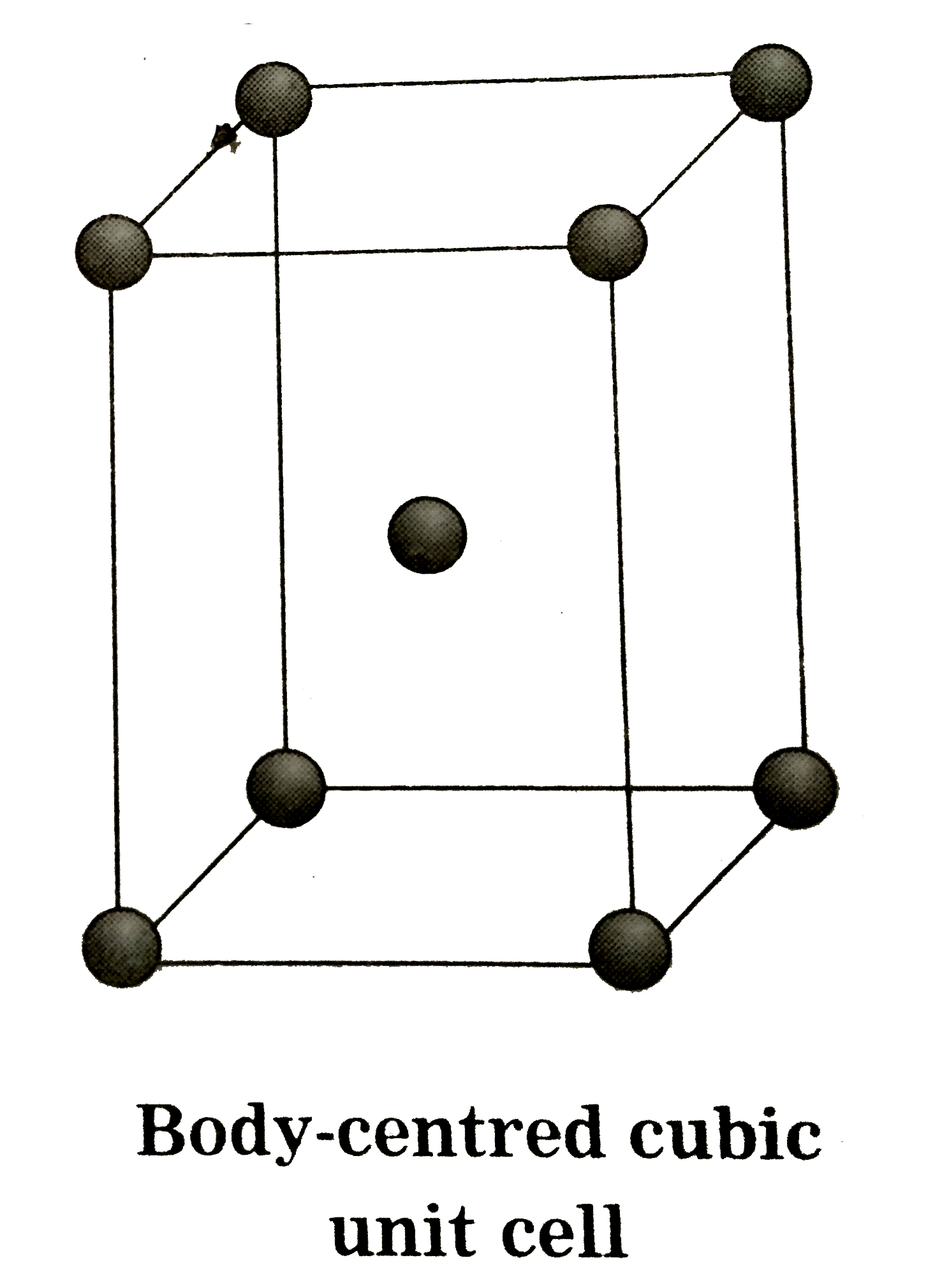 (2) Number of atoms in face-centred cubic (fcc)crystal: In thisunit cell, thereare8 atomsat 8 corners and 6 atoms at 6 facecentre. Each corner contributes 1/8th atom to the unit cell, hence due to 8 corners. 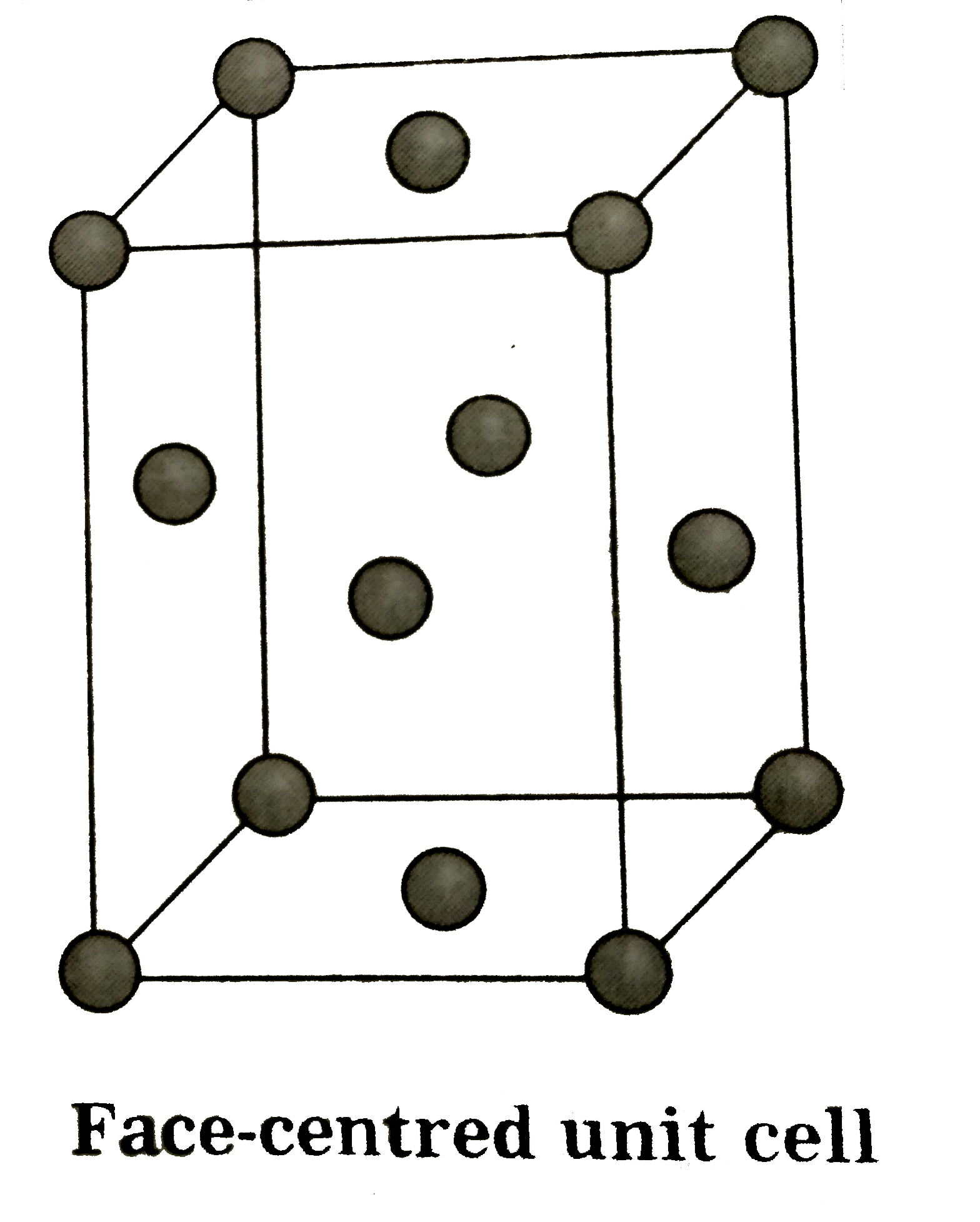
|
|
| 28. |
Find the number of atoms of each type present in 3.42 grams of cane sugar (C_(12)H_(22)O_(11)). |
| Answer» SOLUTION :`C=7.226xx10^(22)` ATOMS, `H=1.325xx10^(23)` atoms, `O=6.624xx10^(22)` atoms | |
| 29. |
Find the no. of gaseous species (including water vapours) obtained on heating basic lead carbonate, PbCO_(3)Pb(OH)_(2) at 450^(@)C. |
|
Answer» SOLUTION :3 `PbCO_(3)PbOH_(2)overset(45^(@)C)pB_(2)O_(4)+CO+CO_(2)+H_(2)O` |
|
| 30. |
Find then-factor for thereactants in each of the following cases . (i)l to l_(2) (b) l_(2) to l (c ) S_(2)O_(3)^(2-) to S_(4)O_(6)^(2-) (d)l_(2) to l^(+) (e ) CuS to Cu^(2+) + SO_(2) |
|
Answer» SOLUTION :(a) n-factor = `1 xx |0-(-1) | = 1` (b) n-factor `= 2 xx |-1-0| = 2` (c ) n-factor`= 2 xx |2.5 -2|= 1` (d) n-factor ` = 1 xx |1 - 5| = 4` (e ) n-factor ` = 1 xx |4 - (-2) | = 6` |
|
| 31. |
Find the n factor of KMnO_(4) in difference medium . |
|
Answer» Solution :(i) In acidic medium `KMnO_(4) rarr Mn^(-2)` CHANGE in oxidation number of `Mn+ 7 -2=5` `:.` the n factor of `KMnO_(4) = 5` (ii) stronggly basic medium `KMnO_(4) rarr K_(2) MnO_(4)` n factor of `KMnO_(4) = +7- 6 = 1` (iii) NEUTRAL mediumor weakly basic medium `KMnO_(4) rarr MnO_(2)` n factor of `KMnO_(4) = +7 - 4 =3` |
|
| 33. |
Find the molecule having lowest boiling point? |
|
Answer» `D_(2)` <BR>`Br_(2)` |
|
| 34. |
Find the molecular weight of the compound C. |
Answer» 
|
|
| 35. |
Find the molecular formula of a compound of boron with hydrogen if the mass of 1 litre of this gas equals the mass of 1 litre of nitrogen under same condition and the boron content in the substance is 78.2%. (B=11, N=14, O=16) |
|
Answer» Solution :100g of the compound contains 78.2g of B and 21.8g of H. Moles of `B= (78.2)/(11)=7.1` Moles of `H= (21.8)/(1)= 21.8` `therefore B:H= 1: 3` EMPIRICAL formula is `BH_(3)` `therefore` empirical formula WEIGHT `=11 +3=14` Now, since equal VOLUMES fo two gases contain the same number of molecules or moles if their temperature and pressure are the same, the number of moles of the gaseous compound is equal to the number of moles of nitrogen, both the gases occupying 1 litre of volume. Moles of the compound= moles of `N_(2)`. `("weight of the compound")/("mol. wt. of the compound")= ("weight of "N_(2))/("mol. wt. of"N_(2))` `because` weight of compound= weight of `N_(2)` (as given). Molecular weight of the compound= molecular weight of `N_(2)=28` We KNOW, `("molecular formula weight of the compound")/("empirical formula wt. of the compound")= (28)/(14)=2` `therefore` molecular formula is `(BH_(3))_(2)`, i.e., `B_(2)H_(6)` |
|
| 36. |
Find the molarity and molality of a 15% solution of H_(2)SO_(4) (density of H_(2)SO_(4)=1.020gcm^(-3)). (Atomic mass : H=1,O=16, S=32 a.m.u.). |
|
Answer» Solution :`15%` solution of `H_(2)SO_(4)` means 15 g of `H_(2)SO_(4)` are present in 100 g of the solution, i.e., Mass of `H_(2)SO_(4)` DISSOLVED = 15 g , Mass of the solution = 100 g, Density of the solution = 1.02 `g//cm^(3)` (given) Calculation of molality : Mass of solution = 100g , Mass of `H_(2)SO_(4)` (solute) = 15 g Mass of water (SOLVENT ) = `100-15=85g=(85)/(1000)kg=0.085kg` `"Mass of water (solvent)"=100-15=85g=(85)/(1000)kg=0.085kg` `"Molar mass of "H_(2)SO_(4)="98 g mol"^(-1)""therefore""15gH_(2)SO_(4)=(15g)/(98"g mol"^(-1))=0.153"moles"` `"Molality"=("No. of moles of solute")/("Mass of solvent in kg")=(0.153mol)/(0.085kg)=1.8mol kg^(-1)=1.8m` Calculation of molarity = 15 g of `H_(2)SO_(4)=0.153` moles (CALCULATED above) `"Volume of solution"=("Mass of solution")/("Density of solution")=(100)/(1.02)=98.04cm^(3)=(98.04)/(1000)L=0.09804L` `"Molarity "=("No. of moles of the solute")/("Volume of solution in litres")=(0.153mol)/(0.09804L)=1.56mol L^(-1)=1.56M` |
|
| 37. |
Find the molarity and molality of a 15% solution of H_(2)SO_(4) (density of H_(2)SO_(4)="1.020 g cm"^(-3)). (Atomic mass : H = 1, O = 16, S = 32 a.m.u.). |
|
Answer» Solution :`15%` solution of `H_(2)SO_(4)` MEANS 15 g of `H_(2)SO_(4)` are present in 100 g of the solution, i.e., MASS of `H_(2)SO_(4)` dissolved = 15 g , Mass of the solution = 100 g , Density of the solution `= "1.02 g/cm"^(3)"(Given)"` Calculation of molality : Mass of solution = 100 g , Mass of `H_(2)SO_(4)` (solute) = 15 g Mass of water (solvent) `=100-15=85 g =(85)/(1000)kg=0.085kg` Molar mass of `H_(2)SO_(4)="98 g mol"^(-1)""therefore"15 g "H_(2)SO_(4)=(15g)/("98 g mol"^(-1))="0.153 moles"` `"Molality"=("No. of moles of solute")/("Mass of solvent in kg")=("0.153 mol")/("0.085 kg")="1.8 mol kg"^(-1)=1.8m` Calculation of molarity : `"15 g of "H_(2)SO_(4)="0.153 moles(calculated above)"` `"Volume of solution "=("Mass of solution")/("Density of solution")=(100)/(1.02)="98.04 cm"^(3)=(98.04)/(1000)L=0.09804L` `"Molarity"=("No. of moles of the solute")/("Volume of solution in LITRES")=("0.153 mol")/("0.09804 L")="1.56 mol L"^(-1)="1.56 M"` |
|
| 38. |
Find the molality of a solution containing a non-volatile solute if the vapour pressure is 2% below the vapour pressure or pure water. |
|
Answer» Solution :`"Accoriding to Raoult's Law "(P_(A)^(@)-P_(S))/P_(S)=n_(B)/n_(A)` `" If" n_(B)" is the number of moles of the solute present in 1000 G of the solvent, then "n_(B)" will represent molality of the solution. LET "P_(A)^(@)=1 ATM, P_(S) =0.98 atm, P_(S)^(@)-P_(S)=0.02 atm, W_(A)=1000g, M_(A)-18G mol^(-1)` `(p_(A)^(@)-P_(S))/P_(S)=(n_(B)xxM_(A))/W_(A)` `n_(B)=((p_(A)^(@)-P_(S)))/P_(S)xxW_(A)/M_(A)=((0.02 atm))/((0.98 atm))xx((1000g))/((18g mol^(-1)))=1.134 mol` The molality (m) of solution is 1.134 m because of the mass of solvent is one kg. |
|
| 39. |
Find the maximum number of planes having maximum number of all same atoms in SF_(6). |
|
Answer» |
|
| 40. |
Find the maximum number of plane having maximum number of atoms in CH_(4). |
|
Answer» |
|
| 41. |
Find the maximum number of atoms in one plane in [Fe(CN)_(6)]^(3-) |
Answer» 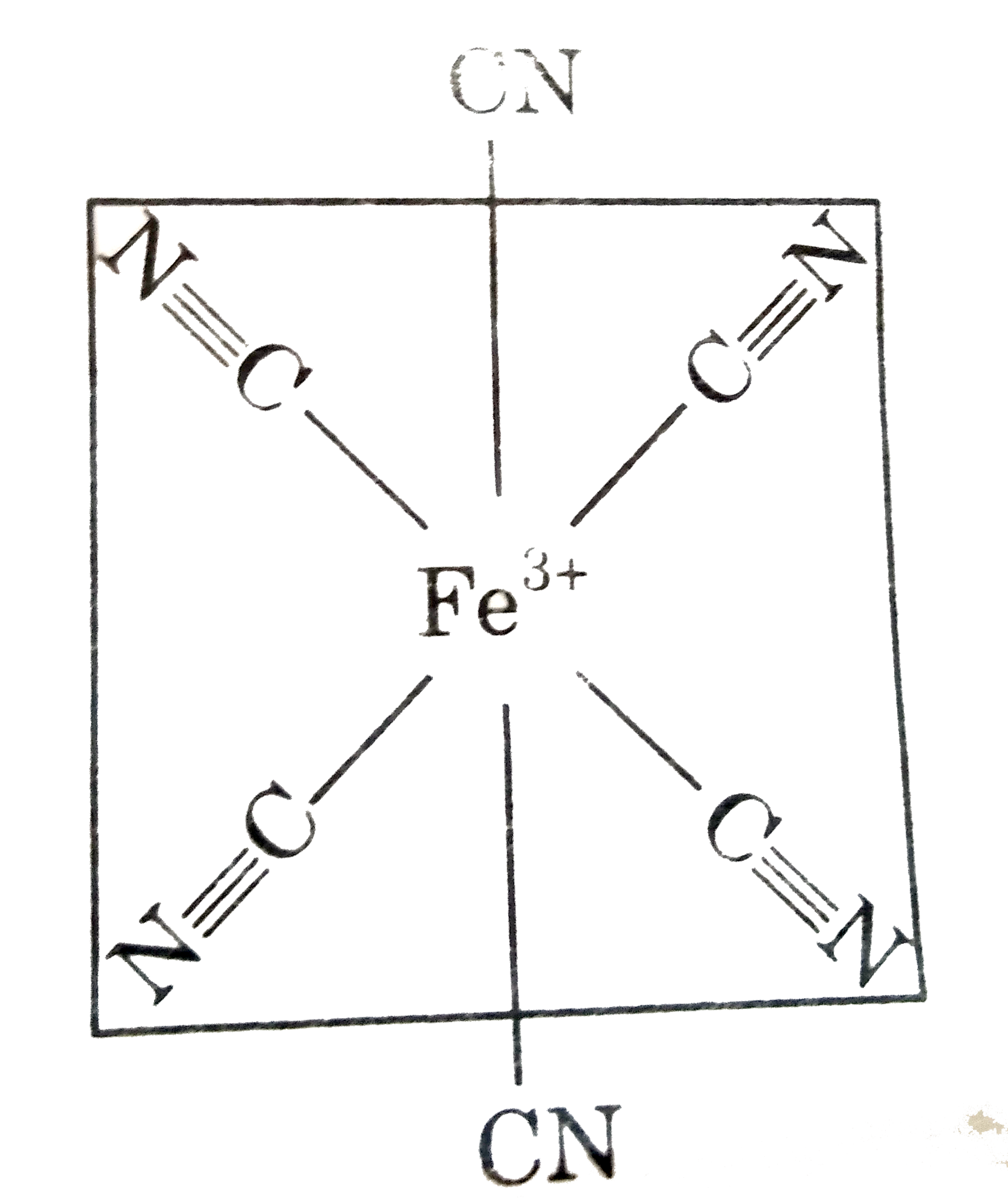
|
|
| 42. |
Find the mass of glucose that should be dissolved in 50g of water in order to produce the same lowering of vapour pressure as produce by dissolving 1 g of urea in the same quantity of water |
|
Answer» 1 g |
|
| 43. |
Find the major product of the following reaction (AAK_MCP_35_NEET_CHE_E35_009_Q01) |
|
Answer» `(AAK_MCP_35_NEET_CHE_E35_009_A01)` |
|
| 45. |
Find the K_(sp) of AgCl from the following data. The standard electrode potential of Ag/AgCl/Cl^– is 0.222 V and Ag^+/Ag is 0.799 V. |
|
Answer» |
|
| 46. |
Find the interplanar distance in a crystal in which a series of planes produce a first orderreflection from a copper X-ray tube (lambda = 1.542 A^@)at an angle of 23.2^@. |
| Answer» SOLUTION :`1.9573 A^@` | |
| 47. |
Find the incorrectly matched pair ? |
|
Answer» `{:("Column-I(ores)","Column-II(metals)"),("Sylvine",(1)"POTASSIUM"):}` |
|
| 48. |
Find the incorrect statement regarding the conditions for the combination of atomic orbitals. |
|
Answer» The combining atomic orbitals MUST have the same or nearly the same energy |
|
| 49. |
Find the incorrect second ionisation energy order from following option :- |
|
Answer» `Al gt Mg` |
|
| 50. |
Find the incorrect statement |
|
Answer» `PH_4^+` ion is tetrahedral like `NH_4^+` ion and is OBTAINED when `PH_3` is bonded to proton |
|