

Saved Bookmarks
This section includes 7 InterviewSolutions, each offering curated multiple-choice questions to sharpen your Current Affairs knowledge and support exam preparation. Choose a topic below to get started.
| 2. |
Ethane can be prepared from ethanal in one step by the use of |
|
Answer» zinc amalgam and conc. HCl |
|
| 3. |
Ethane can bepreparedby : |
|
Answer» heatingsodalimewithsodiumacetane |
|
| 4. |
Ethane can be freed (isolated )from the impurity of ethylene by washing with: |
|
Answer» HCI |
|
| 5. |
Ethane can be obtained from ethanal in one step by : |
|
Answer» Na-Hg + WATER |
|
| 6. |
Ethane as well as methane can be prepared in single steps from |
|
Answer» `CH_(2)I` (ii) `2CH_(3)+I+2Na overset("ether") to CH_(3)-CH_(3)+2Nal` |
|
| 7. |
Ethane and chlorine when allowed to react in presence of light, the total possible products (excluding stereoisomers if any) |
|
Answer» |
|
| 8. |
Ethanaminewithexcessof acetylchloridegives |
|
Answer» `C_(2) H_(5) NH_(3)^(+)CI^(-)` |
|
| 9. |
Ethanamine to methanamine |
| Answer» SOLUTION :`underset(("METHANAMINE"))(CH_(3)NH_(2)) underset(H_(2)O)OVERSET(NHO_(2))rarr CH_(3)OH overset(PI_(3))rarr CH_(3)I overset(KCN)rarr CH_(3)CN overset(LiAlH_(4))rarr underset(("Ethanamine"))(CH_(3)CH_(2)NH_(2))` | |
| 10. |
Ethanamine reacts with benzenesulphonyl chloride to form____which dissolves in____ |
| Answer» SOLUTION :N-ethylbenzenesulphonamide, AQUEOUS NAOH solution | |
| 11. |
Ethanamine is treated with nitrous acid at ordinary temperature, the product will be |
|
Answer» ethanol only |
|
| 12. |
Ethanamine reacts with benzenesulfonyl chloride to form N-ethylbenzenesulfonamide which is underline("insoluble in KOH"). |
| Answer» SOLUTION :Ethanamine reacts with benzenesulfonyl chloride to FORM N-ethylbenzenesulfonamide which is SOLUBLE in KOH. | |
| 14. |
Ethanal to butane-1,3-diol |
| Answer» Solution :`2CH_(3)CHO overset(OH^(-))rarr underset(("Aldol"))(CH_(3)-overset(overset(OH)(|))(CH)-CH_(2)-CHO) underset("(REDUCTION)")overset(NaBH_(4))rarr CH_(3)- underset(underset(OH)(|))(CH)-CH_(2)-underset(underset(OH)(|))(CH_(2))` | |
| 15. |
Ethanal reacts with alkali to give 3- hydroxy butanal . The reaction is |
|
Answer» ALDOL condensation |
|
| 16. |
Ethanal to but-2-enal |
Answer» SOLUTION :
|
|
| 17. |
Ethanal reacts with alkali to give 3-hydroxy butanal. This reaction is: |
|
Answer» Polymerisation |
|
| 18. |
Ethanal is more reactive towards nucleophilic addition reaction than propanone. Why? |
|
Answer» Solution :(i) Ethanal `(CH_(3)CHO)` is more reactive towards nucleopilic ADDITION reaction than propanone `(CH_(3)-underset(O)underset(|)(C)-CH_(3))` because of steric and electronic reasons. (II) Greater the number of alkyl groups attached, less will be the reactivity of carbonyl compound towards nucleophilic addition. (iii) So ETHANOL is more reactive than propanone. |
|
| 19. |
Ethanal is rcacted with acidified K_2 Cr_2 O_2 What is the product formed? |
|
Answer» `C_2H_5OH` |
|
| 20. |
Ethanal is soluble in water. Why? |
Answer» Solution :ETHANAL is soluble in WATER due to H-bonding between the polar carbonyl group and water molecules. 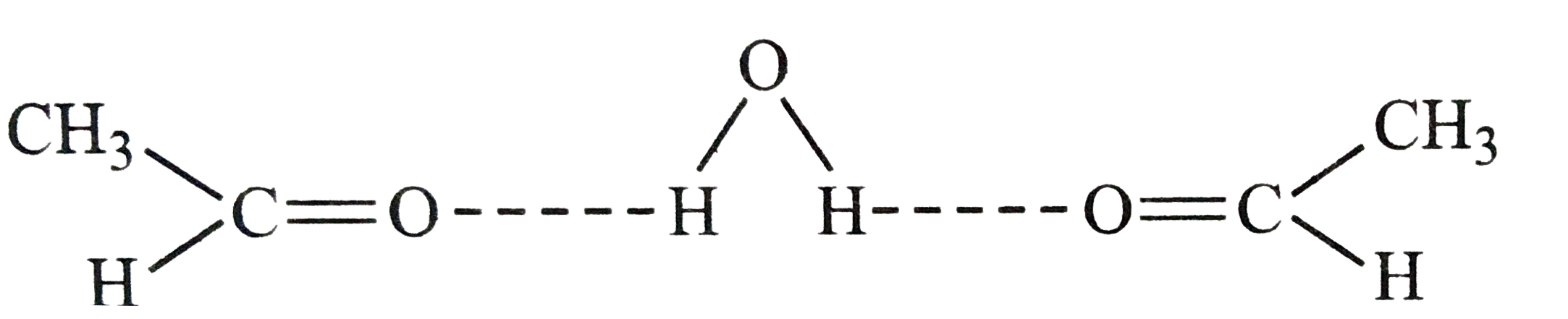 . .
|
|
| 21. |
Ethanal(CH_3CHO)undergoes aldol condensation reaction.Give reason. |
| Answer» SOLUTION :ETHANAL contian `PROP` -HYDROGENS. | |
| 22. |
Ethanal and propanone undergoes aldol condensation reaction inpresence of dilute alkali to form |
|
Answer» `CH_(3)C(OH)(CH_(3))CH_(2)CHO` `CH_(3)CHO + HCH_(2)COCH_(3) overset("dil.NaOH") to underset(" 4- hydroxy 2- pentanone")(CH_(3)CH(OH) CH_(2)COCH_(3))` |
|
| 24. |
Etard oxidation convert toluene to |
|
Answer» BENZOIC ACID |
|
| 25. |
Estimation of nitrogen: There are two methods for the estimation of nitrogen (i) Dumas method and (ii) Kjedahl's method. i. Dumas method: A known mass of compound is heated with copper oxide (CuO) in an atomsphere of CO_(2), which gives free nitrogen along with CO_(2) and H_(2)O C_(x)H_(y)N_(z) + (2x + y//2) CuO rarr xCO_(2) + y//2 (H_(2)O) + z//2 (N_(2)) + (2x + y//2) CU The gaseous mixture is passed over a heated copper gauze which converts traces of nitrogen oxides formed to N_(2). The gaeous mixture is collected over an aqueous solution of KOH which absorbs CO_(2), and nitrogen is callected in the upper part of the graduated tube. ii. Kjeldahl's method: A known mass of organic compound (0.5 gm) is mixed with K_(2)SO_(4) (10 gm) and CuSO_(4). (1.0 gm) or a drop of mercury (Hg) and conc. H_(2)SO_(4) (25ml), and heated in Kjeldahl's flask. CuSO_(4) or Hg acts as a catalyst, while K_(2)SO_(4) raises the boiling point of H_(2)SO_(4). The nitrogen in the organic compound is quantitatively converted to ammonium sulphate. The resulting mixture is then distilled with excess of NaOH solution and the NH_(3) evolved is passed into a known but excess volume of standard HCl or H_(2)SO_(4). The acid left unused is estimated by titration with some standard alkali. The amount of acid used against NH_(3) can be thus be known and from this the percentage of nitrogen is calculated. (a) C + H + S underset(H_(2)SO_(4))overset("conc.")rarr CO_(2) + H_(2)O + SO_(2) (b) N underset(H_(2)SO_(4))overset("conc.")rarr (NH_(4))_(2)SO_(4) (c) (NH_(4))_(2) SO_(4) + 2NaOH rarr Na_(2)SO_(4) + 2NH_(3) + 2H_(2)O (d) 2NH_(3) + H_(2)SO_(4) rarr (NH_(4))_(2) SO_(4) (iii) This method is not applicable to compounds containing N in intro and azo groups, and N present in the ring (e.g., pyridine) as N of these compounds does not change to (NH_(4))_(2)SO_(4) (ammonium sulphate) under these reaction conditions 0.002 gm of an organic compound was treated according to Kjeldahl's method. 0.2 xx 10^(-4) mol of H_(2)SO_(4) was required to neutralise NH_(3). Calculate the percentage of N_(2) |
|
Answer» 50 |
|
| 26. |
Et-N^(o+)-=C^(ɵ) underset(or HgO or O_(3))overset(Cl_(2)+DMSO)(rarr). The compound (A) is: |
|
Answer» a.ETHYL methyl amine |
|
| 27. |
Et-underset(O)underset(||)C-Me is prepared as one of the product in which of the following reactions ? |
|
Answer» By DRY distilition of calcium salt of ethonic acid and methanoic acid |
|
| 28. |
Estrone is a human hormones. How many number of sp^2 hybridised carbon atoms are present in the structure of estrone |
|
Answer» |
|
| 29. |
Estimation of nitrogen: There are two methods for the estimation of nitrogen (i) Dumas method and (ii) Kjedahl's method. i. Dumas method: A known mass of compound is heated with copper oxide (CuO) in an atomsphere of CO_(2), which gives free nitrogen along with CO_(2) and H_(2)O C_(x)H_(y)N_(z) + (2x + y//2) CuO rarr xCO_(2) + y//2 (H_(2)O) + z//2 (N_(2)) + (2x + y//2) CU The gaseous mixture is passed over a heated copper gauze which converts traces of nitrogen oxides formed to N_(2). The gaeous mixture is collected over an aqueous solution of KOH which absorbs CO_(2), and nitrogen is callected in the upper part of the graduated tube. ii. Kjeldahl's method: A known mass of organic compound (0.5 gm) is mixed with K_(2)SO_(4) (10 gm) and CuSO_(4). (1.0 gm) or a drop of mercury (Hg) and conc. H_(2)SO_(4) (25ml), and heated in Kjeldahl's flask. CuSO_(4) or Hg acts as a catalyst, while K_(2)SO_(4) raises the boiling point of H_(2)SO_(4). The nitrogen in the organic compound is quantitatively converted to ammonium sulphate. The resulting mixture is then distilled with excess of NaOH solution and the NH_(3) evolved is passed into a known but excess volume of standard HCl or H_(2)SO_(4). The acid left unused is estimated by titration with some standard alkali. The amount of acid used against NH_(3) can be thus be known and from this the percentage of nitrogen is calculated. (a) C + H + S underset(H_(2)SO_(4))overset("conc.")rarr CO_(2) + H_(2)O + SO_(2) (b) N underset(H_(2)SO_(4))overset("conc.")rarr (NH_(4))_(2)SO_(4) (c) (NH_(4))_(2) SO_(4) + 2NaOH rarr Na_(2)SO_(4) + 2NH_(3) + 2H_(2)O (d) 2NH_(3) + H_(2)SO_(4) rarr (NH_(4))_(2) SO_(4) (iii) This method is not applicable to compounds containing N in intro and azo groups, and N present in the ring (e.g., pyridine) as N of these compounds does not change to (NH_(4))_(2)SO_(4) (ammonium sulphate) under these reaction conditions 0.4gm of an organic compound was treated according to Kjeldahl's method. The ammonia evolved was absorbed in 50ml of 0.5M H_(3)PO_(3). The residual acid required 30 ml of 0.5M Ca(OH)_(2). Find the percentage of N_(2) in the compound |
|
Answer» 20 |
|
| 30. |
Estimation of nitrogen: There are two methods for the estimation of nitrogen (i) Dumas method and (ii) Kjedahl's method. i. Dumas method: A known mass of compound is heated with copper oxide (CuO) in an atomsphere of CO_(2), which gives free nitrogen along with CO_(2) and H_(2)O C_(x)H_(y)N_(z) + (2x + y//2) CuO rarr xCO_(2) + y//2 (H_(2)O) + z//2 (N_(2)) + (2x + y//2) CU The gaseous mixture is passed over a heated copper gauze which converts traces of nitrogen oxides formed to N_(2). The gaeous mixture is collected over an aqueous solution of KOH which absorbs CO_(2), and nitrogen is callected in the upper part of the graduated tube. ii. Kjeldahl's method: A known mass of organic compound (0.5 gm) is mixed with K_(2)SO_(4) (10 gm) and CuSO_(4). (1.0 gm) or a drop of mercury (Hg) and conc. H_(2)SO_(4) (25ml), and heated in Kjeldahl's flask. CuSO_(4) or Hg acts as a catalyst, while K_(2)SO_(4) raises the boiling point of H_(2)SO_(4). The nitrogen in the organic compound is quantitatively converted to ammonium sulphate. The resulting mixture is then distilled with excess of NaOH solution and the NH_(3) evolved is passed into a known but excess volume of standard HCl or H_(2)SO_(4). The acid left unused is estimated by titration with some standard alkali. The amount of acid used against NH_(3) can be thus be known and from this the percentage of nitrogen is calculated. (a) C + H + S underset(H_(2)SO_(4))overset("conc.")rarr CO_(2) + H_(2)O + SO_(2) (b) N underset(H_(2)SO_(4))overset("conc.")rarr (NH_(4))_(2)SO_(4) (c) (NH_(4))_(2) SO_(4) + 2NaOH rarr Na_(2)SO_(4) + 2NH_(3) + 2H_(2)O (d) 2NH_(3) + H_(2)SO_(4) rarr (NH_(4))_(2) SO_(4) (iii) This method is not applicable to compounds containing N in intro and azo groups, and N present in the ring (e.g., pyridine) as N of these compounds does not change to (NH_(4))_(2)SO_(4) (ammonium sulphate) under these reaction conditions 0.50 gm of an organic compound was treated according to Kjeldahl's method. The ammonia evolved was absorbed in 50ml of 0,5M H_(2)SO_(4). The residual acid required 60 ml of M/2 NaOH solution. Find the percentage of nitrogen in the compound |
|
Answer» 50 |
|
| 31. |
Estimation of nitrogen: There are two methods for the estimation of nitrogen (i) Dumas method and (ii) Kjedahl's method. i. Dumas method: A known mass of compound is heated with copper oxide (CuO) in an atomsphere of CO_(2), which gives free nitrogen along with CO_(2) and H_(2)O C_(x)H_(y)N_(z) + (2x + y//2) CuO rarr xCO_(2) + y//2 (H_(2)O) + z//2 (N_(2)) + (2x + y//2) CU The gaseous mixture is passed over a heated copper gauze which converts traces of nitrogen oxides formed to N_(2). The gaeous mixture is collected over an aqueous solution of KOH which absorbs CO_(2), and nitrogen is callected in the upper part of the graduated tube. ii. Kjeldahl's method: A known mass of organic compound (0.5 gm) is mixed with K_(2)SO_(4) (10 gm) and CuSO_(4). (1.0 gm) or a drop of mercury (Hg) and conc. H_(2)SO_(4) (25ml), and heated in Kjeldahl's flask. CuSO_(4) or Hg acts as a catalyst, while K_(2)SO_(4) raises the boiling point of H_(2)SO_(4). The nitrogen in the organic compound is quantitatively converted to ammonium sulphate. The resulting mixture is then distilled with excess of NaOH solution and the NH_(3) evolved is passed into a known but excess volume of standard HCl or H_(2)SO_(4). The acid left unused is estimated by titration with some standard alkali. The amount of acid used against NH_(3) can be thus be known and from this the percentage of nitrogen is calculated. (a) C + H + S underset(H_(2)SO_(4))overset("conc.")rarr CO_(2) + H_(2)O + SO_(2) (b) N underset(H_(2)SO_(4))overset("conc.")rarr (NH_(4))_(2)SO_(4) (c) (NH_(4))_(2) SO_(4) + 2NaOH rarr Na_(2)SO_(4) + 2NH_(3) + 2H_(2)O (d) 2NH_(3) + H_(2)SO_(4) rarr (NH_(4))_(2) SO_(4) (iii) This method is not applicable to compounds containing N in intro and azo groups, and N present in the ring (e.g., pyridine) as N of these compounds does not change to (NH_(4))_(2)SO_(4) (ammonium sulphate) under these reaction conditions 0.20gm of an organic compound gave 82.1 ml of nitrogen collected at 300K and 775mm pressure in Dumas method. Calculate the percentage of nitrogen in the compound. (Vapour pressure of water or aqueous tension of water at 300K is 15mm. |
|
Answer» `31.11` |
|
| 32. |
Estradiol is responsible for the development of |
|
Answer» PRIMARY MALE characters |
|
| 33. |
Estimation of halogens: CarisuMethod: A known mass of compound is heated with conc. HNO_(3) in the presence of AgNO_(3) contained in a hard glass tube known as carius tube in a furnce. C and H are oxidised to CO_(2) and H_(2)O . The halogen forms the corresponding AgX. It is filtered , dried , and weighed. Estimation of sulphur: A known mass of compound is heated with fuming HNO_(3) or sodium peroxide (Na_(2)O_(2)) in the presence of BaCl_(2) solution in Carius tube. Sulphur is oxidised to H_(2)SO_(4) and precipitated as BaSO_(4) . It is filerted, dried and weighed. 0.32 gm of an organic substance when treated by Carius method gave 0.466 gm of BaSO_(4) . Calculate the percentage of sulphur in the compound (Ba=137) |
|
Answer» `10.0` |
|
| 34. |
Estimation of halogens: CarisuMethod: A known mass of compound is heated with conc. HNO_(3) in the presence of AgNO_(3) contained in a hard glass tube known as carius tube in a furnce. C and H are oxidised to CO_(2) and H_(2)O . The halogen forms the corresponding AgX. It is filtered , dried , and weighed. Estimation of sulphur: A known mass of compound is heated with fuming HNO_(3) or sodium peroxide (Na_(2)O_(2)) in the presence of BaCl_(2) solution in Carius tube. Sulphur is oxidised to H_(2)SO_(4) and precipitated as BaSO_(4) . It is filerted, dried and weighed. 0.15 gm of an organic compound gave 0.12 gm of silver bromide by the Carius method. Find the percentage of bromine in the compound. (Ag=108, Br=80) |
|
Answer» `34.0` |
|
| 35. |
Estimate the numbers for the central metal ion : (a) Oxidation state in [Mn(H_(2)O)_(6)]SO_(4)=x (b) d-orbitals occupation in cis-[Cr(en)_(2)Cl_(2)]Cl=y(if d^(8) then y=8) (c ) Co-ordination number in K_(3)[Co(C_(2)O_(4))_(3)]=z (d) Spin multiplicity in Cs[FeCl_(4)]=t Hence, find the value of z-(x xx y)+t |
|
Answer» |
|
| 36. |
Estimate the temperature range for which the following standard reaction is product-favoured. SiO_(2)(s)+2C(s)+2Cl_(2)(g) to SiCl_(4)(g)+2CO(g) DeltaH^(0)=+32.9"kJ/mole and"DeltaS^(0)=226.5"J/mole.K" |
|
Answer» SOLUTION :In this problem the factor `DeltaS^(@)` being positive is favourable to spontaneity, whereas the factor `DeltaH^(@)` being positive is unfavourable. Thus the REACTION becomes product-favoured above some temperature. We can SET `DeltaG^(@)` equal to ZERO in the equation `DeltaG^(@)=DeltaH^(@)-TDeltaS^(@)` and the solve for the temperature at which the reaction is at equilibrium and above which the reaction becomes product favoured as then `DeltaG^(@)` becomes NEGATIVE. `T=(DeltaH^(@))/(DeltaS^(@))=(+32.9)/(+0.2265)=145.25K` |
|
| 37. |
Estimate the minimum potential difference required to reduce Al_(2)O_(3)at 500^(@) C. The free energy change for the decomposition reaction : 2/3Al_(2)O_(3) to 4/3 Al + O_(2) is DeltaG = 960 kJ 1 F = 96500 C mol^(-1). |
|
Answer» Solution :The following data is provided `DeltaG^(@) = +960 kJ = 960 xx 10^(3) J, 1F = 96500 C mol^(-1)` The reduction equation may be written as: `4/3 Al^(3+) + 4e^(-) to 4/3 Al`. Thus, n=4. Use the following RELATION to calculate potential difference. `DeltaG^(@) = -nFE^(@)` `=-960 xx 10^(3) J =-4 xx 96500 C mol^(-1) xx E^(@)` volt or `E^(@) = (960 xx 10^(3) J)/(4 xx 96500 C mol^(-1)"volt") = +2.48 V` |
|
| 38. |
Estimation of calcium and magnesium is done by |
|
Answer» EDTA |
|
| 39. |
Estimate the number of molecules left in a volume of the size of a pinhead about 1 cubic rum when the air is pumped out to give a vacuume of 10^(-6) mm Hg at 25^(@)C. |
| Answer» SOLUTION :`3.24 XX 10^(7)` | |
| 40. |
Estimate the minimum potential difference needed toreduce Al_(2)O_(3) at 500^(@)C The gibbs energy change for the decomposition reaction 2/3Al_(2)O_(3)rarr4/3Al+O_(2)is 960 kJ (F=96500 C mol^(-1)) |
|
Answer» Solution :`(2)/(3)Al_(2)O_(3)rarr(4)/(3)Al+O_(2)` `n=(6xx2)/(3)=4e` `DeltaG=-nFE` `DeltaG=960xx10^(3)J, n=4, F="96500 C mol"^(-1)` `960xx10^(3)=-4xx96500xxE` `=E=-2.487V` `"Minimum potential DIFFERENCE needed to reduce "Al_(2)O_(3)=-2.487V`. |
|
| 41. |
Estimate the minimum potential difference needed to reduce Al_(2)O_(3) at 500^(@)C. The free change for the decomposition rection (2)/(3)Al_(2)O_(3)to(4)/(3)Al+O_(2) is DeltaG=+960kJ""(F=96500" C "mol^(-1)). |
|
Answer» Solution :`Al_(2)O_(3)(2AL^(3+)+3O^(2-))to2Al+(3)/(2)O_(2),n=6e^(-)""therefore(2)/(3)Al_(2)O_(3)to(4)/(3)Al+O_(2).n=4e^(-)` SUBSTITUTING `DeltaG=+960kJ=+960,000J and n=4` in the equation, `DeltaG=-nFE`, we get `960,000=-4xx96500xxE" or "E=-2.487V` `therefore`MINIMUM POTENTIAL DIFFERENCE needed to reduce `Al_(2)O_(3)` is 2.487 V. |
|
| 42. |
Estimate the cell potential of a Daniel cell having 1.0 M Zn^(2+) and originally having 1.0 M Cu^(2+) after sufficient ammonia has been added to the cathode compartment to make the NH_(3) concentration 2.0 M. Given, E_(Zn//Zn^(2+))^(@) and E_(Cu//Cu^(2+))^(@) are 0.76 and -0.34 V respectively. Also equilirbrium constant for the [Cu(NH_(3))_(4)]^(2+) formation is 1 xx 10^(12). |
|
Answer» |
|
| 43. |
Estimate the difference in energy between first and second Bohr orbit for ahydrogen atom. At what minimum atomic number, a transition from n=2 to n=1 energy level would result in the emission of X-rays with lamda=3.0 xx 10^(-8) m?Which hydrogen-atom like species does this atomic number correspond to? |
|
Answer» Solution :Apply `Delta E = RchZ^2 ((1)/(n_1^2) - (1)/(n_2^2)) ` `1.63 xx 10^(-11) ERG, Z = 2, He^+` |
|
| 44. |
Estimate the heat of formation of gaseous isoprene (H_(2)C=overset(CH_(3))overset(|)(C)-overset(H)overset(|)(C)=CH_(2)) from the following data : Bond energies : C-H=98.8 kcal/"mole" H-H=104.0 kcal/"mole" C-C=83.1 kcal/"mole" C-C=147.0 kcal/"mole" |
|
Answer» |
|
| 45. |
Estimatethe mass ofcoppermetalproducedduringthe passage of5Acurrentthrough CuSO_(4)solutionfor 100minutes. The molarmassof Cu is 63.5 g "mol"^(-1) |
| Answer» SOLUTION :`W_(CU) = 9.87 G` | |
| 46. |
Estimatethe mass ofcopper metalproducedduringthepassage of5 AcurrentthroughCuSO_(4) solutionfor 100minutes.Themolarmass of Cu is63.5 g mol^(-1) |
|
Answer» Time = t = 100 min= 100 `xx 60 s= 6000 s ` MOLARMASS ofCu =Atomicmass ofCu =63.5g `mol^(-1)` MASS ofcu deposited= ? Reduction halfreactionat cathode . `Cu_((AG))^(++)+ 2e^(-)to Cu_((s))` Quantityof electricity`= Q=I xx t = 5 xx6000 =3000 C` Numberof molesof electrons PASSED`= (Q)/(F ) ` `= (3000)/(96500)"mol"` ` C "mol"^(-1)` `= 0.3109 "mol"` Fromthe halfreductionreaction1 molof Cu isformedby thepassageof 2 molesof electrons. Molarratioof Cu `= ("Molarof Cuformed" )/("Number ofmolesof electron" ) ` `= (1 " mol " ) /(2" mol " ) =0.5 ` Numberof molesof Cuformed = Numberof molesof electrons passed`xx ` Moleratio `= 0.3109xx 0.5= 0.1554` mol Mass ofCuformed= Molesof Cuformed`xx`MolarMass of Cu `= 0.1554 xx 63.5 = 9.87 g` |
|
| 47. |
Estimate the adiabatic flame temperature of a slit lamp from the following data. C_(2)H_(5)OH(l) + 3O_(2)(g) to 2CO_(2)(g) + 3H_(2)O(g) DeltaH_(298) = 1370 kJ mol^(-1) C_(P) for (i) CO_(2) (g) = 36.43 JK^(-1) mol^(-1) , (ii) H_(2)O(g) = 33.70 JK^(-1) and(iii) N_(2)(g) = 294.4 JK^(-1) "mol"^(-1) if the above reaction is carried out in air consisting of 80% N_(2) and 20% of O_(2) by volume, what would be the final temperature? |
|
Answer» Solution :The expression of adiabatic flame temperature is `T_(1) = (DeltaH)/(C_(p)("products"))/(2 xx 36.43 + 3 xx 33.70) + 298` `=7875 + 298 = 8173` K If the reaction is carried out in air, the CONSUMPTION of 3 MOL of `O_(2)` would leave 12 mol of `N_(2)` from air. Hence, `T_(1) = (1370 xx 10^(3))/(2 xx 36.43 + 3 xx 33.70 + 12 xx 29.4) + 298 = 2600 + 298 = 2899 K` |
|
| 48. |
The average S-F bond energy in kJ mol^(-1) of SF_(6) is ________ (Rounded off to the nearest integer) [Given : The values of standard enthalpy of formation of SF_(6)(g),S(g) andF(g) are -1100, 275 and 80 kJ mol^(-1) respectively. ] |
| Answer» SOLUTION :`309.6 KJ "MOL"^(-1)` | |
| 49. |
Estimate DeltaH_(f)^(@) { "pyridine "(l)} from the given data. |
Answer» SOLUTION :  
|
|
| 50. |
Esters on treatment with excess of grignard reagents followed by acid hydrolysis gives_____. |
| Answer» SOLUTION :Sec-or tert-alcohols | |


