Saved Bookmarks
This section includes 7 InterviewSolutions, each offering curated multiple-choice questions to sharpen your Current Affairs knowledge and support exam preparation. Choose a topic below to get started.
| 1. |
Electrolysis of an acetate solution produces ethane according to the reaction:2CH_3COO^(-) to C_2H_6(g) + 2CO_2 (g) + 2eThe efficiency of the reaction is 82%. What volume of ethane and CO_2would be produced at 27^@Cand 740 mmHg if a current of 0.5 amp is passed through the solution for 420 minutes? |
| Answer» SOLUTION :1.354 L, 2.708 L | |
| 2. |
Electrolysis of a solution of MnSO_(4) in aqueous sulphuric acid is a method for the preparation of MnO_(2). Passig a curret of 27 A for 24 hours gives 1 kg of MnO_(2). The current efficiency in this process is: |
| Answer» SOLUTION :`(1000xx2)/((55+32))=(27xx24xx3600xxeta)/(96500)` or `eta=0.951=95.1%` | |
| 3. |
Electrolysis of a solution of MnSO_(4) in aqueous sulphuric acid is a method for the preparation of MnO_(2) as the per reaction, Mn^(2+) (aq.)+2H_(2)O rarr MnP_(2) +2H^(+) (aq.) +H_(2) Passing a current of 27 A for 24 hours gives one kg of MnO_(2). what is the value of current efficiency ? Write the reactions taking place at the cathode and at the anode. |
|
Answer» Solution :Apply `w=(Exxixxt)/(96500)` `1000=(87xxixx24xx60xx60)/(2xx96500)` `i=25.6` ampere Current efficiency `=25.6/27.0xx100=94.8 %` REACTION : `{:("Anode:",Mn^(2+) RARR Mn^(4+)+2e^(-)),("Cathode :",2H^(+) +2e^(-) rarr H_(2)):}` |
|
| 4. |
Electrolysis of a solution of HSO_(4)^(-) ions produces S_(2)O_(8)^(2) .Assuming 75% current efficiency, what current should be employed to achieve a production rate of 1 mol of S_(2)O_(8)^(2-) per hour ? |
|
Answer» 71.47 A `=(2xx96500 C)/(3600s) = (2 xx 965) /(36) Lambda =53.6 A` So, required CURRENT`=(4)/(3) xx 53.6 A =71. 48 A` |
|
| 5. |
Electrolysis of a solution of HSO_4^(-) ions produces S_2O_2^(--), Assuming 75% current efficiency , what current should be employed to achieve a production rate of 1 mole of S_2O_6^(--) per hour ? |
|
Answer» 71.48 A so REQUIRED rate =1 mole / HR 2 mole of `e^(-)`/hr `=(2xx96500)/(3600 sec)=(2xx965)/36A=53.61 A` so required CURRENT =`4/3xx53.61 A=71.48 A` |
|
| 6. |
Electrolysis of a concentrated solution of sodium fumarate gives: |
|
Answer» Fumaric acid |
|
| 7. |
Electrolysis of a concentrated solution of sodium fumarate gives : |
| Answer» Answer :C | |
| 8. |
Electrolysis of a concentrated solution of potassium acetate forms: |
|
Answer» acetylene |
|
| 9. |
Electrolysis of a 20% potassium acetate solution at 290 K yields, among other things, ethane evolved on the anode according to the equationCH_3COO^(-)= C_2H_6 + 2CO_3 + 2eThe ratio between the molecules of ethane evolved on the anode and those of hydrogen evolved on the cathode is 0.8. Find current yield of ethane. |
|
Answer» |
|
| 10. |
Electrolysis of 50 L aqueous solution of CH_3COONa was done by passing 2F of electricitythe pH of the solution and the gaseous products obtained at anode and cathode are respectively |
|
Answer» pH=12.6,`C_2` `H_6`(G)+`CO_2`(g) &` H_2`(g) |
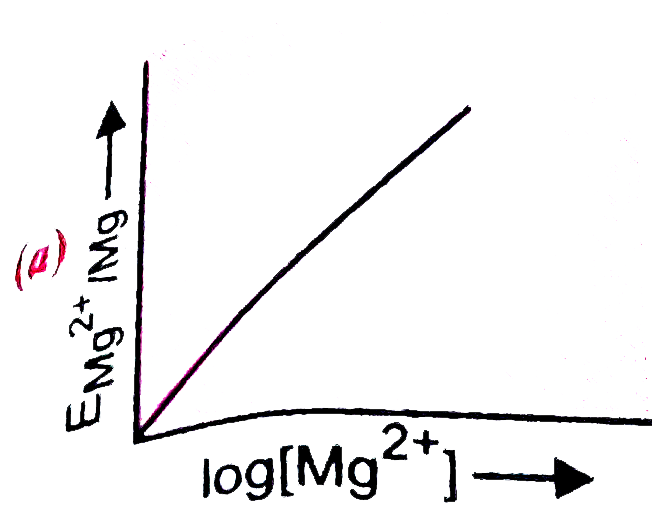
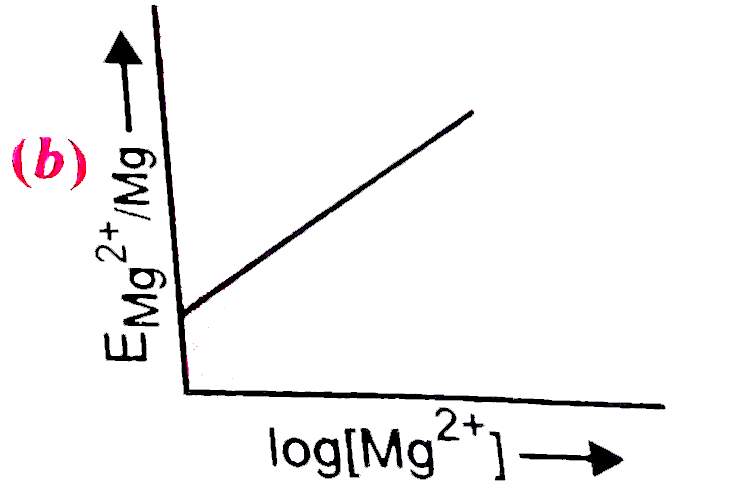
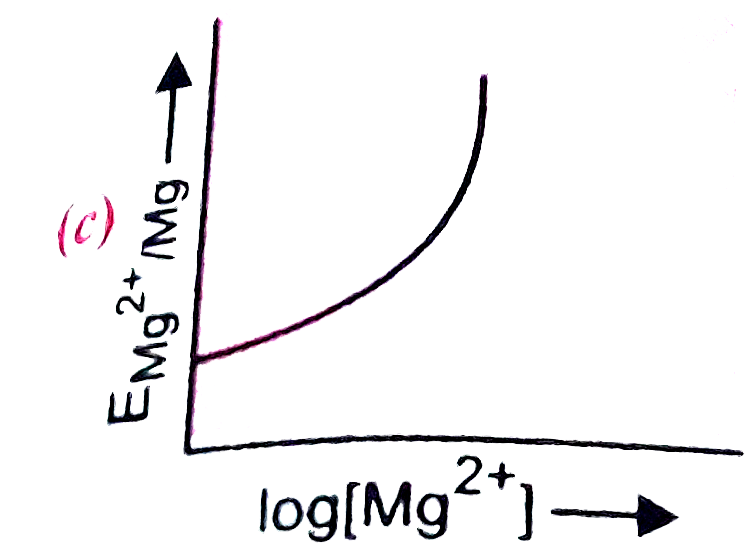
|
| 11. |
Electrolysis method is used for the extraction of |
|
Answer» Cu |
|
| 12. |
Electrolysis is the process in which electrical energy is converted to chemical energy. In electrolyte cell, oxidation takes place at anode and reduction at cathode. Electrode process depends on the electrode taken for electrolysis. Amount of substance liberated at an electrode is directly proportionation to the amount of charge passed through it. The mass of substance liberated at electrode is calculate using the following realation : m=(itE)/(96500) Here, E represent the equivalent mass and 96500 C is called the faraday constant. Faraday (96500 C) is the charge of 1 mole electron i.e., 6.023 xx 10^(23) electrons, it is used to liberate ongram equivalent of the substance. Calculate the volume of gas liberated at the anode at STP during the electrolysis of a CuSO_4 solution by a current of 1 A passed for 16 minutes and 5 seconds. |
|
Answer» `224 mL ` ` 1 xx 16 xx 60 CaCl to NO_2 = ?` ` n_(O_2) = (1 xx 16 xx 60 xx (1)/(4))/(96500) , V_(O_2) + n_(O_2) xx 22400 = 55. 709 = ~= 56 ml` |
|
| 13. |
Electrolysis is used commercially to isolate which metas(s): (P)(Q) Fe |
|
Answer» <P>P only |
|
| 14. |
Electrolysis is used in : |
|
Answer» ELECTROPLATING |
|
| 15. |
Electrolysis is the process in which electrical energy is converted to chemical energy. In electrolyte cell, oxidation takes place at anode and reduction at cathode. Electrode process depends on the electrode taken for electrolysis. Amount of substance liberated at an electrode is directly proportionation to the amount of charge passed through it. The mass of substance liberated at electrode is calculate using the following realation : m=(itE)/(96500) Here, E represent the equivalent mass and 96500 C is called the faraday constant. Faraday (96500 C) is the charge of 1 mole electron i.e., 6.023 xx 10^(23) electrons, it is used to liberate ongram equivalent of the substance. The passage of current liberates H_2 at cathode and Cl_2 at anode. The solution is |
|
Answer» copper chloride in water Anode : `2Cl^(-)to Cl_2 +2e^(-)` CATHODE : `2H^(+) + 2e^(-) to H_2` |
|
| 16. |
Electrolysis is the decomposition of an electrolyte on passing current and it involves the migration of the ions of the electrolyte towards oppositely charged electrodes. Reduction occurs at cathode by the gain of electrons while oxidation at the anode by the loss of electrons. The electrical conductivity of an electrolyte increases upon dilution as well as with the increase in temperature. The nature of the products formed at the respective electrodes depends upon the nature of the electrodes as well as the nature of electrolyte whether in molten state or in aqueous solution. The mass of the substance deposited at a particular electrode is guided by the Faraday's first and second laws of electrolysis. The same quantity of electrical charge that deposited 0.583 g of Ag was passed through a solution of gold salt and 0.355 g of gold was formed. What is the oxidation state of gold in the salt ? |
|
Answer» `+1` Eq. MASS of Au `=197//n` Eq. mass of mass Au =108 `("Mass " of AG)/("Mass " of Au)=(Eq. mass of Ag)/(Eq. mass of Au)` `((0.583 g))/((0.355 g))=(108xxn)/(197)` O.S of `Au=(197)/(108)xx((0.583g))/((0.355g))=0.996` =3 or +3 |
|
| 17. |
Electrolysis is the process in which electrical energy is converted to chemical energy. In electrolyte cell, oxidation takes place at anode and reduction at cathode. Electrode process depends on the electrode taken for electrolysis. Amount of substance liberated at an electrode is directly proportionation to the amount of charge passed through it. The mass of substance liberated at electrode is calculate using the following realation : m=(itE)/(96500) Here, E represent the equivalent mass and 96500 C is called the faraday constant. Faraday (96500 C) is the charge of 1 mole electron i.e., 6.023 xx 10^(23) electrons, it is used to liberate ongram equivalent of the substance. The platinum electrodes were immersed in a solution of cupric sulphate (CuSO_4) and electric current is passed through the solution. After sometimes, it was observed that the colour of copper sulphate disappeared with evolution of a gas at the electrode. The colourless solution contains. |
|
Answer» PLATINUM SULPHATE |
|
| 18. |
Electrolysis is the decomposition of an electrolyte on passing current and it involves the migration of the ions of the electrolyte towards oppositely charged electrodes. Reduction occurs at cathode by the gain of electrons while oxidation at the anode by the loss of electrons. The electrical conductivity of an electrolyte increases upon dilution as well as with the increase in temperature. The nature of the products formed at the respective electrodes depends upon the nature of the electrodes as well as the nature of electrolyte whether in molten state or in aqueous solution. The mass of the substance deposited at a particular electrode is guided by the Faraday's first and second laws of electrolysis. An ion is reduced to an element when it absorbs 6xx10^(20) electrons. The number of equivalents of ion is : |
|
Answer» 0.1 `6.0xx10^(20)` electrons will reduce `=((1 G " equiv"))/((6.0xx10^(23)))XX(6.0xx10^(20))` =0.001 g equiv |
|
| 19. |
Electrolysis is the decomposition of an electrolyte on passing current and it involves the migration of the ions of the electrolyte towards oppositely charged electrodes. Reduction occurs at cathode by the gain of electrons while oxidation at the anode by the loss of electrons. The electrical conductivity of an electrolyte increases upon dilution as well as with the increase in temperature. The nature of the products formed at the respective electrodes depends upon the nature of the electrodes as well as the nature of electrolyte whether in molten state or in aqueous solution. The mass of the substance deposited at a particular electrode is guided by the Faraday's first and second laws of electrolysis. In and electrolytic cell, one litre of 1 M aqueous solution of MnO_(4) is reduced at the cathode. The quantity of electricity required, so that the final solution is 0.1 MnO_(4)^(2), will be : |
|
Answer» 0.1 F 1 MOLE of `MnO_(4)^(2-)` can be obtained by passing charge =1F 0.1 mole of `MnO_(4)^(2-)` can be obtained by passing charge =0.1 F. |
|
| 20. |
Electrolysis is the decomposition of an electrolyte on passing current and it involves the migration of the ions of the electrolyte towards oppositely charged electrodes. Reduction occurs at cathode by the gain of electrons while oxidation at the anode by the loss of electrons. The electrical conductivity of an electrolyte increases upon dilution as well as with the increase in temperature. The nature of the products formed at the respective electrodes depends upon the nature of the electrodes as well as the nature of electrolyte whether in molten state or in aqueous solution. The mass of the substance deposited at a particular electrode is guided by the Faraday's first and second laws of electrolysis. A current of 12 amperes is passed through an electrolytic cell contianing aqueous NiSO_(4) solution. Both Ni and H_(2) are formed at cathode. The current efficiency is 60%. What is the mass of nickel deposited on the cathode per hour ? (Atomic mass of Ni=58.7). |
|
Answer» Solution :(a) Quantity of charge (Q) passed `=(12 amp)xx(60xx60 s)=43200" C"` `Ni^(2+)(AQ) +underset(2F)2e^(-) to underset(58.7 g)(Ni(s))` `2xx96500" C"` of charge deposit Ni =58.7 g 43200 C of charge deposit Ni `=((58.7 g))/((2xx96500 C))xx(43200C)=13.139 g` Mass of Ni actually DEPOSITED `=((13.139 g)xx60)/(100)=7.883" g"`. |
|
| 21. |
Electrolysis is an important technique for extraction of metals and each low of the solution needs a minimum voltage to get discharged and this value is expressed in terms of discharge potential. For some metal ions the discharge potentials follow the order give below : Li^(+) gt K^(+) gt Ca^(2+) gt Na^(+) gt Mg^(2+) gt Al^(3+) gt Zn^(2+) gt Fe^(2+) gt Ni^(2+) gt H_(3)O^(+) gt Cu^(2+) gt Hg_(2)^(2+) gt Ag^(+) gt Au^(3+) For some anions the discharge potentials are in the order: SO_(4)^(2-) gt NO_(3)^(-) gt OH^(-) gt Br^(-) gt I^(-) A mixture containing chlorides of sodium, calcium and zinc is electrolysed in presence of water The product obtained at cathode will be |
|
Answer» NaCl `:. H_(2)` gas is obtained at cathode. Cathode reaction is `2H_(2)O+2e^(-) to H_(2)+2OH^(-)` |
|
| 22. |
Electrolysis is an important technique for extraction of metals and each low of the solution needs a minimum voltage to get discharged and this value is expressed in terms of discharge potential. For some metal ions the discharge potentials follow the order give below : Li^(+) gt K^(+) gt Ca^(2+) gt Na^(+) gt Mg^(2+) gt Al^(3+) gt Zn^(2+) gt Fe^(2+) gt Ni^(2+) gt H_(3)O^(+) gt Cu^(2+) gt Hg_(2)^(2+) gt Ag^(+) gt Au^(3+) For some anions the discharge potentials are in the order: SO_(4)^(2-) gt NO_(3)^(-) gt OH^(-) gt Br^(-) gt I^(-) When cone. H_(2)SO_(4) is electrolysed with high current density using Pl clectrodes, the product obtained at anodes |
|
Answer» `SO_(2)` At ANODE `: 2HSO_(4)^(-) to H_(2)S_(2)O_(8)+2e^(-)`: At CATHODE `:2H^(+)-2e^(-) to H_(2)` |
|
| 23. |
Electrolysis is an important technique for extraction of metals and each low of the solution needs a minimum voltage to get discharged and this value is expressed in terms of discharge potential. For some metal ions the discharge potentials follow the order give below : Li^(+) gt K^(+) gt Ca^(2+) gt Na^(+) gt Mg^(2+) gt Al^(3+) gt Zn^(2+) gt Fe^(2+) gt Ni^(2+) gt H_(3)O^(+) gt Cu^(2+) gt Hg_(2)^(2+) gt Ag^(+) gt Au^(3+) For some anions the discharge potentials are in the order: SO_(4)^(2-) gt NO_(3)^(-) gt OH^(-) gt Br^(-) gt I^(-) When aqueous NaCl is electrolysed by using Hg electrode, the product obtained at cathode is |
|
Answer» NA-Hg amalgam `2NaCl to 2Na^(+)+2Cl^(-)` At Anode `: 2Cl to Cl_(2)+2e^(-):` Ato CATHODE `Na^(+)+Hg+e^(-) to Na-Hg` Sodium amalaga. |
|
| 24. |
Electrolysis is an important technique for extraction of metals and each low of the solution needs a minimum voltage to get discharged and this value is expressed in terms of discharge potential. For some metal ions the discharge potentials follow the order give below : Li^(+) gt K^(+) gt Ca^(2+) gt Na^(+) gt Mg^(2+) gt Al^(3+) gt Zn^(2+) gt Fe^(2+) gt Ni^(2+) gt H_(3)O^(+) gt Cu^(2+) gt Hg_(2)^(2+) gt Ag^(+) gt Au^(3+) For some anions the discharge potentials are in the order: SO_(4)^(2-) gt NO_(3)^(-) gt OH^(-) gt Br^(-) gt I^(-) The product formed at anode and cathode, when dilute H2.So4 is electrolysed are |
|
Answer» `SO_(2),H_(2)` At anode `2H_(2)O to O_(2)+4H^(+)+4e^(-), "At Cathode" , 2H^(+)+2e^(-) to H_(2)` |
|
| 25. |
Electrolysis is an important technique for extraction of metals and each low of the solution needs a minimum voltage to get discharged and this value is expressed in terms of discharge potential. For some metal ions the discharge potentials follow the order give below : Li^(+) gt K^(+) gt Ca^(2+) gt Na^(+) gt Mg^(2+) gt Al^(3+) gt Zn^(2+) gt Fe^(2+) gt Ni^(2+) gt H_(3)O^(+) gt Cu^(2+) gt Hg_(2)^(2+) gt Ag^(+) gt Au^(3+) For some anions the discharge potentials are in the order: SO_(4)^(2-) gt NO_(3)^(-) gt OH^(-) gt Br^(-) gt I^(-) When aqueous solution of cuprous bromide is electrolysed the product obtained a cathode will be |
|
Answer» CU |
|
| 26. |
Electrolysis is a phenomenon where a reaction is carried out by passing electricity through the molten electrolyte or the electrolytic solution in water. In electrolysis, electrolyte first decomposes into anions and cations and thereafter anions undergo oxidationat anode and cations undergo reduction at cathode. for example. XY (molten ) hArrX^(n+)+Y^(n-) Oxidation at anode : Y^(n-)-"ne"^(-)rarrY Reduction at cathode X^(n+)+ "ne"^(-)rarrX In order to predict the electrolytic products accurately an array of substances is arranged in decreasing order tendency of oxidation of the substances or increasing order of standard reducton potential in electrochemical series. the standard electrode potentials of some species (elements,or ions) is given as under. Cl_(2)(g)+2e^(-)rarr2Cl^(-),E^(@)=1.360V Na^(+)+e^(-)rarrNa,E^(@)=-2.71V 2H_(2)O+e^(-)rarrH_(2)(g)+2OH^(-),E^(@)=-0.83V 2H^(+)+2e^(-) rarrH_(2),E^(@)=OV When aqueous solution of 100mL of 1M NaCl is electrolysed using Pt electrodes then answer the following question. What will b e the total volume of the gases obtained at STP when 0.1F charge is passed |
|
Answer» 3.24 litres |
|
| 27. |
Electrolysis is a process in which the cations and anions of the electrolyte are |
|
Answer» |
|
| 28. |
Electrolysis is a phenomenon where a reaction is carried out by passing electricity through the molten electrolyte or the electrolytic solution in water. In electrolysis, electrolyte first decomposes into anions and cations and thereafter anions undergo oxidationat anode and cations undergo reduction at cathode. for example. XY (molten ) hArrX^(n+)+Y^(n-) Oxidation at anode : Y^(n-)-"ne"^(-)rarrY Reduction at cathode X^(n+)+" ne"^(-)rarrX In order to predict the electrolytic products accurately an array of substances is arranged in decreasing order tendency of oxidation of the substances or increasing order of standard reducton potential in electrochemical series. the standard electrode potentials of some species (elements,or ions) is given as under. Cl_(2)(g)+2e^(-)rarr2Cl^(-),E^(@)=1.360V Na^(+)+e^(-)rarrNa,E^(@)=-2.71V 2H_(2)O+e^(-)rarrH_(2)(g)+2OH^(-),E^(@)=-0.83V 2H^(+)+2e^(-) rarrH_(2),E^(@)=OV When aqueous solution of 100mL of 1M NaCl is electrolysed using Pt electrodes then answer the following question. What will be the electrolytic products of 100 mL 1M aq. solution? |
|
Answer» `H_(2)` |
|
| 29. |
Electrolysis is a phenomenon where a reaction is carried out by passing electricity through the molten electrolyte or the electrolytic solution in water. In electrolysis, electrolyte first decomposes into anions and cations and thereafter anions undergo oxidationat anode and cations undergo reduction at cathode. for example. XY (molten ) hArrX^(n+)+Y^(n-) Oxidation at anode : Y^(n-)-"ne"^(-)rarrY Reduction at cathode X^(n+)+ "ne"^(-)rarrX In order to predict the electrolytic products accurately an array of substances is arranged in decreasing order tendency of oxidation of the substances or increasing order of standard reducton potential in electrochemical series. the standard electrode potentials of some species (elements,or ions) is given as under. Cl_(2)(g)+2e^(-)rarr2Cl^(-),E^(@)=1.360V Na^(+)+e^(-)rarrNa,E^(@)=-2.71V 2H_(2)O+e^(-)rarrH_(2)(g)+2OH^(-),E^(@)=-0.83V 2H^(+)+2e^(-) rarrH_(2),E^(@)=OV When aqueous solution of 100mL of 1M NaCl is electrolysed using Pt electrodes then answer the following question. What will b e the pH of the resulting solution upon passage of 0.2F charge |
|
Answer» 13 |
|
| 30. |
Electrolysis involves electronation and deelectronation at the respective electrodes. Anode of electrolytic cell is the electrode at which deelectronation takes place whereas at cathode electronation is noticed. If two or more ions of same charge are to be electronated or de-electronated, the ion having lesser discharge potential is discharged. Discharge potential of an ion refers forE_(OP)^0 or E_(RP)^0 as the case may be. The products formed at either electrode is given in terms of Faraday's laws of electrolyis i.e W=(Eit)/(96500) |
|
Answer» During ELECTOLYSIS of `CuSO_(4(AQ))` the pH ofsolution BECOMES. `Lambda_(AgCl)^0`= `kxx1000/S`, `:. S`=`(kxx1000)/Lambda_(AgCl)^0` = `(1.8xx10^-6xx1000)/137.2` = `1.31xx10^-5` M |
|
| 31. |
Electrolysis involves electronation and deelectronation at the respective electrodes. Anode of electrolytic cell is the electrode at which deelectronation takes place whereas at cathode electronation is noticed. If two or more ions of same charge are to be electronated or de-electronated, the ion having lesser discharge potential is discharged. Discharge potential of an ion refers forE_(OP)^0 or E_(RP)^0 as the case may be. The products formed at either electrode is given in terms of Faraday's laws of electrolyis i.e W=(Eit)/(96500) During electrolysis of HCOONa_((aq)) , the gas librated at anode and cathode are respectively. |
|
Answer» `H_2,CO_2` and `O_2` `Lambda_v` = Sp. Conductivity `xx` dilution =0.0092 `xx` 10,000=108`ohm^-1` `Lambda_oo`= `lambda_(Na^+)+ lambda_(Cl^-)`= 43.0 +65.0 = 108`ohm^-1` Degree of dissociation, `alpha`= `Lambda_v/Lambda_oo` =92/108= 0.85 |
|
| 32. |
Electrolysis involves electronation and de-electronation at the respective electodes. Anode electrolytic cell is the electode at which de-electronation takes place whereas at cathod electronation is noticed. If two or more ions of same charge are to be electonated or deelectronate the ion having lasser discharge potential is discharged. Discharge potential of anion refers forEP_(OP)^(@)of E_("RP")^(@) as the case may be. The products formed at either electode is given in terms Faraday's laws of electrolusis i.e. w=(Eit)/(96500) During electrolysis of CH_3COONa_((aq)), the mole ratio of gases formed at cathode and anode is |
|
Answer» CATHODE : `2H^(+) + 2e^(-) to ul(H_(2))` Anode :`2CH_3COO^(-) ul(C_2H_6) + ul(2CO_2) +2e^- , 1 : 3 ` |
|
| 33. |
Electrolysis involves electronation and de-electronation at the respective electodes. Anode electrolytic cell is the electode at which de-electronation takes place whereas at cathod electronation is noticed. If two or more ions of same charge are to be electonated or deelectronate the ion having lasser discharge potential is discharged. Discharge potential of anion refers forEP_(OP)^(@)of E_("RP")^(@) as the case may be. The products formed at either electode is given in terms Faraday's laws of electrolusis i.e. w=(Eit)/(96500) During electrolysis of CuSO_(4(aq)) , the pH of solution becomes |
|
Answer» `lt 7` Anode : `2H_2O to O_2 + 4E^(-) + 4H^(+)` Cathode : `Cu^(+2) + 2e^(-) to Cu` ` P^(H) + log""(1)/([H^(+)]) , P^(H) lt 7` . |
|
| 34. |
Electrokinetic potential is the potential difference between |
|
Answer» the FIXED layer and DIFFUSED layer. |
|
| 36. |
Electrode potentials of the given half-cells : Pt(H_(2),p_(1))|H^(+) [C_(1)],Pt(Cl_(2),p_(2))|Cl^(-)[C_(2)],Ag(s) |Ag^(+)[C_(3)] |
|
Answer» will INCREASE on in creasing `C_(1), C_(2)& C_(3)` |
|
| 37. |
Electrode potentials of the given half cells, Pt(H_(2))|H^(+)(C_(1)),Pt(Cl_(2))|Cl^(-)(C_(2)),Ag|Ag^(+)(C_(3)) |
|
Answer» Will increase on increasing `C_(1),C_(2) and C_(3)` |
|
| 38. |
Electrode potentials ofCu^(2+)//Cu andAg^(+)//Ag electrodes are + 0.33V and +0.8V respectively. What is the EMF of the cell constructed from these electrodes. |
|
Answer» |
|
| 39. |
Electrode potentials of five elements A,B,C,D and E are respectively -1.36,, -0.32,0,-1.26 and -0.42. The reactivity order of these elements are in the order of |
|
Answer» A,D,E,B and C |
|
| 40. |
Electrode potential of Zn^(2+)//Zn is -0.76V and that of Cu^(2+)//Cu is +0.34V. The EMF of the cell constructued between these two electrodes is |
|
Answer» 1.10V |
|
| 41. |
Electrodepotentialof M^(2+) // M forNi isabnormalbecauseof _______ |
|
Answer» HIGH `IE_(1) + E_(2)` |
|
| 42. |
Electrode potential is, Cu_((aq))^(2+)+e^(-) to Cu_((aq))^(+),E^(@)=+0.15V Cu_((aq))^(+)+e^(-) to Cu_((S)),E^(@)=+0.50V then what is the value of E_(Cu^(2+)|Cu)^(@) ? |
|
Answer» 0.550V |
|
| 43. |
Electrode potential of hydrogen electrode is 18 m V then [H^(+)] is - |
|
Answer» `0.2` AlC to Nernst equation `E_(H^(+) | H_(2)) = E_(H^(+) | H_(2))^(@) - (0.0592)/(n) "log" (1)/([H^(+)])` `18 xx 10^(-3) V = 0 + (0.0592)/(1) "log" [H^(+)]` `therefore log [H^(+)] = (18 xx 10^(-3) V)/(0.0592) = 0 . 3046` `[H^(+)] = AL (0.3046) = 2.02 = 2` |
|
| 44. |
Electrode potential of any electrode depends are: |
|
Answer» NATURE of the metal |
|
| 45. |
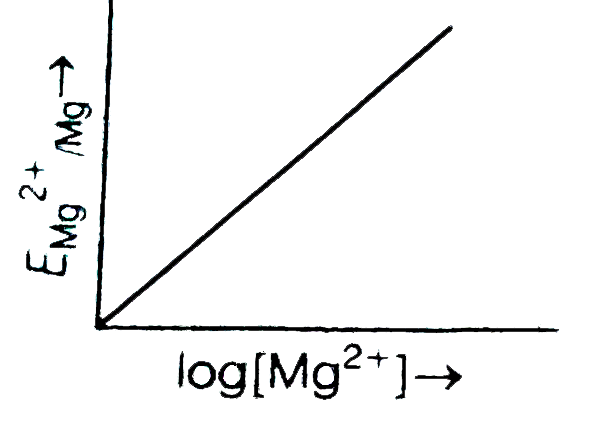
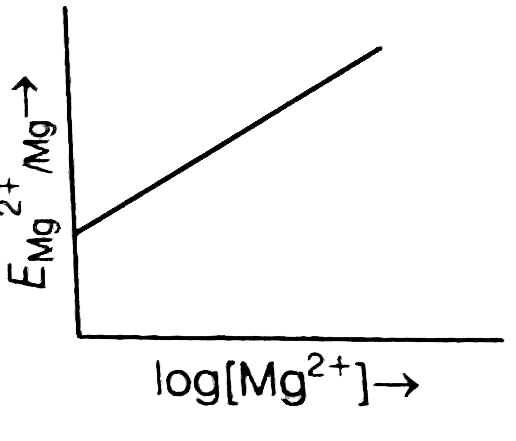
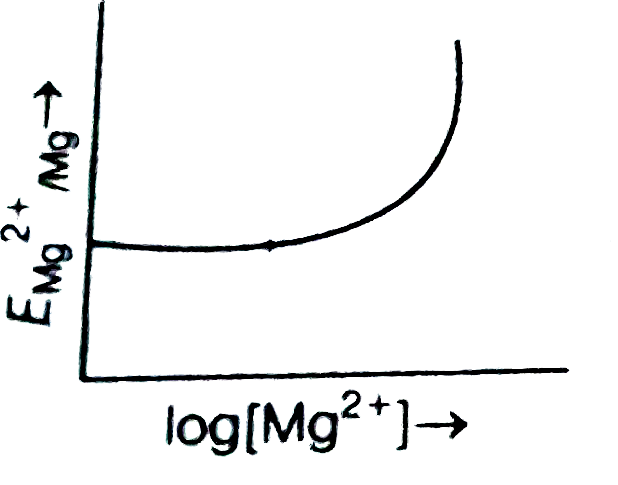
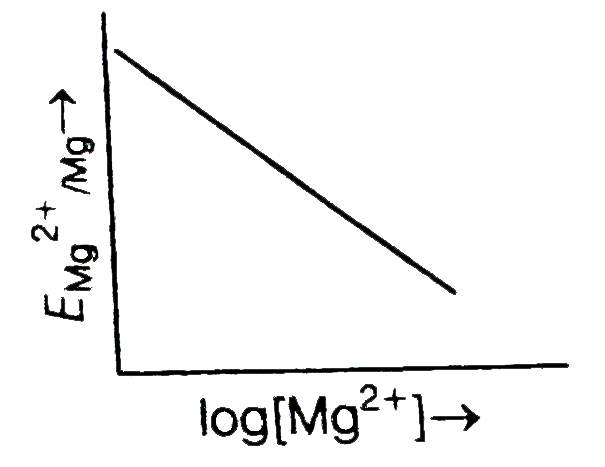
Electrode potential for Mgelectrode varies accordingto the euation E_(mg^(2+)//Mg)=E_(Mg^(2+)//Mg)-(0.059)/(2) log (1)/[(Mg^(2+))] the graphof E_(Mg^(2+)//Mg) "vs" log [Mg^(2+)]is |
|
Answer»
|
|
| 46. |
Electrode potential for Mg electrode varies according to the equation E_(Mg^(2+)//Mg)=E_(Mg^(2+)|Mg)^(Theta)-(0.059)/(2)"log"(1)/([Mg^(2+)]) The graph of E_(Mg^(2+)|Mg) vs log [Mg^(2+)] is |
|
Answer»
|
|
| 47. |
Electrode potential for Mg electrode varies according to the equation : E_(Mg^(2+)|Mg)=E_(Mg^(2+)|Mg)^(Theta)-(0.59)/(2)"log"(1)/([Mg^(2+)]) The graph of E_(Mg^(2+)|Mg) to log[Mg^(2+)] is |
|
Answer»
|
|
| 48. |
Electrode potential data are used for predicting fessibility of any process. These are particularly useful in deciding products obtained on electrolysis and also on suitability of any substance for quantitative estimation. Some of the electrode potentials are given below: On adding KMnO_(4) solution to an aqueous solution of ferrous oxalate in presence of HCl, it is observed that 0.1 "mole" of Cl_(2)(g) and 0.2 "mole"s of CO_(2)(g) was obtained. What must be the amount of KMnO_(4) compound taken? |
|
Answer» 0.1"MOLE"s |
|
| 49. |
Electrochemical series is series of elements arranged in increasing order of their reduction potential. E_(H^(+)|H_(2))=0. The metals abvoe H_(2) have reductioni potential, they are more reactive than hydrogen whereas metals below hydrogen are less reactive than H_(2). Reduction potentials of metal depends upon (i) sublimation energy (ii) ionization energy and hydration energy of ions. Which of the following cannot displace H_(2) from dil acid? |
|
Answer» Pt |
|
| 50. |
Electrochemical series is series of elements arranged in increasing order of their reduction potential. E_(H^(+)|H_(2))=0. The metals abvoe H_(2) have reductioni potential, they are more reactive than hydrogen whereas metals below hydrogen are less reactive than H_(2). Reduction potentials of metal depends upon (i) sublimation energy (ii) ionization energy and hydration energy of ions. Which of the following is weakest reducing agent among alkali metals? |
|
Answer» Na |
|