

Saved Bookmarks
This section includes 7 InterviewSolutions, each offering curated multiple-choice questions to sharpen your Current Affairs knowledge and support exam preparation. Choose a topic below to get started.
| 1. |
During roasting of zinc, zinc blende , it convets to : |
|
Answer» `ZNO` |
|
| 2. |
During roasting of copperr pyrites the major reaction observed is ___________. |
|
Answer» `2FES + 3O_(2) to 2FeO + 2SO_(2)` |
|
| 3. |
During refining of liquid iron to steel , CaO plays various roles, out there which of the following is most important |
|
Answer» To MAKE a slag with `SiO_2` FORMED |
|
| 4. |
Draw the structure of BrO_(4)^(-) |
Answer» SOLUTION :
|
|
| 5. |
During respiration , food is oxidised to carbon dioxide in the presence of oxygen . This process is called : |
|
Answer» Aerobic |
|
| 6. |
During reduction of CuO, impurity of FeO can be removed by adding _________ |
|
Answer» an acidic FLUX , `SiO_(2)` |
|
| 7. |
Draw the structure of BrF_(3). |
Answer» SOLUTION :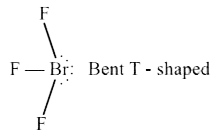
|
|
| 8. |
Draw the structure of BrF_(5). |
Answer» Solution :The electronic configuration of Br (Z = 35) is `1s^(2) 2s^(2) 2p^(6) 3s^(2) 3p^(6) 3d^(10) 4S^(2) 4p_(x)^(2) 4p_(y)^(2)4p_(z)^(1)`. It has only one half-filled orbital. But to form five Br-F bonds, we need five half-filled ORBITALS. To achieve this, one electron each of `4p_(x) and 4p_(y)` gets excited to 4d-orbitals. The resulting six orbitals of the fourth shell of Br in the 2ND  excited state undergo `SP^(3)d^(2)`-hydridization. As a result, `BeF_(5)` has octahedral (or square pyramidal) geometry with one position occupied by a lone pair. 
|
|
| 9. |
During reduction of aldehydes with hydrazine and potassium hydroxide, the first is the formation of |
|
Answer» `R-CH=N-NH_2` |
|
| 10. |
During reduction of aldehydes with hydrazine and potassium hydroxide, the first is formation of |
|
Answer» `R-C-=N` |
|
| 11. |
Draw the structure of BrF_(3) molecule. |
Answer» SOLUTION :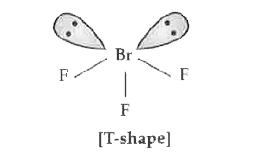
|
|
| 12. |
During reduction of aldehydes with hydrazine and C_(2)H_(5)ONa the product formed is |
|
Answer» `R-CN=N-NH_(2)` |
|
| 13. |
During reduction of aldehyde with hydrazine andKOH , thefirst is the formation of |
|
Answer» `R - CH = NH` |
|
| 14. |
Draw the structure of boric acid. |
Answer» Solution :Boric acid has a two dimensional LAYERED structure. It consists of `[BO_(3)]^(3-)` UNIT and these are linked to each other by HYDROGEN bonds. 
|
|
| 15. |
During reaction of benzene with neopentyl chloride in the presence of AICI_(3) the major product is 2- methyl-2-phenylbutane and not neopentylbenzene. Explain? |
Answer» SOLUTION :The initially formed primary carbocation rearranges by methyl migration to form a more stable tertiary carbocation which ACTS as a electrophile and attack the benzene to GIVE the MAJOR product. 
|
|
| 16. |
During recharging of car-battery, the battery acts as |
|
Answer» Electrolytic cell |
|
| 17. |
Draw the structure of beta-D-ribose and beta-D-2-deoxyribose. |
Answer» SOLUTION :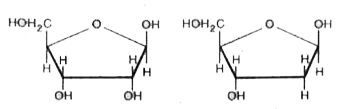
|
|
| 18. |
During reduction of aldehyde with(H_2N-NH_2)/(OH // "glycol") the first interinediate compound formed as |
| Answer» Answer :D | |
| 19. |
During purification of colloidal sol by ultracentrifugation which of the following is . Observed ? |
|
Answer» COLLODIAL particles are settled at THEBOTTOM of ultracentrifuge tube |
|
| 20. |
Draw the structure of borazole. B_(3)N_(3)H_(6). |
Answer» SOLUTION :
|
|
| 21. |
During preparation of phenol from cumene, side product obtained is |
|
Answer» acetone |
|
| 22. |
Draw the structure of ampicillin. |
Answer» SOLUTION :
|
|
| 23. |
Draw the structure of an aromatic compound having molecular formula C_(12) O_(9) . |
Answer» SOLUTION :
|
|
| 24. |
Draw the structure of all isomeric alcohols of molecular formula C_(4)H_(10)O and give their IUPAC names. |
| Answer» Solution :`{:("Imomers","IUPAC name"),((i)CH_(3)-CH_(2)-CH_(2)-CH_(2)-OH,"Butan-1-ol"),((ii)CH_(3)-UNDERSET(CH_(3))underset("|")(CH_(2))-CH_(2)-OH,"2-Methylpropan-1-ol"),((iii) CH_(3)-underset(OH)underset("|")"CH"-CH_(2)-CH_(3),"Butan-2-ol"),((iv) CH_(3)-OVERSET(CH_(3))overset("|")underset(OH)underset("|")"C "-CH_(3),"2-Methylpropan-2-ol"):}` | |
| 25. |
During prepartion of wrought iron, CO and SO_(2) formed escape whereas ________ to form slag. |
|
Answer» MnO and `SiO_(2)` COMBINE |
|
| 26. |
Draw the structure of alpha -D fructose furanose and beta -D fructose furanose. |
Answer» SOLUTION :
|
|
| 27. |
During preparation of arenediazonium salts the excess of nitrous acid, if any, is removed by adding |
|
Answer» AQUEOUS `Na_2CO_3` |
|
| 28. |
Draw the structure of (a) N_(2)O_(4) (b) N_(2)O_(5). |
|
Answer» Solution :(a) `N_(2)O_(4)` (Nitrogen tetraoxide) `OVERSET(":"overset(..)O":")overset(|)underset(underset(..)O)underset(||)N-underset(underset(..)(":"O":"))underset(|)overset(":"O":")overset(||)N` (B) `N_(2)O_(5)` `underset(underset(..)(":"O":"))underset(|)overset(":"O":")overset(||)N-overset(..)underset(..)O-underset(underset(..)(":"O":"))underset(|)overset(":"O":")overset(||)N` |
|
| 29. |
During photochemical halogenation of alkanes the halogen molecule first gives: |
|
Answer» CHLORIDE ION |
|
| 30. |
Draw the structure of (a) white phosphorous (b) red phosphorous |
Answer» Solution :(a) White PHOSPHOROUS (B)Red PHOSPHORUS 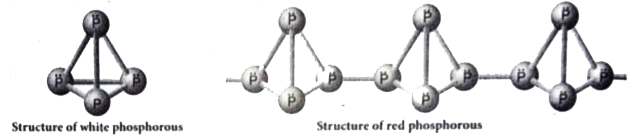
|
|
| 31. |
Draw the structure of (a) white phosphorous (b) red phsphorous |
Answer» SOLUTION :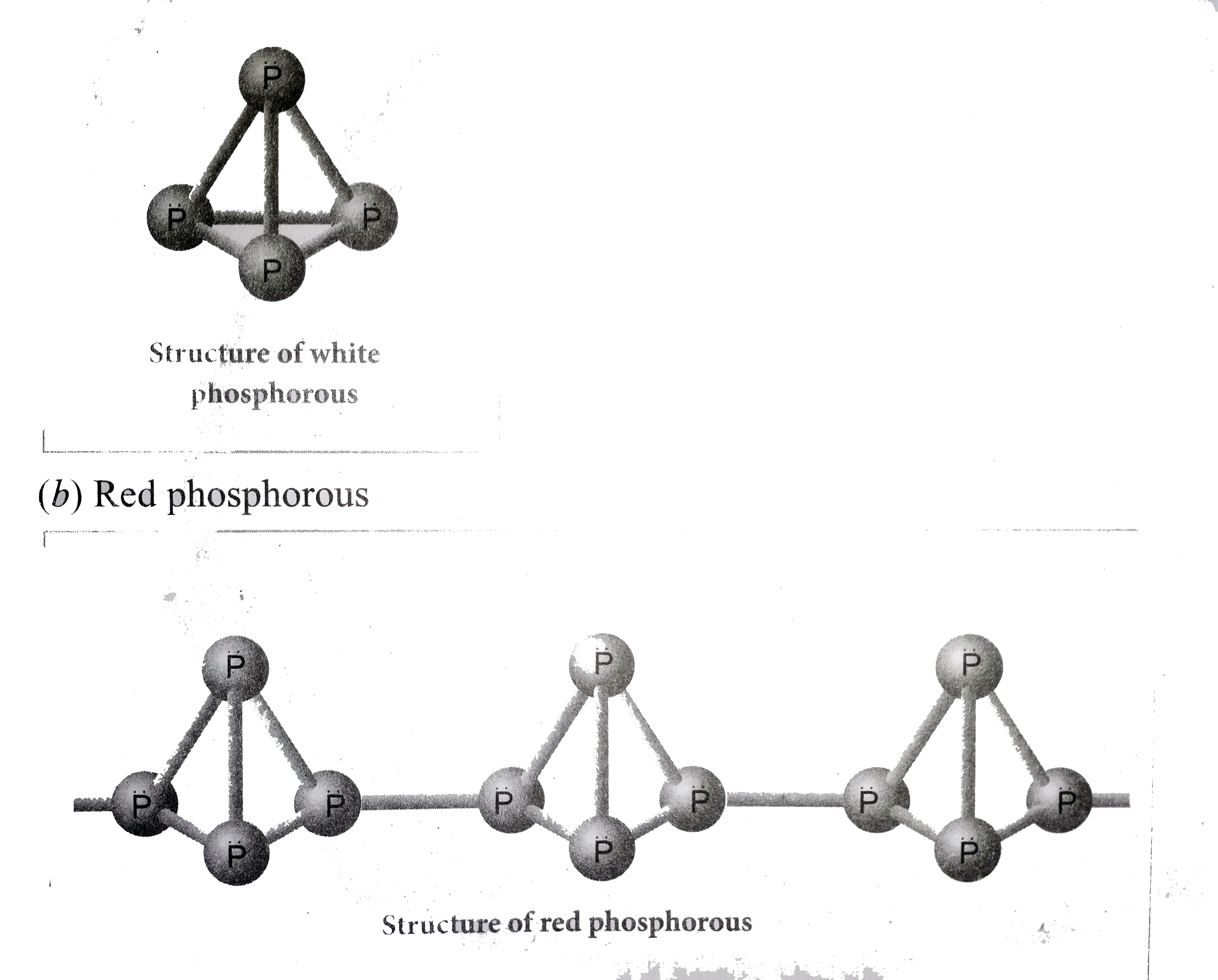
|
|
| 32. |
During oxidation of oxalic acid by acidified KMnO_4 how many unpaired electrons are present in the autocatalyst ? |
|
Answer» `Mn^(+2) = 3d^5 "" n = 5`. |
|
| 33. |
Draw the structure of (a) Pyrosulphuric acid (b) Peroromonosulphuric acid? |
|
Answer» SOLUTION :(a) Pyrosulphuric acid `H_(2)S_(2)O_(7)` `HO-OVERSET(O)overset(||)underset(O)underset(||)S-O-overset(O)overset(||)underset(O)underset(||)S-OH` (B) Peroromonosulphuric acid `H_(2)SO_(5)` `HO-overset(O)overset(||)underset(O)underset(||)S-O-OH` |
|
| 34. |
During osmosis, net flow of water through a semipermeable membrane is |
|
Answer» from both SIDES of semipermeable membrane with UNEQUAL flow rates |
|
| 35. |
Draw the structure of (a) Hyponitrous acid (b) Hydronitrous acid. |
|
Answer» SOLUTION :(a) Hyponitrous ACID : `H_(2)N_(2)O_(2)` `HO-N=H-OH` (b) Hydronitrous acid : 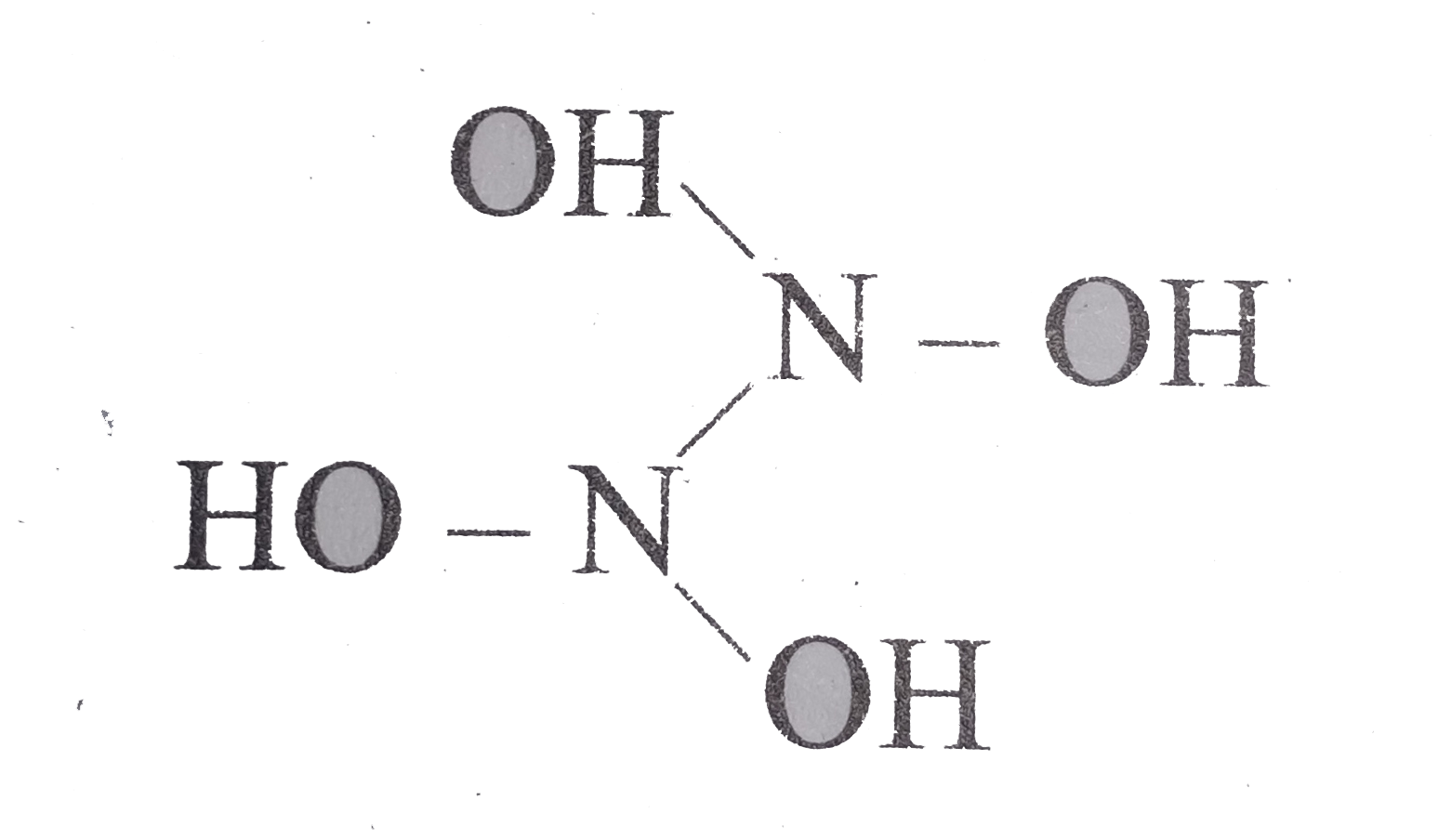
|
|
| 36. |
During osmosis, flow of water through a semipermable membrane is : |
|
Answer» FORM both sides of the SEMIPERMEABLE with equal flow rates. |
|
| 37. |
Draw the structure of (a) N_(2)O (b) N_(2)O_(3). |
|
Answer» SOLUTION :(a) `N_(2)O` (Nitrous oxide) `:N-=overset(o+)N-overset(Theta)overset(..)UNDERSET(..)O:harroverset(Theta)overset(..)underset(*..)N=overset(o+)N=overset(..)underset(..)O` (b) `N_(2)O_(3)` (Nitrogen sesquoxide) `{:("O"O^(Theta)"OO"),("|||||||"),(N-N^(o+)harrN-N_(o+)),("|||"),("O"""O^(Theta)):}` |
|
| 38. |
During nucleophilic addition reaction, the hybridisation of carbon changes from ..... |
|
Answer» `SP^2` to `sp^3` |
|
| 39. |
Draw the structure of (a) Marshall's acid (b) Polythionic acid (c ) Dithionic acid |
Answer» SOLUTION :
|
|
| 40. |
Duringnuclearexplosion , one of the productsis ""^(90)Sr withhalf-lifeof 28.1 years. If 1 mu gof ""^(90)Sr was absorebedin the bones of a newly born baby instead of calcium ,how much of it will remain after 10 years and ""^(14)C foundin a livingtree. Estimatethe ageof the sample. |
|
Answer» |
|
| 41. |
Draw the structure of a carbonyl group and indicate : the sigma and pi bonds. |
Answer» SOLUTION :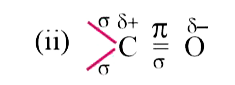 . .
|
|
| 42. |
Draw the structure of a carbonyl group and indicate : the electrophilic and nucleophilic centres |
Answer» SOLUTION :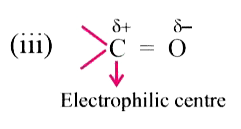 . .
|
|
| 43. |
During osmosis, flow of water through a semi permeable membrane is |
|
Answer» from both sides of semi PERMEABLE MEMBRANE with EQUAL flow rates |
|
| 44. |
Draw the structure of a carbonyl group and indicate : hybridized state of carbon . |
Answer» SOLUTION : . .
|
|
| 45. |
During nuclear explosion, one of the products is ""^(90)Sr with half-life of 28.1 years. If 1 mugof ""^(90)Srwas absorbed in the bones of a newly born baby instead of calcium, how much of it will remain after 10 years and 60 years if it is not lost metabolically? |
|
Answer» SOLUTION :Radioactive decay follow first order kinetics, Decay constant of `""^(90)Sr(k)=(0.693)/(t_(1//2))=(0.693)/(28.1" years")=2.466xx10^(-2)"years"^(-1)` Amount LEFT after 10 years. `a=1 mug, t=10" years", k=2.446 xx 10^(-2)"years"^(-1)` Substituting the values in the first order equation `k=(2.303)/(t)"log"(a)/(a-x) or 2.466 xx 10^(-2)=(2.303)/(10)"log"(1)/((a-x))` or `log(a-x)= -0.1071` or `(a-x)="Antilog " bar1.8929=0.7814 mu G`. Amount left after 60 years `2.466 xx 10^(-2)=(2.303)/(60)"log"(1)/(a-x) or log(a-x)= -0.6425` or `(a-x)="Antilog "bar1.3575=0.2278 mu g`. |
|
| 46. |
Draw the structure of a carbonyl group and indicate clearly (i) the hybridised state of carbon, (ii) the sigma and pi it bonds present and (iii) the electrophilic and nucleophilic centres in it. |
Answer» SOLUTION : (i) The hybridised state of .C. is `SP^(2)`, (II)  (iii) 
|
|
| 47. |
During nuclear explosion, one of the products is ""^(90)"Sr" with half life of 28.1 years. If 1 mug of ""^(90)"Sr" was absorbed in bones of a newly born baby instead of calcium, how much of it will remain after 10 years and 60 years if it is not lost metabolically ? |
|
Answer» Solution :As radioactive disintegrations follow first order kinetics, Decay CONSTANT of `""^(90)"Sr "(k)=(0.693)/(t_(1//2))=(0.693)/(28.1" y")=2.466xx10^(-2)y^(-1)` To CALCULATE the amount left after 10 years. `a=1 mug,t=10" years,"k=2.466xx10^(-2)y^(-1),(a-x)=?` `k=(2.303)/(t)log""(a)/(a-x)` `2.466xx10^(-2)=(2.303)/(10)log""(1)/((a-x))" or "log(a-x)=-0.1071` or `(a-x)=" Antilog "=1.8929=0.7814 mug` To Calculate the amount left after 60 years. `2.466xx10^(-2)=(2.303)/(60)log""(1)/(a-x)" or "log(a-x)=-0.6425` or `(a-x)=" Antilog T"*3575=0.2278" "mug.` |
|
| 48. |
Draw the structure of 4- tertbutyl -3- iodoheptane . |
|
Answer» Solution :The structure of 4- tertbutyl -3- iodoheptaneis `OVERSET(1)CH_(3) - overset(2)CH_(2) - overset(I)overset(3|)CH -underset(CH_(3) - underset(CH_(3)) underset(|) overset(|) C - CH_(3))overset(4)(CH)- overset(5)CH_(2) - overset(6)CH_(2)- overset(7)CH_(3)` |
|
| 49. |
Draw the structure of 3 - methylbutanal. |
| Answer» SOLUTION :`UNDERSET("3 - Methylbutanal")(CH_(3)-overset(CH_(3))overset("|")"CH"-CH_(2)-CHO)` | |
| 50. |
During nuclear explosion one of the products is ""^(90)Sr with half-life of 28.1 years .If 1 mug of ""^(90)Sr was absorbed in the boned of a newly born baby instead of calcium ,how much of it wil reman after 10 years and 60 years if it is not lost metabolically. |
|
Answer» Solution :Nuclear explosion is a first order reaction. `1 mug ""^(90)Sr` is observed in NEW born baby. `therefore[R]_(0)=1mug` Time `t_(1)` =fter 10 years,so,`[R]_(t_(2))`=y `mug` Constant of explosion reaction =k.If the reaction is of first order. `k=(0.693)/(t_((1)/(2)))=(0.693)/(28.1 year)=2.4662xx10^(-2)years` After 10 years ,the calculation of remianing `""^(90)Sr`: `t=(2.303)/(k)` log `([R]_(0))/([R]_(t))` where ,t=10 `therefore 10=(2.303)/(2.4662xx10^(-2))(log 1 mug)/(x mug)` `therefore (1)/(x)=(10xx0.024662)/(2.303)=0.1070 ` `therefore (1)/(x)`=ANTI log 0.1070 `therefore (1)/(2)=1.2794` `therefore=0.7816 mu g ""^(90)Sr` will be remaining. Suppose `""^(90)S=y mug` after t=60 year, `t=(2.303)/(k)` log `([R]_(0))/([R]_(r))` `therefore 60=(2.303)/(0.024662)` log`(1)/(y)` `therefore (60xx0.024662)/(2.303)` =log `-log y `therefore` 0.6425=0-log y=-log y `therefore` log y=-0.6425 `therefore` y=Antilog (-0.6425) |
|