

Saved Bookmarks
This section includes 7 InterviewSolutions, each offering curated multiple-choice questions to sharpen your Current Affairs knowledge and support exam preparation. Choose a topic below to get started.
| 1. |
Differentiate between adsorption and absorption. |
Answer» Solution :DIFFERENCE between adsorption and ABSORPTION is GIVEN in the TABULAR form: 
|
|
| 2. |
Differentiate between addition and condensation polymers based on the mode of polymerisation. Give one example of each type. |
Answer» SOLUTION :
|
|
| 3. |
Differentiate between addition and condensation polymerisation with the help of a suitable example. |
Answer» SOLUTION :DIFFERENCE between ADDITION and CONDENSATION POLYMERISATION 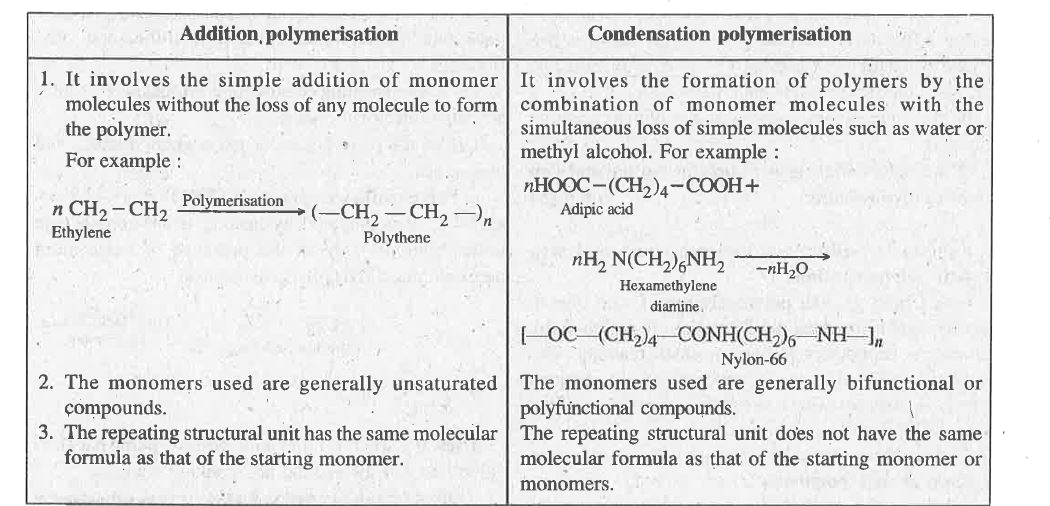
|
|
| 4. |
Differentiate between a homopolymer and a copolymer. Give one example of each |
|
Answer» Solution :HOMOPOLYMERS: Polymers which are OBTAINED from only one type of monomers are called homopolymers. For example, polythene and POLYSTYRENE. Copolymers: Polymers which are FORMED from TWO or more types of monomers are called copolymers. For example, Buna-S and Nylon 6, 6. |
|
| 5. |
Different theories have been put forward to explain the geometrical of co-ordianation compounds. Out of them , the most practical is the valence bond theory which is based upon the concept of hybridisation . According to this , the complexes with C.N.4 may be either tetrahedral (sp^(3) hybridised ) or square planar (dsp^(2) hybridised ) in nature. Similarly , in the octahedral complexes , the metal atom or ion is either paramagnetic if one or more orbitals are half-filled and diamagnetic if all are filled in nature. 5. Which is correct in the case ofcomplex ? |
|
Answer» <P>DIAMAGNETIC |
|
| 6. |
Different reagents used for the identification of different functional groups. Eg. (i)Tollens reagent used for the identification of -CHO, etc. (ii)CAN used for alcohol. {:("Column-I","Column-II","Column-III"),((I)"Benzaldehyde",(i)l_2+NaOH(aq.),(P)"Yellow crystals is formed"),((II)"Butan-1-ol",(ii)AgNO_3(aq.)+NH_4OH,(Q)"White ppt is formed"),((III)"Formic ester",(iii)anhy.ZnCl_2+conc.HCl,(R)"Silver mirror is formed"),((IV)"Acetophenone",(iv)(NH_4)_2[Ce(NO_3)_6](CAN),(S)"Wine red colouration"):} The only correct combination in which the reation does not proceed through redox mechanism ? |
|
Answer» <P>(I),(ii),(R) `C_4H_9OH+underset("CAN (a yellow solid)")((NH_4)_2[CE(NO_3)_6])to[Ce(NO_3)_5(n-C_4H_9O)]^(2-)` Wine red complex `NH_4^+` ION present as spectators and so not partcipate. |
|
| 7. |
Different reagents used for the identification of different functional groups. Eg. (i)Tollens reagent used for the identification of -CHO, etc. (ii)CAN used for alcohol. {:("Column-I","Column-II","Column-III"),((I)"Benzaldehyde",(i)l_2+NaOH(aq.),(P)"Yellow crystals is formed"),((II)"Butan-1-ol",(ii)AgNO_3(aq.)+NH_4OH,(Q)"White ppt is formed"),((III)"Formic ester",(iii)anhy.ZnCl_2+conc.HCl,(R)"Silver mirror is formed"),((IV)"Acetophenone",(iv)(NH_4)_2[Ce(NO_3)_6](CAN),(S)"Wine red colouration"):} For the formation of silver mirror the only correct combination is : |
|
Answer» (IV),(II),(R) |
|
| 8. |
Different reagents used for the identification of different functional groups. Eg. (i)Tollens reagent used for the identification of -CHO, etc. (ii)CAN used for alcohol. {:("Column-I","Column-II","Column-III"),((I)"Benzaldehyde",(i)l_2+NaOH(aq.),(P)"Yellow crystals is formed"),((II)"Butan-1-ol",(ii)AgNO_3(aq.)+NH_4OH,(Q)"White ppt is formed"),((III)"Formic ester",(iii)anhy.ZnCl_2+conc.HCl,(R)"Silver mirror is formed"),((IV)"Acetophenone",(iv)(NH_4)_2[Ce(NO_3)_6](CAN),(S)"Wine red colouration"):} For the formation of two different organic compounds the only correct combination is : |
|
Answer» (I),(ii),(R) 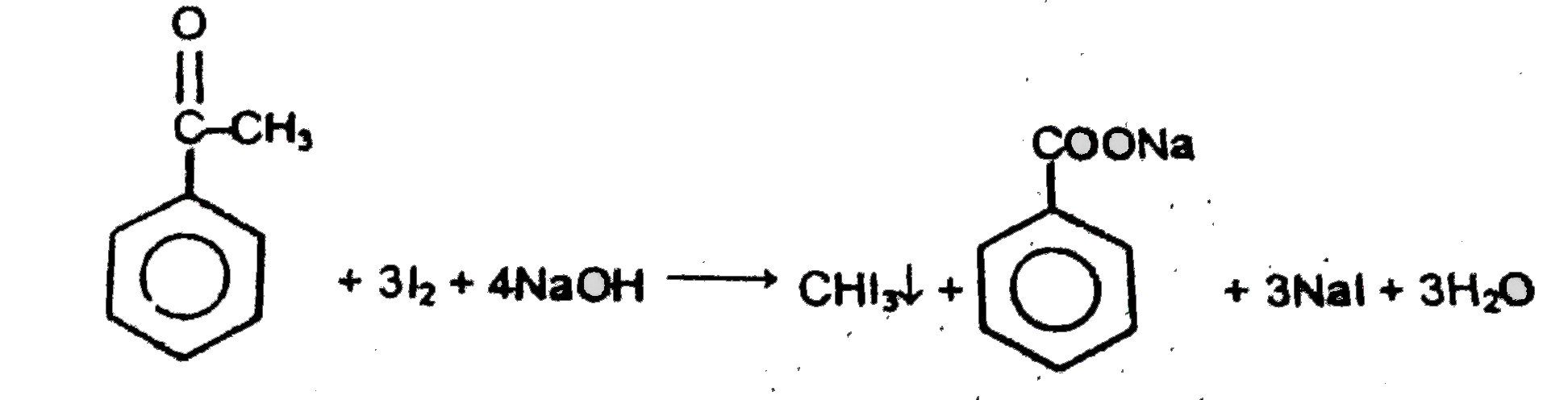
|
|
| 9. |
Different proportions of oxygen in the various oxides of nitrogen prove the law of: |
|
Answer» EQUIVALENT proportion |
|
| 10. |
Different possible thermal decomposition pathways for peroxy esters are shown below. Match each pathway from list I with an appropriate structure from list II and select the correct answer using the code given below the list. |
| Answer» SOLUTION :(P-1),(Q-3),(R-4),(S-2)`. | |
| 11. |
Different proportions of oxygen in the various oxides of nitrogen, prove the law of |
|
Answer» reciprocal PROPORTIONS |
|
| 12. |
DIfferent possible thermal decomposition pathways for peroxyesters are shown below. Match each pathway from peroxyesters are shown below. Match each phthway from column t I with an appropriate structure from Column II and select the correct answer using the code given below the lists. |
|
Answer» <P>`{:("P" , Q , R , S), ( 1 , 3, 4 , 2):}` |
|
| 13. |
Different hydrogen in overset(a)(C )H_(3)overset(b)(C )H=overset(b)(C )H-overset(C )H_(2)-overset(d)(C )H_(2)-overset(e )(C )H(overset(f)(C )H_(3))_(2) represnted by alphalbets. Arrange them in decreasing order of reactivity towards radical substitution |
|
Answer» c gt a gt e gt d gt F gt B `3^(@) gt 2^(@) gt 1^(@)` |
|
| 14. |
Different possible thermal decomposition pathwasy for peroxyesters are shown below. Match each pathway from List-I with an appropriate structure from List-II and select the correct answer using the code given below the lists |
|
Answer» <P>`{:(A,B,C,D),(p,R,s,q):}` 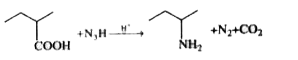
|
|
| 15. |
Different gases at the same temperature must have |
|
Answer» Same volume |
|
| 16. |
Different allotropuc forms of sulphur differ in crystalline structure. |
|
Answer» |
|
| 17. |
Different allotropic forms of sulphur differ in: |
|
Answer» CRYSTALLINE structure |
|
| 18. |
Difference in density is the basis of: |
|
Answer» ULTRA filtration |
|
| 19. |
Difference in ._(17)Cl^(35) and ._(17)Cl^(37) is of |
|
Answer» ATOMIC number |
|
| 20. |
Difference between S and S^(2-) as S^(2-) has |
|
Answer» Larger radii and larger size As the radii of the anion is always larger than the atomic radii of its parent atom. In an anion as electron or electrons are added to the neutral atom the nuclear charge acts on more electrons so that each electron is held less TIGHTLY and thereby the electron cloud expands. |
|
| 21. |
Differenccebetween Globularand fibrousproteins. |
Answer» SOLUTION :
|
|
| 22. |
Difference between diamond and graphite is due to : |
|
Answer» GRAPHITE combines with oxygen to FORM carbon DIOXIDE but diamond does not |
|
| 23. |
Differenatiate between "minerals " and " ores". |
|
Answer» SOLUTION :Minerals are naturally OCCURING chemical substance in the earths CRUST obtainable by mining. The minerals from which a metal can be economically and conveniently extracted is ore. For example, Al occurs in the earth.s crust in the form of two chemical substances BAUXITE `(Al_2O_3.2H_2O)` and clay `(Al_2O_3.2SiO_2. 2H_2O)`. These are CALLED minerals. However, Al can be convenienthly and economicallyextracted from bauxite. Therefore, bauxite is an ore of Al. |
|
| 24. |
................differ in configuration at the glycosidic carbon while ............differ in configuration at any other carbon of hte carbohydrate molecule. |
| Answer» SOLUTION :ANOMERS, EPIMERS | |
| 25. |
Diethylenetriamine is :- |
|
Answer» Chelating agent |
|
| 26. |
Diethylenetriamine is : |
|
Answer» chelating agent |
|
| 27. |
Diethylene triamine is: |
|
Answer» Chelating ligand |
|
| 28. |
Diethylamine reacts with nitrous acid to give : |
|
Answer» `(C_(2)H_(5))_(2)NH^(+)NO_(2)^(-)` |
|
| 29. |
Diethyl ketone and a dimethyl ketone can be distinguished with |
|
Answer» TOLLEN's REAGENT |
|
| 30. |
Diethyl ether with cold HI yields, |
|
Answer» `C_2H_5I` |
|
| 31. |
Diethyl ether will not reacts with which of the following one ? |
|
Answer» `H_(2)SO_(4)` |
|
| 32. |
Diethyl ether when refluxed with excess of HI gives two molecules oful((i)) . Ethers can be most commonly prepared by reaction oful ((ii)) and((III)) . The method is called((IV)) (i),(ii) , (iii)and (IV) respectively are |
|
Answer» ethyl IODIDE, sodium ALKOXIDE, alkyl halide, Williamson's synothesis |
|
| 33. |
Diethyl ether when treated with Cl_2 in dark gives mostly |
|
Answer» `C_(2)H_(5)Cl` |
|
| 34. |
Diethyl ether reacts will excess of HI to form____________ |
|
Answer» `C_(2)H_(5)OH` and `H_(2)O` |
|
| 35. |
Diethyl ether to ethanol |
|
Answer» SOLUTION :Diethyl ETHER to ETHANOL : `underset("diethyl ether")(C_(2)H_(5)-O)-C_(2)H_(5)+H_(2)Ounderset("heat, pressure")overset("dil."H_(2)SO_(4))rarrunderset("Ethanol")(2C_(2)H_(5)OH)` |
|
| 36. |
Diethyl ether reacts, inspite of its usual inert nature, with: |
|
Answer» DILUTE SULPHURIC ACID |
|
| 37. |
Diethyl ether on treatment with chlorine in presence of sunlight gives |
|
Answer» Trichlorodiethyl ether |
|
| 38. |
Diethyl ether on treatment with CI_2 in presence of sunlight give : |
|
Answer» Trichlorodiethyl ether |
|
| 39. |
Diethyl ether on reaction with CO in specific conditions forms : |
|
Answer» ACETIC acid |
|
| 40. |
Diethyl ether on heating with concentrated HI gives two moles of : |
|
Answer» ETHANOL |
|
| 41. |
Diethyl ether on heating with conc.HI gives two mole of: |
|
Answer» Ethanol |
|
| 42. |
Diethyl ether on heating with excess of conc. HI gives two moles of |
|
Answer» ethanol `(C_(2)H_(5)OH+ HI to C_(2)H_(5)I)/(UNDERSET("excess")((C_(2)H_(5)OC_(2)H_(5)+ 2HI to 2C_(2)H_(5)I+ H_(2)O)))` |
|
| 43. |
Diethyl ether on heating with conc. HI gives two moles of |
|
Answer» ethanol |
|
| 44. |
Diethyl ether may behave as : |
|
Answer» LEWIS acid |
|
| 45. |
Diethyl ether may be regarded as anhydride of : |
|
Answer» `C_2H_5COOH` |
|
| 46. |
Diethyl ether is soluble in : |
|
Answer» Water |
|
| 47. |
Diethyl ether is safe anesthetic agent. On administration it affect quickly to the central nerve system because |
|
Answer» it is more soluble in FATTY acid than WATER |
|
| 48. |
Diethyl ether is prepared by passing vapours of ethyl alcohol over heated catalyst under high temperature and pressure. The catalyst is : |
|
Answer» `SiO_(2)` |
|
| 49. |
Diethyl ether is prepared by passing vapours of ethyl alcohol over heated under high temperature and pressure. The catalysy is : |
|
Answer» `SiO_(2)` |
|
| 50. |
Diethyl ether is not associated with which one of these isomers |
|
Answer» Butanoic acid (B) `CH_(3)CH_(2)-COOCH_(3)(C_(4)H_(8)O_(2))` Diethyl ETHER `C_(2)H_(5)-O-C_(2)H_(5)` have position isomer and not stereoisomer. |
|