

Saved Bookmarks
This section includes 7 InterviewSolutions, each offering curated multiple-choice questions to sharpen your Current Affairs knowledge and support exam preparation. Choose a topic below to get started.
| 1. |
Define boilling. What is elevation in boiling point ? How will youfind the molecular mass of a solute by using this property. |
| Answer» SOLUTION :For ANSWER CONSULT SECTION 10. | |
| 2. |
Define azeotropic mixture. |
|
Answer» Solution : A liquid mixture which boils at a constant TEMPERATURE without any change in its composition is called an azeotropic solution or azeotrope. MAXIMUM boiling azeotrope : Mixture of 80% `H_2 O & 20% `HCI (b.p. = `108^@ C`) Minimum boiling azeotrope : Mixture of 94.5% `C_2 H_5 OH & 4.5% H_2O ` (b.p. = `78.5&^@ C)` |
|
| 3. |
Define azeotropes. What type of azeotrope is formed by positive deviation from Raoult's law ? Give an example. |
| Answer» SOLUTION : Mixtures of liquids having the same composition in liquid and VAPOUR phase and boiling at a constant TEMPERATURE are called AZEOTROPES. It is not possible to separate the components of an azeotrope by fractional distillation. The solutions which show positive deviation from Raoult.s law FORM minimum boiling azeotropes.Ethanol-water mixture is an example of this type of azeotrope. | |
| 4. |
Define Azeotropes and explain briefly minimum boiling azeotrope by taking suitableexample. |
|
Answer» SOLUTION :Azeotropes : Binary liquid mixtures, which have the same composition in liquid and vapourphase and boil at a constant TEMPERATURE, are called azeotropes. Minimum boiling azeotropes : The solutions which show a large positive deviation from Raoult.s law FORM minimum boiling azeotrope at a specific composition For example, ETHANOL-water mixture. This mixture on fractional distillation gives a solution containing approximately 95% by volume of ethanol. Once this composition has been ARRIVED,the liquid and vapour have the same composition and no further separation occurs. |
|
| 5. |
DefineAzeotropemixture |
|
Answer» SOLUTION :A liquidmixturewhichboilsat a constanttemperaturewithoutanychangein itscompositionsiscalledan azeotropicsolutionor azeotrope . maximumboilingazeotrope: mixtureof80 %H_2 O`& 20 %HCI(b.p = 108 ^@C` ) Maximumboilingazeotope: mixtureof 94.5 %`C_2 H_5 OH& 4.55 H_2 O( b.p = 78.5^@ C)` |
|
| 6. |
Define average rate and instantaneous rate. |
|
Answer» Solution :(i) Average rate : The average rate of a reaction is DEFINED as the rate of change of CONCENTRATION of a reactant (or of a product) over a specified measurable period of time. (ii) INSTANTANEOUS rate : Instantaneous rate of reaction gives the tendency of the reaction at aparticular POINT of time during its course (or) The time derivative of the concentration of a reactant (or product) converted to a positive NUMBER is called the instantaneous rate of reaction. |
|
| 7. |
Define average rate and instantaneousrate. |
|
Answer» Solution :(i) Average RATE : the average rate of a reaction is defined as a rate of change of consideration of reactant(or of a product ) over a specific measurable period of time. (ii) Instantaneous rate : Instantaneous rate of reaction given thetendency of the reaction at a particular POINT of time during its cause (or) The time derivative of theconcentration of a reactant ( or product) CONVERTED to a positive number is called theInstantaneousrate OFREACTION. |
|
| 8. |
Define antiseptics? |
| Answer» Solution :Antiseptics are the chemical SUBSTANCES , antibacterial) which prevent the growth of microorganisms and MAY even KILL them. They are safe to be applied to LIVING tissues. For example, dettol, savlon alcohol. etc | |
| 9. |
Define antioxidant (Feb. '16) and mention two Examples. |
|
Answer» Solution :ANTIOXIDANT is a substance which when added to food, RETARDS or prevents oxidative deterioration of food. Examples : BHA (Butylated HYDROXY anisole), BHT (Butylated hydroxy toluene). |
|
| 10. |
Define antiferromagnetism with example. |
Answer» SOLUTION :When magnetic moments are aligned in such a way that net magnetic moment is zero, then MAGNETISM is called ANTIFERROMAGNETISM, e.g., MNO has antiferromagnetism. 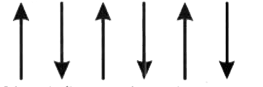 Schematic ALIGNMENTS of magnetic moments in antiferromagnetism. |
|
| 11. |
Define anode and cathode. |
|
Answer» Solution :Anode is the electrodeat which oxidation occurs. It sends electrons into the outer circuit. It has a negative CHARGE and in shown as (-) in CELL DIAGRAM. Cathode is the electrode at which electrons at which electrons are received from the outer circuit. It has a positive charge and is shown as (+) in cell diagram. |
|
| 12. |
Define anode and cathode . |
|
Answer» Solution :(i) ANODE : The electrode at which the OXIDATION OCCUR is called anode. (II) Cathode : The electrode at which the reduction occur is called cathode. |
|
| 13. |
Define Anisotropy, Distinguish between crystalline solids and amorphous solids. |
Answer» Solution :Anisotropy : It means difference in properties when measured along the different AXES or different directions. These properties VARY with different directions. Crystalline SOLIDS shows different values of some of the physical properties LIKE electrical resistance, refractive index, when measured along the different directions. The anisotropy ARISES due to the different arrangement of particles in different directions. 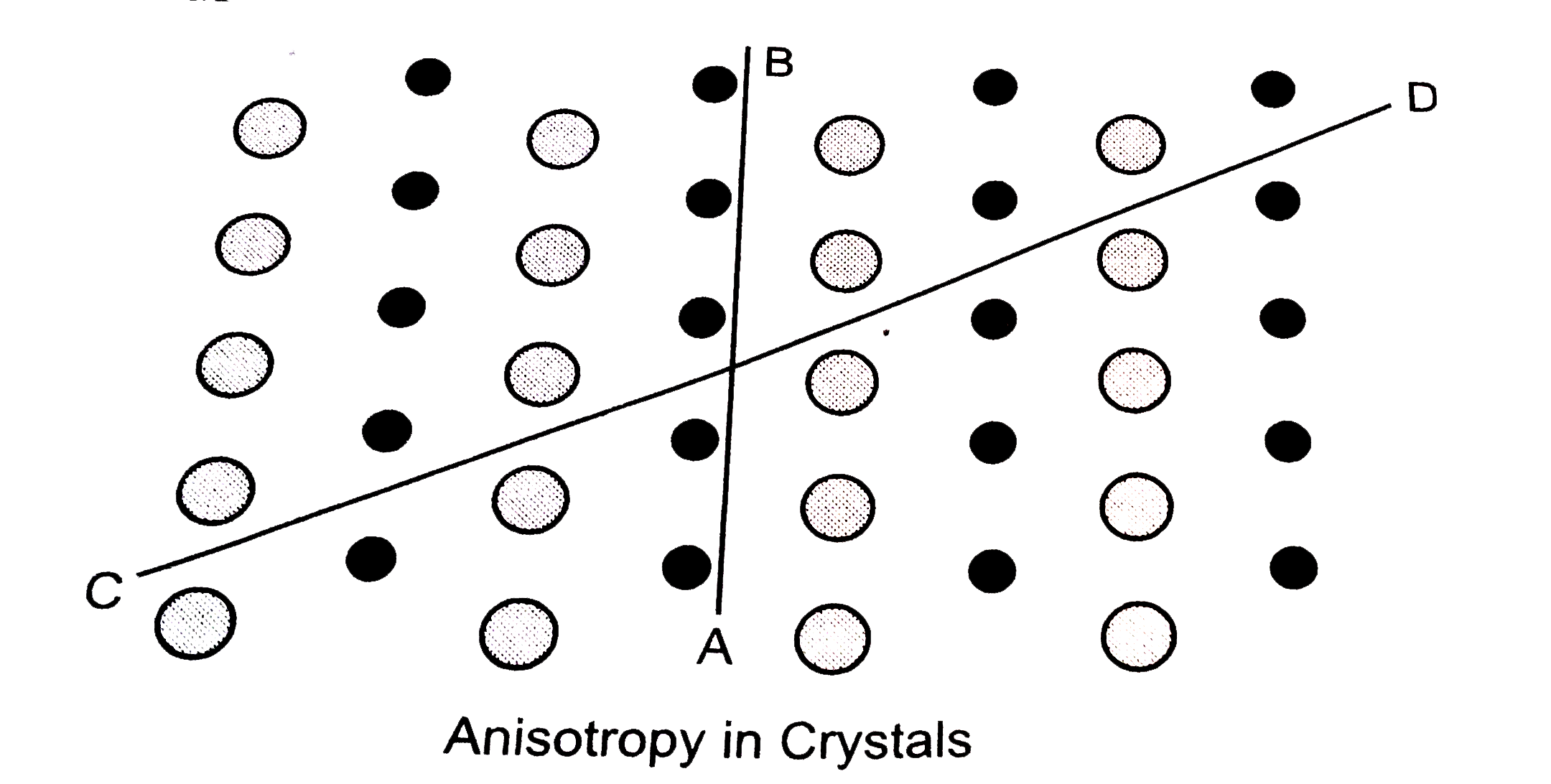 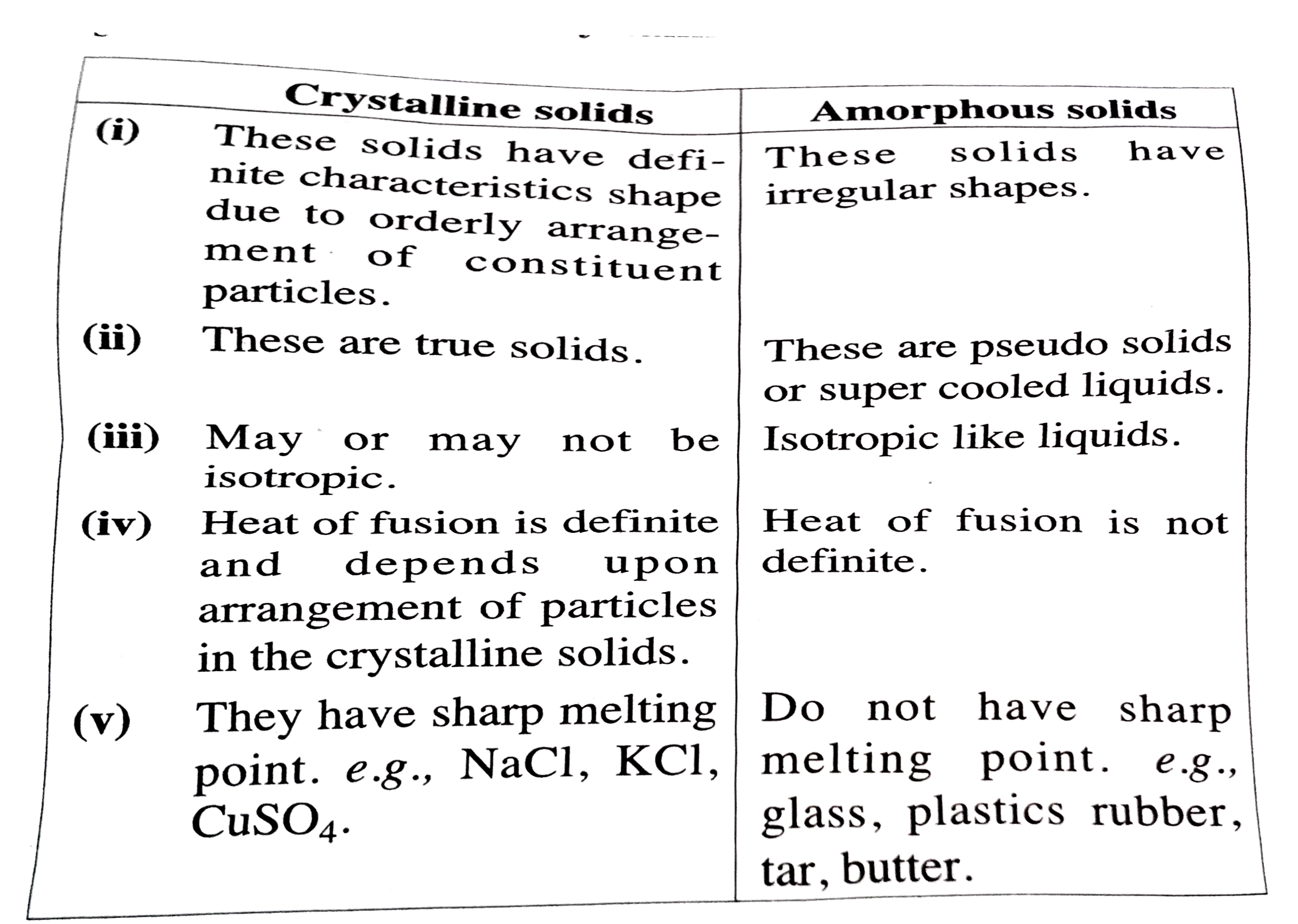
|
|
| 14. |
Define and write an example for the following : (a) Broad spectrum antibitics . (b) Analgestics. |
|
Answer» Solution : Broad Spectrum antibiotics: Antibioticvs which kill or INHIBITS a WIDE range of Gram - positive and Gram - NEGATIVE bacteria are called broad spectrum antibiotics. Example : Chloramphenicol. (B) Analgesics : They reduce or abolish pain withut causing impairement of conciousness mental confusion , incoordination or paralysis or some other disturbances of NERVOUS system Example : Aspirin/Paracetamol etc. |
|
| 15. |
Define and explain the term, enthalpy or heat of reaction. |
|
Answer» <P> Solution :Enthalpy or HEAT of reaction : The enthalpy of a chemicalreaction is the difference between the sum of the enthalpies of products and that of the reactants with every substance in a definite physicalstate and in the amounts (moles) represented by the coefficients in the BALANCED equation.Explanation : Consider the following GENERAL reaction, `aA + bB to cC +dD` The heat of the reaction `DeltaH` is the difference in sum of enthalpies ofproducts and sum of enthalpies of reactants. `therefore DeltaH = sum H_("products") - sum H_("reactants")` ` =[CH_(c) +dH_(D)] - [aH_(A)+bH_(B)]` ` =sum""_(p)H - sum""_(R)H` where H represents enthalpy of the substance. For endothermic reaction, `DeltaH` is positive,`(DeltaH gt 0)` For exothermic reaction, `DeltaH` is negative `(DeltaHlt 0)`. |
|
| 16. |
Define and explain the term elementary reaction |
|
Answer» SOLUTION :MANY reactions take place in a series of steps. Such reactionsare called complex reactions. Each STEP taking place in a complex REACTION is called elementary reaction. This shows that a complex reaction is broken down in a series of elementary chemical reactions. Byadding all the elementary steps of a complex reaction we get theoverall reaction. The mechanism of a reaction is decided from the sequence of the elementary steps that are ADDED to give overall reaction. Elementary reaction: It is defined as the reaction which takes place in a single step and cannot be divided further into simpler chemical reactions. |
|
| 17. |
Define and classify vitamins. Name the disease caused due to lack of any three of them . |
|
Answer» Solution :The organic compounds which are in addition to normal NUTRIENTS for regulating some of the body processes to maintain health and growth are called vitamins . They are essential dietary FACTORS required by an organism in minute quantities and their absence causes specific deficiency DISEASES. Classification of vitamins : Vitamins are generally classified on the basis of their solubility in the following types : 1. Water soluble vitamins . It includes vitamin B (complex of a group of several vitamins `B_1 , B_2 , B_6 , B_(12) `) and vitamin C. 2. Fat soluble vitmains. These are oily substances not readily soluble in water. The group includes vitamin A, D,E and K. 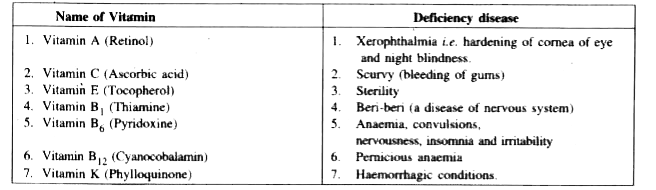
|
|
| 18. |
Define and correlate the terms proteins and peptide with amino acids. |
|
Answer» |
|
| 19. |
Define an ideal solution and write one of its characteristics. |
|
Answer» SOLUTION :The SOLUTIONS which obey Raoult.s LAW over the entire range of concentrations are called ideal solutions. Ideal solutions have the following characteristics : The enthalpy of mixing of the pure components to form solution is zero and the volume of mixing is also zero i.e., ` Delta_(MIX) = H= 0 " and " Delta_(mix) V = 0` |
|
| 20. |
Define an electrochemical cell. Discuss the working of Cu-Zn cell. |
Answer» Solution :The device in which electrical energy is produced from chemical reactions is called galvanic cell. The COMMON galvanic cell is a Daniel cell. It consists of two beakers containing 10 M solution of `ZnSO_(4)`, and 1.0M solution of `CuSO_(4)`. A ZINC rod is dipped into `ZnSO_(4)` solution and a copper rod is dipped into `CuSO_(4)` solution. These rods act as electrodes. The solution in the two beakers are connected by inverted U TUBE containing concentrated solution of some electrolyte such as `KCI, KNO_(3)` or `NH_(4)NO_(3)`. The two openings of the U tube are plugged with some porous material such as glass wool or cotton. 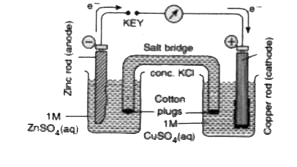 The U tube which connects the two glass beakers is called salt bridge. Salt bridge completes the cell circuit and increases the life of the cell. The arrangement is shown in Fig. When the two electrodes are connected through a voltmeter, the FLOW of electric current through external circuit is indicated by the voltmeter. The cell formed is called galvanic or voltaic cell. The potential difference is due to the CONTRIBUTION of two half cells. At zinc electrode, zinc is oxidised to `Zn^(2+)` ions which go into the solution. The electrons released at zinc electrode move towards the other electrode (copper) through the outer circuit. These are accepted by `Cu^(2+)` ions of `CuSO_(4)` solution which are reduced to copper. Thus, oxidation occurs at zinc electrode and it is called anode. Reduction occurs at copper electrode and it is called cathode. The reactions may be represented as : At anode : `Zn(s)toZn^(2+)(aq)+2e""` (oxidation) At cathode : `Cu^(2+)(aq)+2etoCu(s)""` (reduction) The overall cell reaction is `Zn(s)+Cu^(2+)(aq)toZn^(2+)(aq)+Cu(s)` The reactions occurring at anode and cathode are also referred as oxidation half cell reaction and reduction half cell reaction. The cell may be represented as : `Zn(s)|Zn^(2+)(aq)||Cu^(2+)(aq)|Cu(s)` Anode (-) Cathode (+) |
|
| 21. |
Defineamalgamation. Discussitsusein thepurificationof goldand silver.CanFebe purifiedbythis method ? |
|
Answer» Solution :A homogeneousmixtureofa metaloranon- metalwithmercuryis calledamalgam. Sincetheatomicradii OFAG(144 pm) and Au (144 pm ) arequiteclosetoHg (157 pm ) butwidelydifferentfromFe (126 pm ),therefore,AG andAuformamalgamsbutFedoesnot. Whenimpuresilverorgoldistreatedwithmercury,itformsamalgamleavingbehindimpurities. ` 2 Ag +X Hgtounderset ("Silver amalgam ")(Ag_2 Hg _ x ) ,2Au +x Hg tounderset ("Gold amalgam") (Au_2 Hg_x ) ` Theseamalgams areseparatedfromtheimpuritiesanddistilled,mercurydistilsover leavingbehind puresilverorgold. |
|
| 22. |
What are the ambidentate ligands ? Give examples. |
| Answer» Solution :The ligands which have two or more DIFFERENT donor SITES but only ONE of these is attached to a SINGLE metal atom at given time are called ambidentate ligands. | |
| 23. |
Define ambidentate ligands. Give one example. |
| Answer» SOLUTION :The ligands which have two or more different donor SITES but only ONE of these is attached to a SINGLE metal atom at given time are CALLED ambidentate ligands. | |
| 24. |
Define allotropy. Name the important allotropic forms of sulphur. |
|
Answer» Solution :Allotropy. When an element exists in more than one form leaving different physical PROPERTIES but same or slightly different chemical properties, the various forms are called allotropic forms and this phenomenon is called allotropy. The IMPORTANT allotropic forms of sulphur are : 1. Rhombic sulphur 2. Monoclinic sulphur 3. Plastic sulphur 4. MILK of sulphur 5. Colloidal sulphur. |
|
| 26. |
Define adsorption with an example. What is the role of adsorption in heterogeneous catalysis? |
|
Answer» Solution :The accumulation of molecular species at the surface rather than in the bulk of a solid or a liquid is called adsorption. Example: the air becomes dry in the PRESENCE of silica gel because the WATER molecules get adsorbed at the surface of the gel. ROLE of adsorption: Adsorption of reactants on the solid surface of the catalst increases the concentration and the rate of reaction. Manufacture of `NH_3` using iron as CATALYST, manufacture of `H_2SO_4` by Contact Process are some EXAMPLES of heterogeneous catalysis. |
|
| 27. |
Define allotropism and mention the allotropes of sulphur. |
|
Answer» Solution :Some elements exist in more than one crystalline or molecular FORMS in the same physical state. This phenomenon is CALLED allotropism. ALLOTROPES of SULPHUR : Rhombus sulphur, monoclinic sulphur |
|
| 28. |
Define adsorption isotherm. Give the empirical relationship between the quantity of gas adsorbed by unit mass of solid absorbent and pressure at a particular temperature. |
|
Answer» Solution :The variation in the amount of GAS adsorbed by adsorbent with pressure at constant temperature can be expressed by MEANS of a curve termed as ADSORPTION isotherm. The relation between the quantity of gas adsorbed by unit mass of SOLID adsorbent and pressure at a particular temperature is given by `(x)/(m)=kp^((1)/(n))(NGT1)` where x = mass of gas adsorbed, m = mass of the adsorbent, p = pressure of the gas. |
|
| 29. |
Define adsorption isotherm and explain Freundlich adsorption isotherm of gases on solids. |
|
Answer» <P> Solution : Freundlich adsorption isotherm. The behaviour of adsorption with pressure can be expressed by adsorption isotherm as shown in Fig. The inspection of the graph reveals the following FACTS :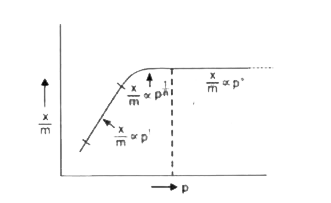 (i) At low pressure. The graph is almost straight line which indicates that x/m is directly proportional to the pressure. This may be expressed as: `x/m prop p " or" x/m =k p ` .where k is a constant....(i) (ii) At HIGH pressure. The graph becomes almost constant which means that x/m becomes independent of pressure. This may be expressed as: `x/m =` constant ` x/m prop p^0""[ because p^0 = 1]` ` x/m= kp^0`...(ii) (iii) Thus, in the intermediate RANGE of pressure, x/m will depend UPON the power of pressure which lies between 0 to 1 i.e., fractional power of pressure. This may be expressed as: 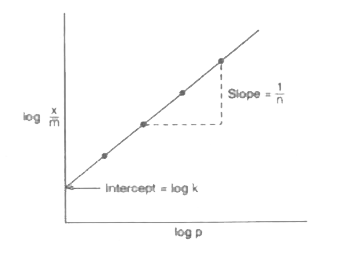 Fig. Linear graph between log x/m and log p ` x/m prop p^(1//n)` or`x/m = kp^(1//n)`....(iii) where n can take any value between 1 and a larger integer depending upon the pressure. The above relationship is also called Freundlich.s adsorption isotherm. The constants k and n can be determined as explained ahead : Taking logarithms on both sides of Eq. (iii), we get log`x/m = log k+ 1/n log p` Thus, if we plot a graph between log (x/m) and log p, a straight line will be obtained. The slope of the line is equal to 1/n and the intercept is equal to log k. |
|
| 30. |
Define adsorption isotherm. |
| Answer» SOLUTION :A plot between the amount of ADSORBATE adsorbed and pressure or concentration of adsorbate at constant TEMPERATURE is CALLED adsorption isotherms. | |
| 31. |
Define adsorption isobar. |
| Answer» Solution :When AMOUNT of ADSORPTION is plotted versus TEMPERATURE at constant pressure it is called adsorption ISOBAR | |
| 32. |
Define adsorption. Give one example. |
| Answer» Solution :It is the PHENOMENON of HIGHER concentration of molecules of one substance on the surface of another substance as compared to in the BULK of the substance e.g. NH, is desorbed by charcoal. | |
| 33. |
Define adsorption. |
| Answer» Solution :“Adsorption is a phenomenon of CONCENTRATION of substance on the surface of liquid or SOLID” (or) “The condition in which concentration of a substance in the interfacial layers between two PHASES is greater than in the bulk of either phase, then the substance is said to be adsorbed at the interface and the phenomenon is known as adsorption”. | |
| 36. |
Define addition polymers. |
| Answer» Solution :Polymers which are formed by REPEATED addition of monomer molecules between containing DOUBLE and triple bond are called addition polymers , For example , polythene , PVC, PAN , PMMA , ETC. | |
| 37. |
Define activity and selectivity of catalysis. |
| Answer» | |
| 38. |
Define 'activation energy' of a reaction. |
| Answer» Solution :The ENERGY required by the REACTANTS to form the ACTIVATED complex is CALLED ACTIVATION energy. | |
| 39. |
Define activation energy of a reaction. |
| Answer» Solution :ENERGY REQUIRED by the reactants to form activated complex is CAUSED the ACTIVATION energy of a REACTION. | |
| 40. |
Define a tranquillizer. |
| Answer» Solution :A TRANQUILLIZER is a DRUG which acts on CENTRAL nervous system and HELPS in REDUCING anxiety. | |
| 41. |
Define : (a) Molality (b) Osmotic pressure Write any two' advantages two cubic faces namely face centered (FCC) and body centered (BCC) whose, unit cell edge lengths are 3*5Å and 3*0 Å respectively. Find the ratio of the densities of FCC and BCC. Arrange the following oxyacid or chlorine -HCIO HClO_(2), HClO_(3) and HClO_(4) with respect to : (a) Increases order of thermal stability. (b) Increasingorder of oxidising power. |
|
Answer» Solution :(a) MOLALITY : It is defined as the number of moles of solute dissolvedin 1 kg of solvent. (b) Osmotic presure : The excess of pressure applied on the side of solution that stops the net flow of solvent into solution through sem-permeable MEMBRANE, is known as osmotic pressure. Advantage of calomel electrod : (i) It is easy to CONSTRUCT, transport and conveninent to HANDLE. (ii) The potential of the electrod is defiined, reproducible and remains constant. `d=(ZxxM)/(a^(3)xxN)` `(d_(fc c))/(d_(bc c))=(Z_(fc c))/(Z_(bc c))xx(a_(bc c^(3)))/(a_(fc c^(3)))` `=(4)/(2)xx(3^(3))/((3*5)^(3))` `2xx(27)/(43)=(54)/(43)` (a) Increasing order f THERMAL stability: `HCIO gt HCIO_(2) gt HCIO_(3) to HCIO_(4)` |
|
| 42. |
Define : (a) Osmosis(b) Freezing point |
|
Answer» Solution :(a) Osmosis : A process by which molecules of a solvent TEND to PASS through a semi-permeable memebrane concentrated one. When the membrane permits the solvent molecules to come out through the membrane, it is CALLED exosmosis. When the membrane permits the solvent molecules to enter inside, it is called endosmosis. The minimum excess pressure that has to be applied on the solution to prevent the entry of the solvent into the solution through the semi-permeable membrane is called the osmotic pressure. (b) FREEZING point : Freezing point of a substance is the temperature at which the solid and liquid forms of a substance are in equilibrium i.e., solid and liquid form of a substance have same vapour pressure Freezing point of the solution is always LOWER than that of pure solvent. the decrease in freezing point is known as depression in freezing point. |
|
| 43. |
Define a homopolymer. |
| Answer» Solution :Polymers whose REPEATING structural units are DERIVED from only one TYPE of MONOMER units are called homopolymers. Fro example , teflon, polythene , POLYPROPYLENE, PAN, PMMA, etc. | |
| 44. |
Define a 'ligand'. Give an example also. |
|
Answer» Solution :A neutral atom or group of atoms with a lone pair of electrons, or a negative group which can donate the electron pair to form a COORDINATE BOND with the metal ion is called a ligand. Examples, `NH_(3), H_(2)O` and `CL^(-)`. |
|
| 45. |
Define (a) Adsorbent (b) Adsorbate with an example. |
|
Answer» Solution :(a) Adsorbent is a material on which ADSORPTION takes place. eg., SILICA GEL and metals like Ni, CU, Pt. (B) Adsorbate is a substance which is adsorbed on the adsorbent. e.g., Gaseous molecules like `He, Ne, O_2, N_2` and solutions of NaCl (or) KCI. |
|
| 46. |
Define order of a chemical reaction. |
| Answer» SOLUTION :Order of a CHEMICAL reaction is the SUM of powers of concentration terms INVOLVED in the experimetnally DETERMINED rate law. | |
| 47. |
Define: : Explain, with energy profile díagram, the mechanísm of alkaline hydrolysis of methyl bromide or Bromomethane |
|
Answer» Solution :(1) Stereochemistry and Kinetics of the reaction (R.D.S.): This hydrolysis reaction takes place only in one step which is a rate DETERMINING step i.e. R.D.S. The rate of hydrolysis reaction depends on the concentration of `CH_(3)Br` and `OH^(-)` which are present in the R.D.S. of the reaction. Rate = R = `k [CH_(3)Br] xx [OH^(-)]` Where K is rateconstateof THEREACTION . `SN^(2)` reaction : Since the rate of the reaction depends on the concentrations of two substances it is bímolecular second order (2nd)Nucleophilic Substitution reaction denoted by `SN^(-2)`. (3) Mechanism of the reaction : It is a one step continuousprocess. The reaction takes place in the followingsteps: 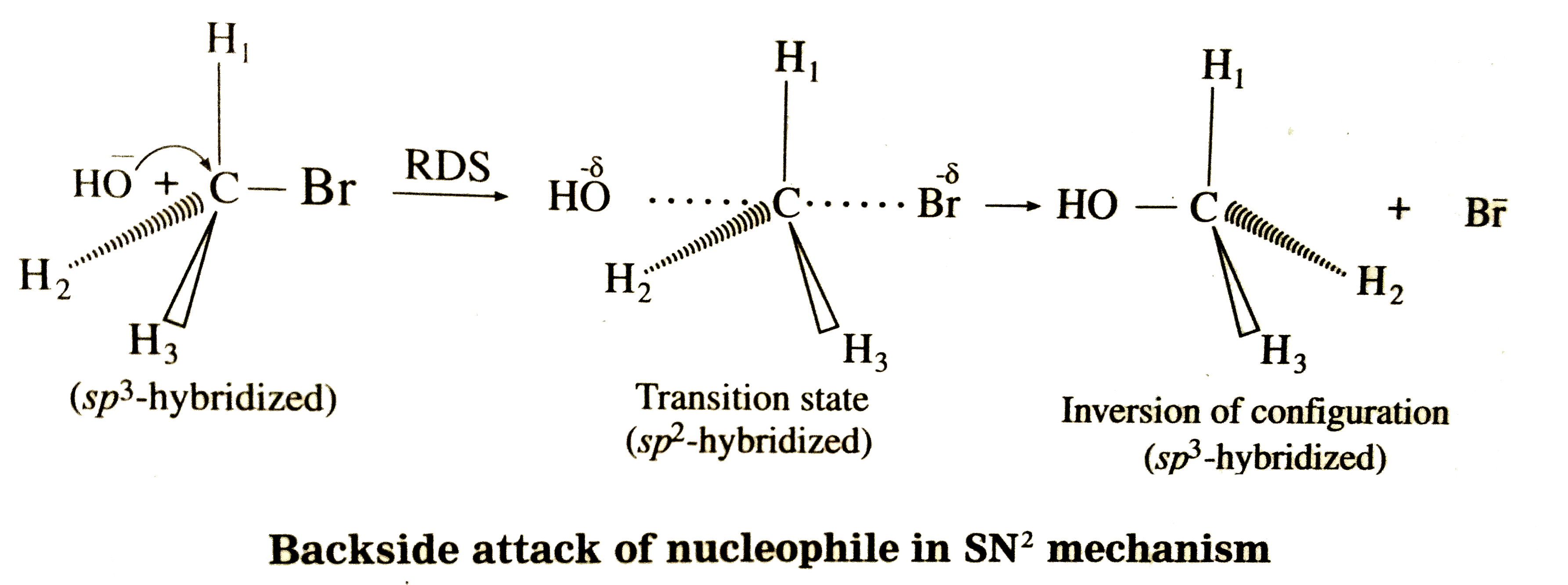 Backside attack of the nucleophile : Nucleophile `OH^(-)` attackscarbon atom of `CH_(3)Br`form back side i.e.,formoppositesideto Brto experienceminimum repulsion andrequiresminimun enegryfor theattack. Transition state : When a nucleophile, `OH^(-)` approaches carbon atoms of `CH_(3)Br`thepotentialenergy of the systemincreaseuntil a transition state (T.S.) of maximum potential energy is formed in which C- Br bond is partially broken and C- OH bond is partially formed. The negative charge is equally shared by both incoming nucleophile OH and outgoing, leaving GROUP `-Br^(-)` In `CH_(3)Br` , carbon atom is `sp^(3)` - hybridized and `CH_(3)Br` moleculeis tetrahedral. In the transition state the hybridisation of carbon atom changes to `sp^(2)` hybridisation and the T.S. complex molecule becomes planar i.e.,`H_(1),H_(2) and H_(3)`atoms lie in one plane while Br and OH lie collinear and on opposite SIDES perpendicular to the plane containing `H_(1)H_(2) and H_(3)`. Inversion of configuration : The transition state decomposes fast by the complete breaking of the C-Br bond and the new C-OH bond is formed on the other side. The breaking of C-Br bond and the ace simultaneously. The energy required to breakthe C-Brbondis partlyobtained formthe energyreleasedwhen C_OH bond is formed . Theformation of product `CH_(3)OH` is accompained by complete or 100% inversion of configuration forming again `sp^(3)`-hybridized carbon atom giving tetrahedral `CH_(3)OH` molecule. Butin this structurethe positions of `H_(2)`and `H_(3)`atomsin the reactant`(CH_(3)Br)`and inproductareonopposite side. This inversionof configurationis calledWalden inversion. Energy profile DIAGRAM : This is obtained by plotting potential energy of the species in the reaction verses reaction coordinate during the course of the reaction. 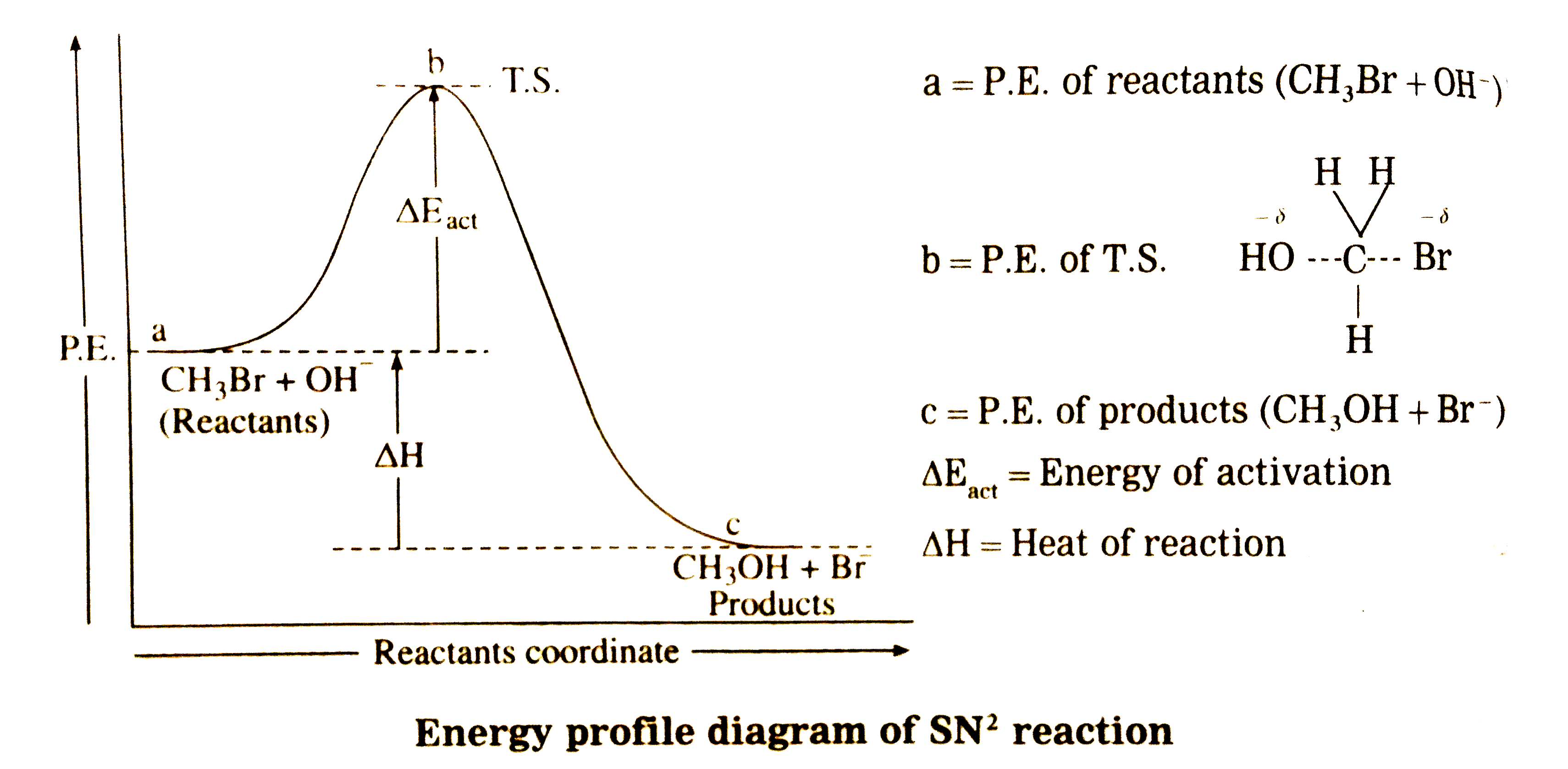
|
|