

Saved Bookmarks
This section includes 7 InterviewSolutions, each offering curated multiple-choice questions to sharpen your Current Affairs knowledge and support exam preparation. Choose a topic below to get started.
| 1. |
CH_(3)CHO overset("1) dil. NaOH")underset("2) "Delta)rarr X. Give the IUPAC name of X. |
|
Answer» Solution :X is `CH_(3) - CH = CH - CHO` This reaction under goes aldol CONDENSATION. The given ethyl ALDEHYDE contains `alpha -` hydrogen atom will react with DIL `NaOH`. To form Aldol product then heating will form But-2-enal. |
|
| 2. |
CH_(3)CHO + NH_(2)OH overset(-H_(2)O)rarrCH_(3)CH = NOH The reaction is carried at : |
|
Answer» `pH = 1` |
|
| 3. |
CH_3CHO+NH_2 OHto X underset(-H_2 O) toY The numberofsigmabondspibonds and lone pairs of electrons in the compound 'Y' are respectively |
|
Answer» 9,1,4 |
|
| 4. |
CH_(3)CHO+HCNrarrX overset(H_(3)O^(+))rarr Which type of polymer is formed from the organic compound Y? |
|
Answer» SOLUTION :X = acetaldehyde CYANOHYDRIN , Y = lactic acid. Hydrolysis of COMPOUND X, acetaldehyde cyanohydrin with a dilute mineral acid gives compound Y, lactic acid. The condensation homopolymer of lactic acid is called polylactic acid. It is a polyester and is a biodegradable polymer. |
|
| 5. |
CH_(3)CHO+HCN to CH_(3)CH(OH)CN overset(H^(+) // H_(2)O)to CH_(3)CH(OH)COOH an asymmetric centre is generated. The acid obtained would be |
|
Answer» D-isomer |
|
| 6. |
CH_(3)CHO+HCHOoverset("dil. NaOH")underset("Heat")rarrAoverset("HCN)underset(H_(3)O^(+))rarrB the structure of compound B is |
|
Answer» `CH= CH - UNDERSET(OH) underset(|)CH- COOH` |
|
| 7. |
CH_3CHO+H_2NOHrarrCH_3-CH=N-OH The above reaction occurs at: |
|
Answer» pH=1 |
|
| 8. |
CH_(3)CHO + H_(2)NOH to CH_(3) CH = N - OH . Thisreactionoccursat. |
|
Answer» PH = 1 |
|
| 9. |
CH_(3)CHO gives 1,1-Dichloroethane with it |
|
Answer» `PCI_(5)`  Each O ATOM of the CARBONYL group is replaced by `2CI` atom. |
|
| 10. |
CH_(3)CHO+CH_(3)CHOoverset(OH^(-))(to)Aoverset("Heat")(to)B+H_(2)O The IUPAC names of compound A is ………..and B is …………. |
|
Answer» Solution :`underset("Acetaldehyde ")(CH_(3)CHO)+CH_(3)CHO underset("Aldol condensation")OVERSET(OH^(-))(to)CH_(3)-underset(.A.)underset(3-"Hydroxybutanal")overset(OH)overset(|)((CH))-CH_(2)-overset(O)overset(||)(C)-Hoverset("Heat")(to)` `CH_(3)-underset(.B.) underset(2-"BUTENAL")(CH=CH)-overset(O)overset(||)(C)-H+H_(2)O` |
|
| 11. |
CH_3CHO + CH_2 (COOH)_2underset(/_\)overset(C_6H_5N)rarrThe product of this reaction is |
|
Answer» `CH_3COOH` and `C_2H_5OH` |
|
| 12. |
CH_3COCH_3 can be obtained by: |
|
Answer» HEATING acetaldehyde with methanol |
|
| 13. |
CH_(3)CHO and C_(6)H_(5)CH_(2)CHO can be distinguished chemically by |
|
Answer» Benedict TEST |
|
| 14. |
CH_(3)CHO and C_(6)H_(5)CHO can be distinguished chemically by |
|
Answer» BAEYERS REAGENT |
|
| 15. |
CH_3CHO and C_6H_5CH_2CHO can be distinguised chemically by : |
|
Answer» BENEDICT's TEST |
|
| 16. |
CH_(3)CHO + 2[H] overset(Ni : Delta)to B. A dibasic acid is formed when "B" reacts with |
|
Answer» `SOCI_(2)` |
|
| 17. |
CH_(3)CHClCH_(3)CH_(3)andCH_(3)CH_(2)CH_(2)Cl shows which type of isomerism, |
|
Answer» functional |
|
| 18. |
CH_(3)CHI_(2)overset(KCN)tounderset(Delta)overset(H_(2)O, here the end product would be: |
|
Answer» 2-cyanopropionic ACID |
|
| 19. |
CH_(3)CHCl_(2) and CH_(2)ClCH_(2)Cl are examples of : |
|
Answer» FUNCTIONAL ISOMERISM |
|
| 20. |
CH_3CH=CH_2overset(NaBD_4)underset(H_2O_2//OH)rarr product X X is: |
|
Answer» `H_3C-UNDERSET(OH)underset(|)CH-CH_2D` |
|
| 21. |
CH_(3)CH=CH_(2)overset(NBS)rarr A overset(KCN)rarr B overset(OH^(-)//Delta)rarr C overset(P//Br_(2))rarr D overset(NH_(3))rarr E overset(Delta)rarr F |
|
Answer» |
|
| 22. |
CH_(3)CH=CH_(2) underset("Peroxide")overset(HBr)rarr (A) overset(Mg)rarr(B) underset((2)H_(2)O //H^(+))overset((1)CO_(2))rarr(C),(C) is |
|
Answer» `CH_(3)NH_(2)CH_(2)OH` `(B)=CH_(3)CH_(2)CH_(2)MgBr`, n-Propylmagnesium bromide `(C)=CH_(3)CH_(2)CH_(2)COOH`,BUTANOIC acid |
|
| 23. |
CH_3CH=CH- COCH_3+CH_3 MgBrunderset(2 ) H_2 O) overset(" ether ") tothepossibleproducts are |
|
Answer» `fCH_3 CH= CHoverset( OH)OVERSET(| )C (CH_3)_2` |
|
| 24. |
CH_(3)CH_(3)Brunderset(Delta)overset(aqNaOH)(to)Aunderset(Delta)overset(KMnO_(4)//H^(+))(to)Bunderset(Delta)overset(NH_(3))(to)D.D is ……………………….. . |
|
Answer» BROMOMETHANE |
|
| 25. |
CH_3CH=CH-CH_3overset(X)rarrY (Not resolvable). Here X can be |
|
Answer» `Br_2` WATER |
|
| 26. |
CH_(3)CH=CH-CH=CH-CH_(2)CHOHCH_(3) How many isomers (geometrical and optical) are possible for the above - mentioned compound? |
|
Answer» 2 |
|
| 27. |
In the reaction, CH_3-CHunderset(Br)underset(|)(CH)-(CH_3)overset("Alc. KOH")(rarr)(A) underset("peroxide")overset(HBr)(rarr)(B)underset("Acetone")overset(NaI)(rarr)(C). The compound (C ) is |
| Answer» SOLUTION :ISOPROPYL IODIDE | |
| 28. |
CH_(3)CH_(3)+HNO_(3) overset(675K)to ? |
|
Answer» `CH_(3)CH_(2)NO_(2)` |
|
| 29. |
CH_(3)CH_(2)overset(O)overset(||)(C)-OHrarrCH_(3)CH_(2)NG_(2) Which of the following is/are effective for this conversion? |
|
Answer» `NH_(3) "(excess), heat", Na, C_(2)H_(5)OH` `CH_(3)CH_(2)CH_(2) - NH_(2)` (b) Schmidt reaction (c) Hofmann.s bromamide DEGRADATION. (d) Gives CH3CH2CONH2 |
|
| 30. |
CH_(3)CH_(2)OHoverset(K_(2)Cr_(3)O_(7)//H^(+))tounderset(__")('X')+H_(2)O 'X' is ______ |
|
Answer» `CH_(3)CHO` |
|
| 31. |
CH_(3)CH_(2)Ohoverset(CI_(2))underset(step-1)to CH_(3)CHOoverset(3GI_(2))underset(step-2)toCI_(3)C CHO In above reactions the role of CI_(2) in step-1 and step-2 respectively is |
|
Answer» OXIDATION, chlorination |
|
| 32. |
CH_(3)CH_(2)OH underset(443K)overset("Excess conc." H_(2)SO_(4))to X What is X? |
|
Answer» ETHENE |
|
| 33. |
CH_3CH_2OH overset(P+I_1)(to) A overset(Mg)(to) B overset(HCHO)(to) C overset(H_2O)(to) D. The compound D is |
|
Answer» propanal |
|
| 34. |
CH_(3)CH_(2)OH underset(O)to CH_(3)CHO underset(O) to CH_(3)COOH To stop the oxidation reactions at the aldehyde stage, ______ is used as an oxidising agent. |
|
Answer» `KMnO_(4) | H^(+)` |
|
| 35. |
CH_(3)CH_(2)OH+HCl overset(ZnCl_(2))rarr CH_(3)CH_(2)Cl+H_(2)O In the above reaction, the leaving group is |
|
Answer» `OH^(-)` |
|
| 36. |
CH_(3)CH_(2)OH+CH_(2)N_(2)overset(HBF_(4))rarr Products Which of the following statements is true about th eabove reaction ? i. The products is CH_(3)CH_(2)OCH_(3). ii. The strong acid HBF_(4) first protonates CH_(2)N_(2) to give CH_(2)N_(2)^(o+), form wich N_(2) (an extremely good leaving group) is displaced. iii.CH_(3)CH_(2)OH acts as a nucleophile. iv. CH_(2)N_(2) acts as a nucleophile. |
|
Answer» i. and II. |
|
| 37. |
CH_(3)CH_(2)OH +CH_(3)COOH overset(H^(+))hArrX+ H_(2)O What is X? |
|
Answer» Ethyl ethanoate |
|
| 38. |
CH_(3)CH_(2)OH can be converted into CH_(3)CHO by __________. |
|
Answer» CATALYTIC hydrogenation |
|
| 39. |
CH_(3)CH_(2)OH can be converted into CH_(3)CHO by _____. |
|
Answer» CATALYTIC hydrogenation |
|
| 40. |
CH_(3)CH_(2)OH can be converted into CH_(3)CHO by ______ |
|
Answer» Catalystic HYDROGENATION |
|
| 41. |
CH_(3)CH_(2)OH and CH_(3)-O-CH_(3) are the example of: |
|
Answer» FUNCTIONAL ISOMERISM |
|
| 42. |
CH_(3)CH_(2)OH can be converted into CH_(3)CHO by ... |
|
Answer» CATALYTIC HYDROGENATION |
|
| 43. |
CH_(3)CH_(2)OH + 2HI underset(Delta)overset("Red P")to X+ I_(2)+ H_(2)O What is X? |
|
Answer» Methane |
|
| 44. |
CH_(3)CH_(2)NO_(2) underset(at 0^(@)C)overset(NaNO_(2)+HBr)(rarr) (A). (A) is |
|
Answer» a.`CH_(3)CH_(2)OH` 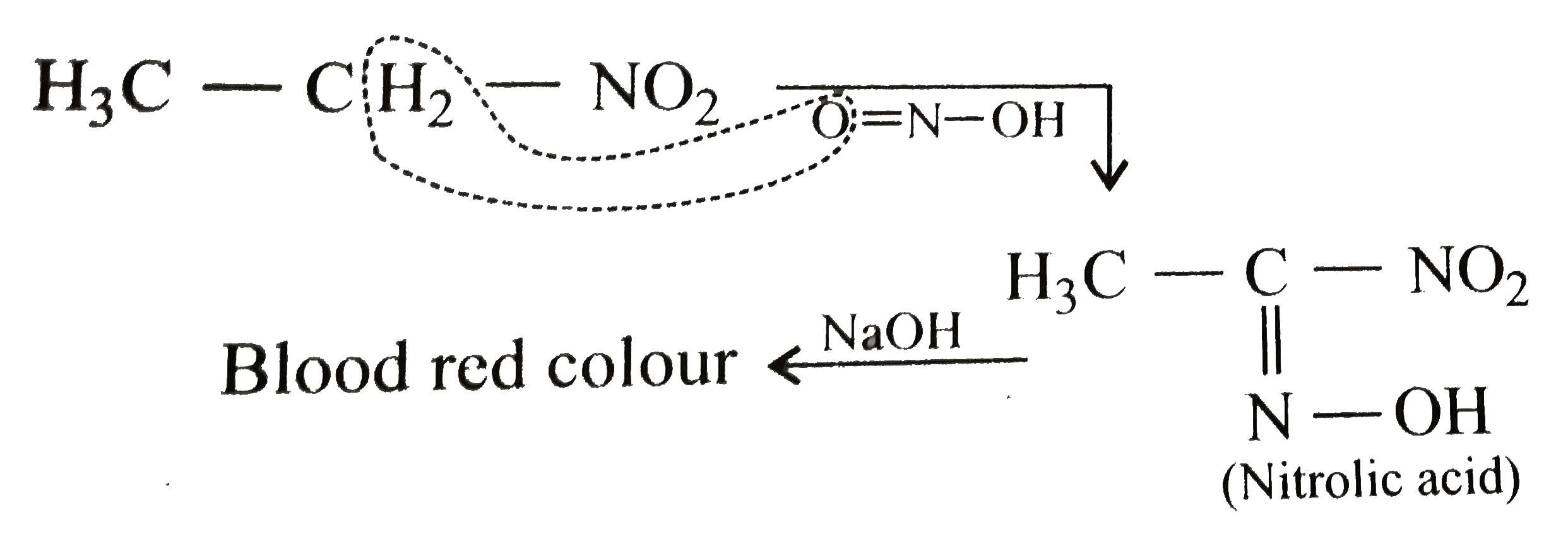 So the answer is `(c )`. |
|
| 45. |
CH_(3)CH_(2)NH_(2) is soluble in |
|
Answer» Dilute HCI |
|
| 46. |
CH_3CH_2NH_2 contains a basic NH_2 group , but CH_3CONH_2 does not , because : |
|
Answer» Acctamide is amphoteric in character |
|
| 47. |
CH_(3)CH_(2)MgBr underset(H_(2)O)overset(CH_(3)CHO)rarr X overset(HBr)rarr Y. Write the product obtained when compound Y is subjected to dehydrohalogenation |
| Answer» SOLUTION :`CH_(3)-CH=CH-CH_(3)` | |
| 48. |
CH_(3)CH_(2)NH_(2) is soluble in :- |
|
Answer» DILUTE HCl |
|
| 49. |
CH_(3)CH_(2)COOHunderset(redP)overset(Cl_(2))toAoverset(alc KOH)to B,Bis |
|
Answer» `CH_(3)CH_(2)COCL` |
|