

Saved Bookmarks
This section includes 7 InterviewSolutions, each offering curated multiple-choice questions to sharpen your Current Affairs knowledge and support exam preparation. Choose a topic below to get started.
| 1. |
(a)Write any two differences between lyophilic sols and lyophobic sols(b) What are the differences between physisorption and chemisorption (c) Give an example for homogeneous catalysis |
Answer» SOLUTION :(a)  (C) `2SO_(2)(G) + O_(2)(g) overset(NO(g))(to)2SO_(3)(g)` |
|
| 2. |
(a)Why is the purest monomer used in free radical polymerisation? (b).How does the presence ofCCl_(4)orCBr_(4)influence the course of vinylic free radical polymersation. (c )what is the monomer of the polymer given below: (d)Why does hole develope in nylon stocking when adrop ofHClis added to it? |
|
Answer» Solution :(a) Trace of impurities present in alkene ,onomer can act as either chain transfer agents RO inhibitors,If it acts as a chain transfer AGENT,then lower-average -molecular-mass polymer is formed.If it acts as an INHIBITOR,the process of POLUMERISATION is inhibited .Hence ,the pureset monomer us uded to avoid these processes. (b)In vinylic polymerisation`,CCl_(4)`and`CBr_(4)`acts as chain transfer agents.i.e.,it reacts eith thr growing chain to interrupt its further growth and initiat eits chain growth (i.e, produces a new radical). The monomer is  (ethylene or acidic hydrolysis of oxirane), (ethylene or acidic hydrolysis of oxirane), (d).This is due to the breaking or acidic hydroysis of amide bond  present in nylon. present in nylon.
|
|
| 3. |
Explain the hybridisation, geometry and magnetic property of [Ni(Cl)_(4)]^(2-). |
Answer» Solution :(i) Orbitals of `Ni^(2+)` ion 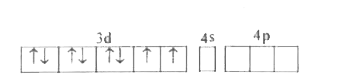 (ii) In PRESENCE of STRONG ligand `CN^(-)` spin pairing takes place and `DSP^(2)` hybridisation takes place. 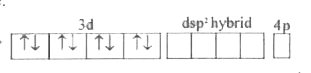 (ii) Four pairs of electrons, one from each CN OCCUPY the four hybrid orbitals. Thus the complex has square planar geometry and diamagnetic because of the absence of unpaired electrons. 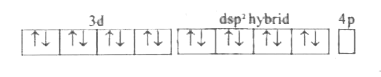 For `[Ni(CN)_(4)]^(-2)`Complex: (i) TYPE of hybridisation : `dsp^(2)` (ii) Geometry: Square planar (iii) Magnetic property: Diamagnetic |
|
| 4. |
(a)When 100 ml of 0.1M NaCN solution is titrated with 0.1 M HCl solution the variation of pH of solution with volume of HCl added will be : (b)Variation of degree of dissociation alpha with concentration for a weak electrolyte at a particular temperature is best represented by : ( c)0.1 M acetic acid solution is titrated against 0.1 M NaOH solution. The difference in pH between 1/4 and 3/4 stages of neutralization of acid will be 2 log 3. |
|
Answer» T,F,T (b) For a weak electrolyte `K_a=(Calpha^2)/((1-alpha))` when `alphaltlt 1` then `alpha=sqrt(k_a/C)` as C increases `implies` `alpha` decreases as C is tending to ZERO `implies` `alpha` will be unity ( c) At `1//4^(th)` neutralisation `CH_3COOH+NaOHtoCH_3COONa+H_2O` `(0.1xx3/4) " " (0.1xx1/4)` `pH=pK_a+"LOG" ([CH_3COO^(-)])/([CH_3COOH])=pK_a+ "log" (1/3)` At `3//4^(th)` neutralisation `pH=pK_a+"log" 3` so difference in pH=`DELTA(pH)="log"3-"log"1/3=2"log"3` |
|
| 5. |
(A)Water vapours are absorbed by anhydrous calcium chloride (R ) Absorption and adsorption are similarprocesses. |
|
Answer» Both (A) and (R ) are TRUE and (R ) is the CORRECT explanation of (A) |
|
| 6. |
Absolute ethanol cannot be obtained by simple fractionation of solution of ethanol and water because : |
|
Answer» Their BOILING points are very near |
|
| 7. |
Avogadro's Number: 6.022xx10^(23) In a thermal neutron-inducted fission process, .^(235)U reacts with a neturon and breaks up into energetic fragmants and (normally) 2-3 new neutrons. We consider one single fission event: 235U+n rarr .^(137)Te+X+2n Identify the fragment X. |
|
Answer» |
|
| 8. |
Avogadro's Number: 6.022xx10^(23) An atom of ..^(238)U disontegates by a series of alpha-decays and beta-decays until it becomes .^(206)Pb, which is stable. (i) How many alpha-decays and many beta-decays does an atom starting as ..^(238)U undergo before it becomes stable? (ii) One of the following ten nuclides is formed from a series of disintegrations starting at ..^(238)U. Which one? .^(235)U, .^(234)U, .^(228)Ac, .^(224)Ra, .^(224)Rn, .^(220)Rn, .^(215)Po, .^(212)Po, .^(212)Pb, .^(211)Pb. |
|
Answer» (II) `^(234)U`, all other answer are incorrect. |
|
| 9. |
Average rate of reaction decrease with concentration of reactant.Explain with example. |
|
Answer» Solution :Example:`C_(4)H_(9)Cl+OH^(-)toC_(4)H_(9)OH+Cl^(-)` The RATE of reaction is expressed at different time in FOLLOWING table.  Thus ,the time INCREASE ,the rate of reaction decrease with respect to reactants. |
|
| 10. |
Average speed is equal to : |
|
Answer» 0.9813 RMS SPEED |
|
| 11. |
Avogadro number (6.022 xx 10^23)of carbon atoms are present in |
|
Answer» 12 grams of`""^12 CO_2` |
|
| 12. |
Average osmotic pressure of human blood is 7.4 atm at 27^@C, then total concentration of various solutes is |
|
Answer» `0.1 MOLL^(-2)` |
|
| 13. |
Average life of a first order reaction is the time in which the concentration of the reactant reduces to………………………of the original concentration. |
|
Answer» |
|
| 15. |
Average life period is equal to : |
|
Answer» 1/HALF LIFE period |
|
| 16. |
Available are 1L of 0.1M NaCl and 2L of 0.2M CaCl_(2) solutions. Using only these two solutions what maximum volume of a solution can be prepared having [Cl^(-)]=0.34M exactly. Both electrolytes are strong |
|
Answer» `2.5L` so `y=4x` so for maximum volome `y=2L & x=(1)/(2)L` |
|
| 17. |
Availabe are 1L of 0.1 M NaCl and 2L 0.25 M CaCl_(2) solution . Using only these two solutions what maximum volume of a solution can be prepared having [Cl^(-)] = 0.34 M exactly ? Both electrolytes are strong . |
|
Answer» `2.5 `L |
|
| 18. |
Available chlorine is liberated from bleaching powder when it : |
|
Answer» Is heated |
|
| 20. |
Autoreduction process is used in the extraction of |
| Answer» Answer :A | |
| 21. |
Automatic estimation of elements in organic compound is done by |
|
Answer» ENT-analyser |
|
| 22. |
Automobile engine blocks are made up of : |
|
Answer» Stainless steel |
|
| 23. |
Auto-reduction process is used in the extraction of |
| Answer» Answer :A | |
| 24. |
Auto reduction process is used in the extraction of |
|
Answer» CU and Hg `2HgO+HgSrarr3Hg+SO_(2)` `2Cu_(2)S+3O_(2)rarr2Cu_(2)O+2SO_(2)` `2Cu_(2)O+Cu_(2)S rarr 6Cu+SO_(2)` |
|
| 25. |
Auto-reduction is used in the extraction of |
|
Answer» Copper |
|
| 26. |
Aunderset("heat")overset(H_(3)O^(+))(larr)CH_(3)underset(CH_(3))underset(|)(C)HNCoverset(H_(2),Ni)underset("heat")(rarr)B. Products 'A' and B can distinguished by |
|
Answer» the distinguished of `CHCI_(3),""^(-)OH` `CHCI_(3)OH^(-)` gives a pungent smell with `1^(@)` amine not with `2^(@)` amine . `HNO_(2):1^(@)` amine gives out usually alcohol liberating `N_(2) 2^(@)` amine gives nitroso COMPOUND . `CS_(2)//HgCI_(2):1^(@)"amine"rarrRNH-overset(S)overset(||)(C)-SHoverset(HgCI_(2))(rarr)underset("oil odour")underset("Mustard")(RN=C=S)` `2^(@)"amine"R-underset(R)underset(|)N-overset(S)overset(||)C-SHoverset(HgCI_(2))(rarr)"no action"` `1_(@)` amine gives alkali soluble sulphonate. With benzene sulphonyl chloride, `1^(@)` amine gives alkali soluble salt while `2^(@)` amine gives alkali insoluble salt. |
|
| 27. |
Auric chloride on reaction with ferrous sulphate changes to : |
|
Answer» Au |
|
| 28. |
Aunderset("dil." H_2SO_4)overset(K_2Cr_2O_7)to B underset(H_2O)overset(CH_3MgI)toCH_3-undersetunderset(OH)|oversetoverset(CH_3)|C-CH_3 The reactant A is |
|
Answer» `CH_3CHOHCH_3` |
|
| 29. |
Aunderset(Delta)overset(.^(-)OH)rarr1-"Acetyl-1-Cyclopentene". A will be |
|
Answer» 6-Oxoheptanal `(DeltaS^(o))/(R)=-2 ""(DeltaH^(o))/(R )=1200` `DELTAG^(o)=1200R+400xx2R=2000R` |
|
| 30. |
(A)underset(250^@C)overset(Al_2O_3)to(B)underset((ii)AgOH)overset(HI)to( C)underset(150^@C)overset(Al_2O_3)to(B)underset((ii)H_2O_2, OH^(-))overset((i)B_2H_6)to(A) In the above reaction sequence (A) and ( C) are isomers.Molecular formula of B is C_5H_10.which can also be obtained form the product of the reaction with CH_3CH_2MgBr and (CH_3)_2CO are followed by acidification. Identify the structure of C |
|
Answer» `CH_3-CH_2-CH_2-undersetunderset(OH)(|)CH-CH_3` 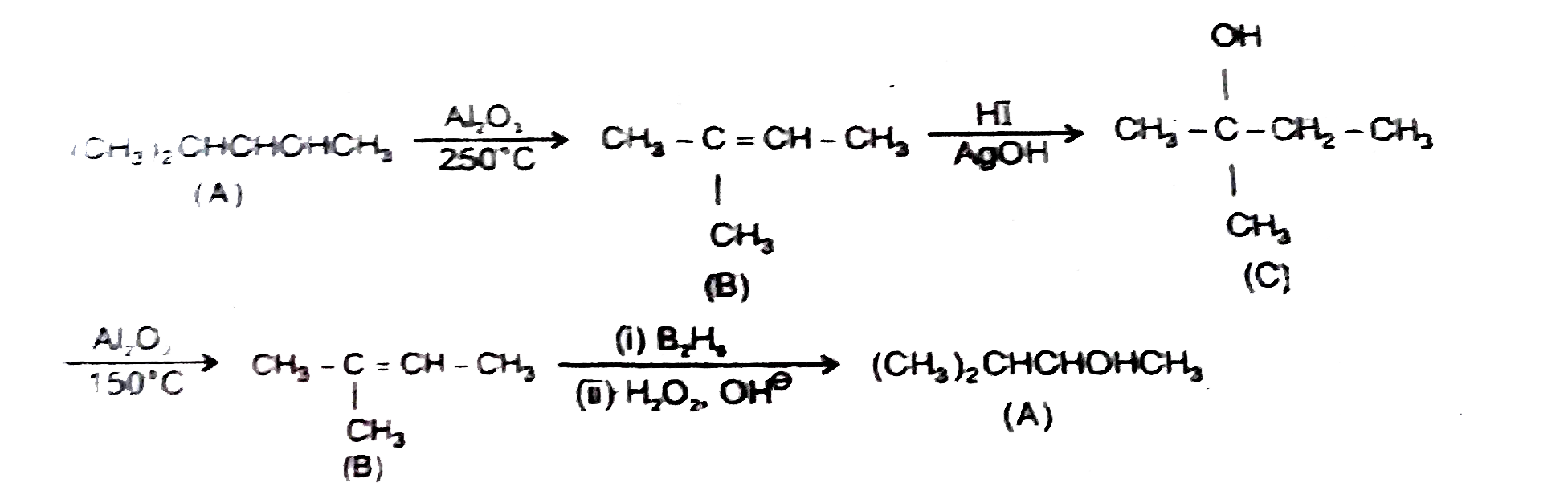
|
|
| 31. |
(A)underset(250^@C)overset(Al_2O_3)to(B)underset((ii)AgOH)overset(HI)to( C)underset(150^@C)overset(Al_2O_3)to(B)underset((ii)H_2O_2, OH^(-))overset((i)B_2H_6)to(A) In the above reaction sequence (A) and ( C) are isomers.Molecular formula of B is C_5H_10.which can also be obtained form the product of the reaction with CH_3CH_2MgBr and (CH_3)_2CO are followed by acidification. Identify the structure of B |
|
Answer» `(CH_3)_2-CH-CH=CH_2` 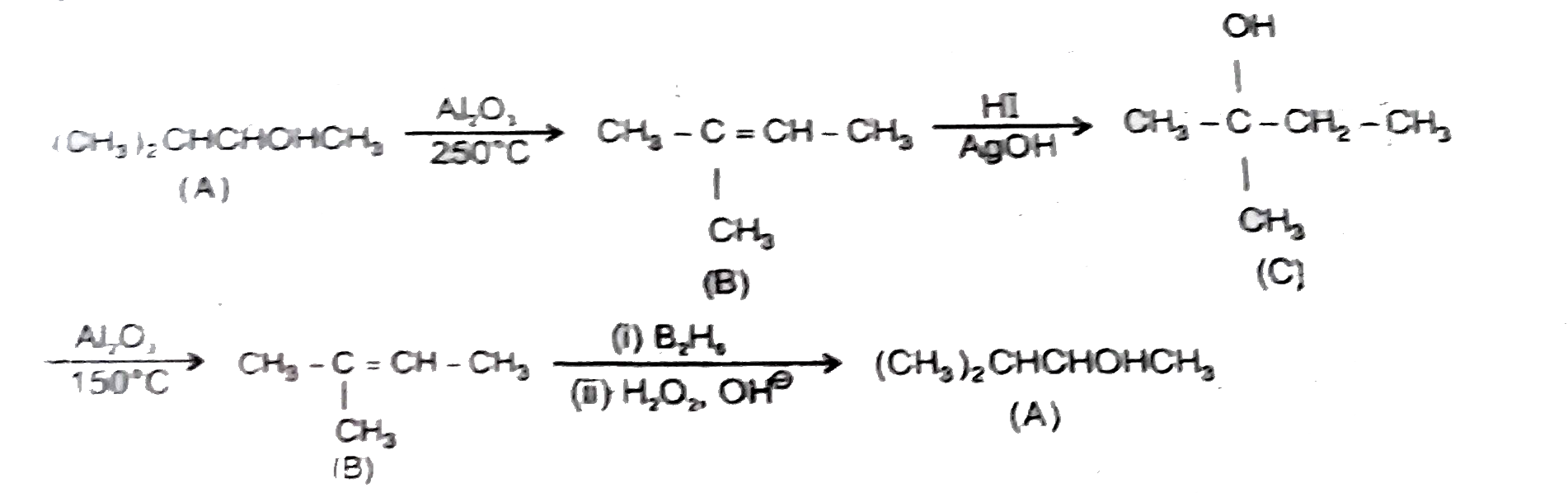
|
|
| 32. |
[A]underset"catalyst"overset"lindlar's"larrCH_3-C-=C-CH_3underset(liq. NH_3)overset"Na in"to[B] [A] and [B] are respectively |
|
Answer» CIS, trans-2-butene |
|
| 33. |
(A)underset(250^@C)overset(Al_2O_3)to(B)underset((ii)AgOH)overset(HI)to( C)underset(150^@C)overset(Al_2O_3)to(B)underset((ii)H_2O_2, OH^(-))overset((i)B_2H_6)to(A) In the above reaction sequence (A) and ( C) are isomers.Molecular formula of B is C_5H_10.which can also be obtained form the product of the reaction with CH_3CH_2MgBr and (CH_3)_2CO are followed by acidification. Identify the structure of A |
|
Answer» `CH_3-CH_2-CH_2-undersetunderset(OH)(|)CH-CH_3` 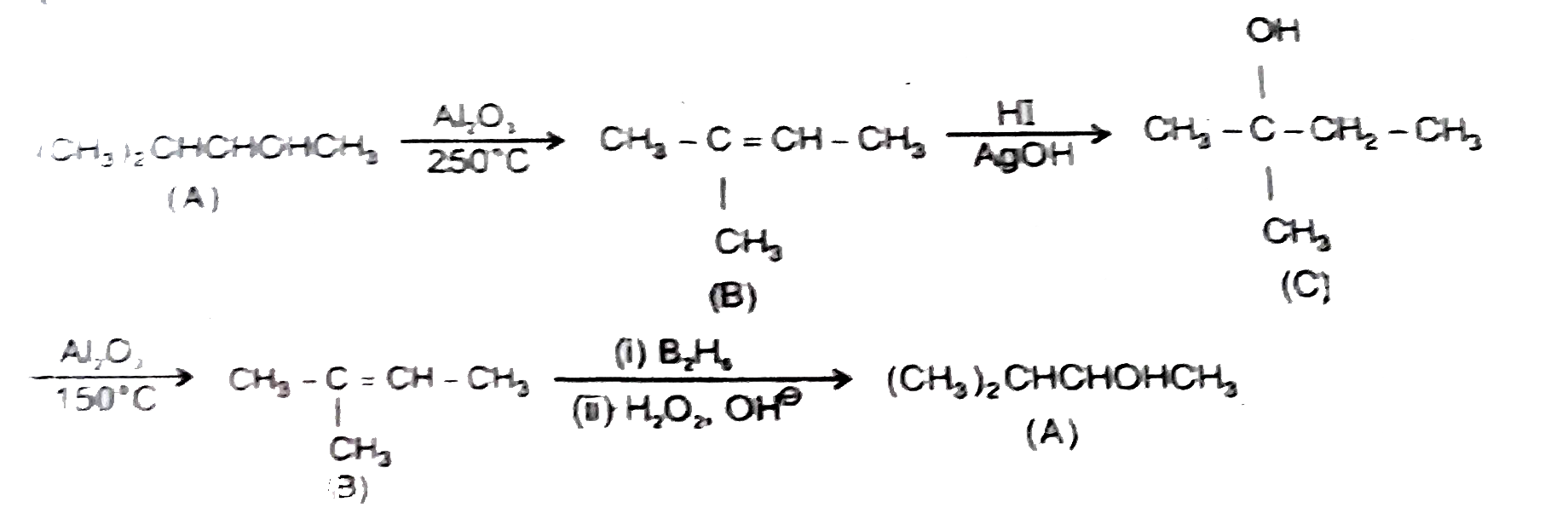
|
|
| 34. |
Au(I) is diamagnetic, while Au(III) has a magnetic moment of 2.95 BM. Predict the colour of aurous and auric ions? |
| Answer» Solution :`AU.(5d^(10))` ion is colourless due to the absence of UNPAIRED d - electron. `Au^(3+) (5d^8)` ion is coloured due to the PRESENCE of unpaired d- electrons and d-d TRANSITIONS. | |
| 36. |
Aufbau law is nol valiJ [ut |
|
Answer» `Cu` |
|
| 38. |
Au+CN^(-)+H_(2)+O_(2) to [Au(CN)_(2)+OH]^(-). How many CN^(-) ions are involved in the above balanced equation? (per mole of Au) |
|
Answer» 4 moles of Au..... 8 moles of NaCn 1 mole...... ? `:.` 2 ole of NaCN is USED for 1 mole of .Au. |
|
| 39. |
Attractive forces between metal ions and mobile electrons can be weaken or overcome by |
|
Answer» hummeer |
|
| 41. |
Attacking speciesin bromination of phenol is ___________. |
|
Answer» `Br_2`<BR>`Br^(+)` |
|
| 42. |
Attacking or reactive or electrophilic species in nitration of benzene is or In the nitration of benzene with concentrated HNO_3 and H_2SO_4 the attack on ring is made by |
|
Answer» `NO_2^-` |
|
| 43. |
Attacking reagent on benzene in the above reaction is |
|
Answer» An ELECTROPHILE i.e. `Fe^-Cl_2` |
|
| 44. |
Attachment of vinyl group or phenyl group directly to carboxylic acid group has effect on the acidic character of that carboxylic acid. Explain. |
Answer» Solution :DIRECT attachment of phenyl group or vinyl group to CARBOXYLIC acid increases the acidic character due to greater electronegativity of `sp^(2)` CARBON and also due to RESONANCE.
|
|
| 45. |
AtpH=2,E_("Quinhydrone")^@ =1.30V,E_("Quinhydrone") will be: |
|
Answer» 1.36V |
|
| 46. |
At pH=2,E_("Quinhydrone")^@ =1.30V,E_("Quinhydrone") will be: |
|
Answer» 1.36V |
|
| 47. |
Atrificial sweetener which is stable under cold conditions only is |
|
Answer» ASPARTAME |
|
| 48. |
Atoms X and Y form bee erystalline structure. Atom X is present at the corners of the cube and Y is at the centre of the cube. What is the formula of the compound ? |
|
Answer» Solution :Atoms X and Y form BCC crystalline structure. Atom X is present at the corners of the cube Atom Y is present at the centre of the cube. `"No of atoms of X in the unit CELL"=(N_(C))/(8)=(8)/(8)=1` `"No of atoms of Y in the unit cell"=(N_(b))/(1)=(1)/(1)=1` `"Ratio of atoms "X:Y=1:1` Hence formula of the compound = XY |
|
| 49. |
Atoms X and Y form bcc crystalline structure, Atom X is present at the corners of the cube and Y is at the centre of the cube. What is the formula of the compound ? |
|
Answer» Solution :Atoms X and Y form bcc CRYSTALLINE STRUCTURE. Atom X is present at the CORNERS of the cube Atom Y is present at the centre of the cube No of atoms of X in the unit cell `= (N_(C))/(8) = (8)/(8) =1` No of atoms of Y in the unit cell `= (N_(b))/(1) = (1)/(1) = 1` Ratio of atoms `X : Y = 1 : 1` Hence formula of the COMPOUND = XY. |
|