

Saved Bookmarks
This section includes 7 InterviewSolutions, each offering curated multiple-choice questions to sharpen your Current Affairs knowledge and support exam preparation. Choose a topic below to get started.
| 1. |
Account for the following : Thermal stability of water is much higher than that of H_2S. |
| Answer» SOLUTION :It is because bond DISSOCIATION energy of H-O bond is higher as COMPARED to H-S bond. | |
| 2. |
Account for the following: There are irregularities in the electronic configuration of actinoids. |
| Answer» SOLUTION :The irregularities in the electronic configurations of actinoids are due to the STABILITIES of `F^0, f^7` and `f^(14)` occupancies of the 5f-orbitals. | |
| 3. |
Account for the following : The two O-O bond lengths in the ozone molecule are equal. |
| Answer» Solution :Ozone may be regareded as a resonance HYBRID of the two RESONATING structures. Because of resonance, both the O-O bond lengths have partial double bond character. In other WORDS, both the O-O bond lengths are EQUAL (128 pm) and lie in between those O = O double bond length of 121 pm and O-O SINGLE bond length of 148 pm. | |
| 4. |
Account for the following: The acidic strength decreases in the order HCl gt H_2S gt PH_3 |
|
Answer» Solution :Acidic STRENGTH of a hydrogen compound depends UPON the electronegativity difference between hydrogen and the second element. Greater the electronegativity difference, greater the acidic strength. Electronegativity DECREASES in the order `CL(3.2) GT S (2.44) gt P(2.1)` Consequently , the acidic strength also decreases in the order `HCl gt H_2S gt PH_3` |
|
| 5. |
Account for the following: Tertiary amines do not undergo acylation reaction |
| Answer» SOLUTION :DUE to absence of any HYDROGEN atom ATTACHED to nitrogen. | |
| 6. |
Account for the following: Tendency to show -2 oxidation state diminishes from sulfur to polonium in group 16. |
| Answer» SOLUTION :Tendency to show-2 OXIDATION STATE decreases from sulfur to POLONIUM because of increase in atomic SIZE and decrease in electronegativity. | |
| 7. |
Account for the following: Tendency to show -2 oxidation state diminishes from sulphur to polonium in Group 16. |
| Answer» Solution :Due to INCREASE in atomic size and decrease in electonegativity, TENDENCY to show -2 oxidation state DECREASES from S to PO. | |
| 8. |
Account for the following: Tendency to show -2 oxidation state diminishes from sulfur to polonium in group16. |
| Answer» Solution :TENDENCY to show-2 OXIDATION state decreases from sulfur to polonium because of INCREASE in ATOMIC size and decrease in electronegativity. | |
| 9. |
Account for the following: Tendency to form pentahalides decreases down the group in Group 15 of the periodic table. |
| Answer» Solution :Tendency to form pentahalides decreases down the group in Group 15 of the periodic table. This is DUE to inert pair EFFECT. The configuration of Group 15 elements in the outermost orbit is `ns^(2) NP^(3)`. The `ns^(2)` electrons BECOME inert and do not participate in the bonding as we MOVE downwards. | |
| 10. |
Account for the following: t-butyl chloride on heating with sodium methoxide gives 2-methylpropene instead of t-butylmethylether |
| Answer» Solution :DUE to the FORMATION of stable INTERMEDIATE tertiary CARBOCATION. | |
| 11. |
Account for the following:Sulphur has a greater tendency for catenation than oxygen. |
| Answer» Solution :Bond strength of S- S bond is higher than that of O - O bond. The VALUES are 226 kJ/mol and 142 kJ/mol respectively. Therefore, SULPHUR has a greater tendency for catenation than oxygen. Oxygen on the other hand forms O=O DUE to SMALLER size of oxygen. | |
| 12. |
Account for the following: SbF_5 is much more stable than BiF_5 . |
| Answer» SOLUTION :As we move down the STABILITY of +5 oxidation state decreases because of inert PAIR EFFECT. That is why `SbF_5` is more stable than `BiF_5` | |
| 13. |
Account for the following : pK_(b) of aniline is more than that of methylamine. |
| Answer» Solution :In aniline, the LONE pair of electrons on the N-atom are delocalised due to resonance with benzene ring. As a result, electron density on the NITROGEN decreases. In CONTRAST, in `CH_(3)NH_(2)`, +I-effect of `CH_(3)` increases the electron density on the N-atom. Therefore, aniline is a weaker BASE than methylamine and hence its `pK_(b)` value is higher than that of methylamine. (Lower the value of `K_(b)`, higher the value of `pK_(b)`). | |
| 14. |
Account for the following pK_b of aniline is more than that of methylamine. |
| Answer» Solution :Basic strength of aniline smaller the value of `pK_b`, STRONGER the base. In aniline, the `NH_2` group is directly attached to the benzene ring. The lone pair of electron on NITROGEN ATOM in ailine gets delocalised over the benzene ring and hence it is less available for protonation makes the, aromatic amines (aniline ) less basic than `NH_3`. So aniline has a LOWER `pK_b` value than methyl amine. | |
| 15. |
Account for the following: Oxygen shows catenation behaviour less than sulphur. |
| Answer» Solution :Oxygen shows catenation BEHAVIOUR less than sulphur because oxygen being a smaller atom, forms strong `p pi- p pi`bond with another oxygen atom to form `O_2` molecule. `p pi - p pi` bonding is not strong in the case of sulphur, because it is a bigger atom. Sulphur, THEREFORE, completes its octet by catenation i.e., by FORMING a chain of `-S-S-S-` | |
| 16. |
Account for the following : Only aliphatic primary amines can be prepared by Gabriel Phthalimide synthesis. |
| Answer» Solution :Aromatic PRIMARY amines cannot be prepared by this method because the HALIDES do not undergo NUCLEOPHILIC SUBSTITUTION reaction with the anion FORMED by phthalimide. | |
| 17. |
Account for the following : On sulphonation of aniline, p-amino benzene sulphonic acid is formed. |
Answer» Solution :When aniline is heated with furming SULPHURIC ACID, p-amino BENZENE sulphonic acid is formed.  Aniline does not give o-amino benzene sulphonic acid because it is steically LESS favoured. |
|
| 18. |
Account for the following : On addition of ozone gas to KI solution, violet vapours are obtained. |
| Answer» Solution :`2KI + O_3 + H_2O to 2KOH + UNDERSET("Violet VAPOUR ")(I_2) + O_2` | |
| 19. |
Account for the following observations : (i) PK_(b) for aniline is more than that for methylamine. (ii) Methylamine solution in water reacts with ferric chloride solution to give a precipitate of ferric hydroxide. (iii) Aniline does not undergo Friedel Crafts reaction. |
|
Answer» Solution :(i) Lone pair of electrons on nitrogen in aniline is delocalised due to resonance with benzene ring. Thus, electron density on the amino group in aniline decreases. Consequently, its basic strength also decreases. On the other hand, electron density on amino group in methylamine increases due to `+I`-effect of `CH_(3)` group. Thus, it has a greater basic strength `(K_(b)). pK_(b)" and "K_(b)` are inversely related. Therefore, `pK_(b)` for aniline is more than that for methylamine. (ii) `CH_(3)NH_(2)+H_(2)O rarr CH_(3)overset(+)(N)H_(3)+OH^(-)` `FeCl_(3)+3OH^(-) rarr UNDERSET(underset("hydroxide")("Ferric"))(Fe(OH)_(3))+3Cl^(-)` It is due to the formation of `OH^(-)`, that the precipitation of ferric hydroxide takes place. (iii) `AlCl_(3)` is used as a catalyst in Friedel-Crafts REACTION. `AlCl_(3)` is a Lewis acid (electron deficient). `AlCl_(3)` gets attached to the lone pair of electrons in aniline. Amino group is thus not able to ACTIVATE the benzene ring for electrophilic SUBSTITUTION. Moreover electrophiles like `overset(+)(C)H_(3)" or "CH_(3)overset(+)(C)O` are not formed as the catalyst is consumed in association with amino group. Therefore, aniline does not undergo Friedel Crafts reaction. |
|
| 20. |
Account for the following observations: fluorine exhibits only -1 oxidation state whereas other halogens exhibit higher positive oxidation states also. |
| Answer» SOLUTION : Fluorine cannot exhibit POSITIVE oxidation states as it has no d-orbitals to accommodate the ELECTRONS from other ATOMS. It can only lose one electron to acquire noble gas configuration and thus exhibits -1 oxidation state only. | |
| 21. |
Account for the following observations : (i) pK_(b) for aniline is more than that for methylamine.(ii) Methylamine solution in water reacts with ferric chloride solution to give a precipitate of ferric hydroxide.(iii) Aniline does not undergo Friedel-Crafts reaction. |
|
Answer» Solution :(i) In aniline, the lone pair of electrons on the N-atom are delocalized over the benzene ring. As a result, electron DENSITY on the nitrogen decreases. In contrast, in `CH_(3)NH_(2)^(+)` I-effect of `CH_(3)` increases the electron density on the N-atom. Therefore, aniline is a weaker base than methylamine and hence its `pK_(B)` value is HIGHER than that of methylamine. (ii) Methylamine being more basic than water, accepts a proton from water liberating `OH^(-)` ions.  These `OH^(-)` ions COMBINE with `Fe^(3+)` ions present in `H_(2)O` to form brown ppt. of hydrated ferric oxide. `FeCl_(3) rarrFe^(3+) 3Cl^(-) 2Fe^(3+)+6OH^(-)rarrundersetunderset(("Brown ppt."))("Hydrated ferric oxide")(2Fe (OH)_(3))`. (iii) Aniline being a LEWIS base reacts with Lewis acid `AlCl_(3)` to form a salt `underset("Lewis base")(C_(6)H_(5)NH_(2))+underset("Lewis acid")(AlCl_(3))rarrC_(6)H_(5)N^(+)H_(2)AlCl_(3)^(-)` As a result, N of aniline acquires +ve charge and hence it acts a strong deactivating group for electrophilic substitution reaction. Consequently, aniline does not undergo Friedel-Crafts reactions. |
|
| 22. |
Account for the following observations: among the halogens F_2 is the strongest oxidising agent. |
| Answer» Solution :`F_2` is the strongest oxidising agent as it has the MAXIMUM value of reduction POTENTIAL among the HALOGENS. | |
| 23. |
Account for the following observations: acidity of oxo acid of chlorine is HOCl lt HOClO lt HOClO_2 lt HOClO_3 |
|
Answer» Solution :Oxidation state of chlorine DECIDES the acid strength. Greater the oxidation state, greater is the acid strength. Oxidation state number of Cl in HOCL = + 1 Oxidation state of Cl in HOClO = + 3 Oxidation state of Cl in HOClO2 = + 5 Oxidation state of Cl in HOClO3 = + 7 Hence, `HOCl lt HOClO lt HOClO_2 lt HOClO_3` |
|
| 24. |
Account for the following : O - O bond lengths in ozone molecule are identical. |
|
Answer» |
|
| 25. |
Account for the following: o-nitrophenol is more steam volatile than p-nitrophenol. |
| Answer» Solution :o-Nitrophenol is steam volatile DUE to INTRAMOLECULAR hydrogen BONDING while p-nitrophenol is less volatile due to INTERMOLECULAR hydrogen bonding. | |
| 26. |
Account for the following:Noble gases have very low boiling points. |
| Answer» SOLUTION :It is because of the WEAK INTERATOMIC, interaction present in noble gases. | |
| 27. |
Account for the following : Nitroethane reacts with nitrous acid. |
| Answer» SOLUTION :`CH_3CH_2NO_2` has TWO `ALPHA`-HYDROGEN and that REACTS with `HNO_2`. | |
| 28. |
Account for the following : Nitroethane is soluble NaOH. |
Answer» Solution :NITROETHANE exhibits tautomerism of nitro form and aci form. Aciform of nitroethane contains (`alpha` - Hydrogen) repalaceable hydrogen atom. Hence it DISSOLVES in SODIUM HYDROXIDE solution forming salt LIKE compounds. 
|
|
| 29. |
Account for the following: NH_3acts-as a Lewis base. |
| Answer» Solution :The PRESENCE of a lone PAIR of ELECTRONS on the nitrogen atom makes `NH_3`a Lewis base. | |
| 30. |
Account for the following: NH_3 is a stronger base than PH_3. |
| Answer» Solution :`NH_3` is a stronger base than `PH_3`. Due to smaller size of N than P, electron density is more on N in `NH_3` than on P in `PH_3`. Moreover, the stability of the CONJUGATE ACID DECREASES from `NH_3` to `PH_3`. THEREFORE, `NH_3` is a stronger base than `PH_3. | |
| 31. |
Account for the following: Neon is not known to form compounds. |
| Answer» Solution :NE has STABLE electronic configuration, small size and high ionisation ENTHALPY. Due to strong ATTRACTION between the nucleus and VALANCE electrons, these are not available for bonding. | |
| 32. |
Account for the following : Most of the reactions in fluorine are exothermic. |
|
Answer» |
|
| 33. |
Account for the following : Methylamine in water reacts with ferric chloride to precipitate hydrated ferric oxide. |
Answer» Solution :Methylamine being more basic than water, accepts a proton from water liberating `OH^(-)` ions.  These `OH^(-)` ions combine with `Fe^(3+)` ions PRESENT in `H_(2)O` to form brown ppt. of hydrated ferric oxide. `""FeCl_(3) rarr Fe^(3+)+3CL^(-)` `""2Fe^(3+)+6OH^(-) rarr underset(underset("(Brown ppt.)")("Hydrated ferricoxide"))(2Fe(OH)_(3)" or "Fe_(2)O_(3).3H_(2)O` |
|
| 34. |
Account for the following : (i)Aspirin drug helps in the prevention of heart attack. (ii)Diabetic patients are advised to take artificial sweeteners instead of natural sweetners. (iii)Detergents are non-biodegradable while soaps are biodegradable. |
|
Answer» Solution :(i)Most of the heart attacks are due to blood clotting in the coronary arteries. Aspirin helps to make the blood thinner and thus prevents the formation of blood CLOTS in the coronary arteries THEREBY preventing heart attacks. (ii)Diabetic patients do not produce enough insulin to metabolize the natural sugar. As a result, sugar remains in the blood and thus affects, liver, heart and kidneys. Therefore, diabetic patients are advised to take ARTIFICIAL sweeteners such as saccharin. It is not metabolized in the body and is excreted as such through urine without affecting the heart, liver and kidneys. (c )Soaps have straight hydrocarbon chains which are easily degraded by bacteria present in the sewage water and hence do not cause water pollution, ASPARTAME. Most of the detergents, on the other hand, have branched hydrocarbon chains which are either not ATTACKED or attacked only slowly by bacteria. As a result, detergents remain undegraded in rivers and waterways and thus cause water pollution. |
|
| 35. |
Account for the following: (i) The boiling points of alchols decrease with increasein branching of the alkyl chain. (ii) Phenol does not give protonation reaction readily. (iii) Phenyl methyl ehter reacts with HI to give phenol and methyl iodide and not iodobenzene and methyl alcohol. |
|
Answer» Solution :(i) The boiling point of alcohols decrease with increase in branching of alkyl chain: This is because of attraction decreases with decrease in surface area, hence boiling point decreases. (ii) Phenol does not give protonation REACTION readily: In phenols, the Ione pair of oxygen is being sharedwith benzene ring through resonance. Hence the electron density around oxygen is RELATIVELY less and therefore penols does not give protonation easily. (iii) Phenyl methyl ether reacts with HI to give phenol and methyl iodide and not iodobenzene and methyl ALCOHOL, 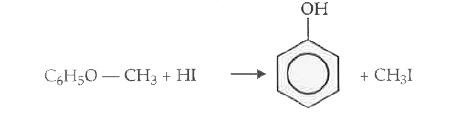 It is probably DUE to the fact that phenyl oxygen bond has a partial double bond character due to resonance. Therefore its cleavage is difficult as compared to alkyl oxygen bond. |
|
| 36. |
Account for the following: (i) Transition elements exhibit higher enthalpies of atomisation. (ii) Cr^(2+) is reducing and Mn^(3+) is oxidising when both have d^4 configuration. |
|
Answer» Solution :(i) The transition elements exhibit high enthalpies of ATOMIZATION because they have large number of unpaired `e^(-)` in their atoms. Due to which they have STRONGER interatomic interaction and hence stronger BONDING between atoms. (ii) Of the d species `CR^(2+)` is strong reducing while `MN^(3+)` is strongly oxidising. `Cr^(2+)`is reducing as its configuration changes from `d^(4)` to `d^3` host 2g configuration which is half-filled `Mn^(3+)` is oxidising because its configuration also changes from `d^5` (which is half filled) and has extra stability. |
|
| 37. |
Account for the following: (i) The boiling point of ethanol is higher than that of methanol. (ii) Phenol is a stronger acid than an alcohol. (iii) The boiling points of ethers are lower than isomeric alcohols. |
|
Answer» Solution :(i) Boiling point of ethanol is greater than METHANOL: Hydrogen bonding is present in both, but with increasing molecular mass , Van der Waals. forces of attraction increases which increases boilingpoint. (ii) Phenol is stronger acid than alcohol: 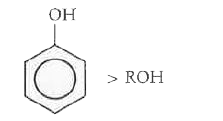 In phenol there is withdrawing `-C_(6)H_(5)` group present which facilitates the removal of a PROTON on the other hand in ROH, there is electron donating R group whcih makes the removal of proton difficult. After removal of proton, phenoxide ion is stabilized by RESONANCE whereas alkoxide ion is but resonance stabilized. (iii) Boiling point of ehters are lower than isomeric they do not INVOLVE hydrogen bonding whcih is present in alcohols. |
|
| 38. |
Account for the following: (i) Primary arnimes (R-NH_(2)) have higher boiling point than tertiary amines (R_(3)N). (ii) Aniline does not undergo Friedel -Crafts reacton. (iii) (CH_(3))_(2)NH is more basic than (CH_(3))_(3)N is an aqueous solution. |
|
Answer» Solution :(i) Due to MAXIMUM intermolecular hydrogen bonding in primary amines (due to presence of morenumber oif H-atoms), primary amines have heigher boilig point in comparison to TERTIARY amines (ii) Aniline does not undergo Friedel-Crafts reaction due to acid base reaction. Aniline and a Lewis acid /Protic Acid, which is used in Friedel crafts reaction. (III) In `(CH_(3))_(3)N` there is maximum steric hindrance and least solvation but in `(CH_(3))_(2)NH` the solvation is more group, di-methyl amine is still a stronger base than trimethyl amine. |
|
| 39. |
Account for the following : (i) Schottky defects lower the density of related solids. (ii) Conductivity of silicon increases on doping it with phosphorus. |
|
Answer» Solution :(i) In schottky DEFECT, some ions are MISSING (or due to vacancies) from their NORMAL lattice sites due to which density decreases. (ii) This is due to availability of unpaired or ODD electron provided by Phosphorus. |
|
| 40. |
Account for the following : (i) Schottky defect lowers the density of related solids. (ii) Conductivity of Si increases on doping it with phosphorus. |
|
Answer» Solution :(i) Schottky defect lowers the density of related solids because, for the same volume, there are smaller NUMBER of ions. THUS the density of the solid decreases. (ii) Phosphorus contains five valence electrons. Four of the five electrons are used in the FORMATION of four covalent bonds with neighbouring silicon ATOMS. The fifth electron is delocalised. These delocalised electrons INCREASE the conductivity of doped silicon. |
|
| 41. |
Account for the following : (i) pK_b of aniline is more than that of methylamine . (ii) Ethylamine is soluble in water, whereas aniline is not. (iii) Methylamine in water reacts with ferric chloride to precipitate hydrated ferric oxide . (iv) Although amino group is o- and p-directing in aromatic electrophilic substitution reactions, aniline on nitration gives a substantial amount of m-nitroaniline. (v) Aniline does not undergo Friedel-Crafts reaction. |
|
Answer» Solution :(i) In aniline, the lone pair of electrons on N atom is delocalized over the benzene ring. As a result, electron DENSITY on the nitrogen decreases. On the other hand , in `CH_3 NH_2 + I ` effect of `CH_3` group increases the electron density on N atom. THEREFORE, aniline is less basic than methylamine and hence `pk_b` of aniline is higher than that of methylamine. (ii) Ethylamine dissolves in water due to intermolecular hydrogen bonding as shown below :  However , because of large hydrophobic part (i.e. hydrocarbon part) of aniline, the extent of hydrogen bonding is less and therefore, aniline is insoluble in water. (III) Methylamine is more basic than water and therefore, accepts a proton from water forming `OH^(-)` ions `CH_3 NH_2 + H - OH to CH_3 - NH_3^+ + OH^-` These `OH^(-)` ions combine with `Fe^(3+)` ions to form brown ppt. of hydrate ferric oxide. `FeCl_3 to Fe^(3+) + 3Cl^(-)` `2Fe^(3+) + 6OH^(-) to underset("Hydrated ferric hydroxide (Brown ppt)")(2Fe(OH)_3 " or " Fe_2 O_3 . 3H_2 O)` (iv) Under strongly acidic conditions of nitrotion (in the presence of a mixture of conc. `NHO_3+ H_2 SO_4`) , aniline gets protonated and is CONVERTED into anilinium ion having - `NH_3^(+)` group. This group is deactivating group and is m-directing . So, the nitration of aniline gives o,p-nitroaniline (mainly p-product) while the nitration of anilinium ion gives m-nitroaniline.  Thus, nitration of aniline gives a substantial amount of m-nitroaniline due to protonation of aniline . (v) Aniline being a Lewis base reacts with Lewis acid such as `AlCl_3` to form a salt. `underset("Lewisbase")(C_6 H_5NH_2) + underset("Lewis acid")(AlCl_3) to underset("salt")(C_6 H_5 NH_2^(+) AlCl_3^(-))` As a result , N of aniline acquires + ve charge and hence it acts as a strong deactivating group for electrophilic substitution reaction. Hence aniline does not undergo Friedel-Crafts reaction. |
|
| 42. |
Account for the following : (i) Primary amines (R-NH_(2)) have higher boiling points than tertiary amines (R_(3)N). (ii) Aniline does not undergo Friedel-Crafts reaction. (iii) (CH_(3))_(2)NH is more basic than (CH_(3))_(3)N in an aqueous solution. |
|
Answer» Solution :(i) Primary amines are engaged in INTERMOLECULAR association due to hydrogen bonding between nitrogen of ONE and hydrogen of another molecule. This raises the boiling point of primary amine. There is no hydrogen in tertiary amines. Hence, no hydrogen bonding. THUS, primary amines have higher boiling point than tertiary amines. (ii) Aniline does not undergo Friedel-Crafts reaction due to salt formation with aluminium chloride which is the catalyst in the reaction. Due to this, nitrogen of aniline acquires positive charge and hence acts as a strong deactivating group for further reaction. According to inductive effect `(CH_(3))_(3)N` should be more basic than `(CH_(3))_(2)NH`. According to hydrogen bonding of substitued ammonium ion, `(CH_(3))_(2)NH` should be more basic than `(CH_(3))_(2)N`. Then there is the steric effect of the methyl group. The net RESULT of all these FACTORS is that `(CH_(3))_(2)NH` is more basic than `(CH_(3))_(3)N`. |
|
| 43. |
Account for the following: (i) pK_(a) of aniline is more than that of methylamine. (ii) Ethylamine is soluble I water whereas aniline is not. (iii) Methylamine in water reacts with ferric chloride to precipitate hydrated ferric oxide. (iv) Although amino group is o, p-directing in aromatic substitution reactions, aniline on nitration gives a substantial amount of m-nitroaniline. (v) Aniline does not undergo Friedel-Crafts reaction. (vi) Diazonium salts of aromatic amines are more stable than those of aliphatic amines. |
|
Answer» Solution :(i) In aniline, the lone pair of electrons on the N-atom is delocalized over the benzene ring. As a result, electron density on the NITROGEN decreases. In contrast, in `CH_(3)NH_(2)`, +I-effect of `CH_(3)` increases the electron density on the N-atom. therefore, aniline is a weaker base than methylamine and hence its `pK_(a)` value is higher than that of methylamine. (ii) Ethylamine dissolves in waer DUE to intermoleclar H-bonding as shown below: 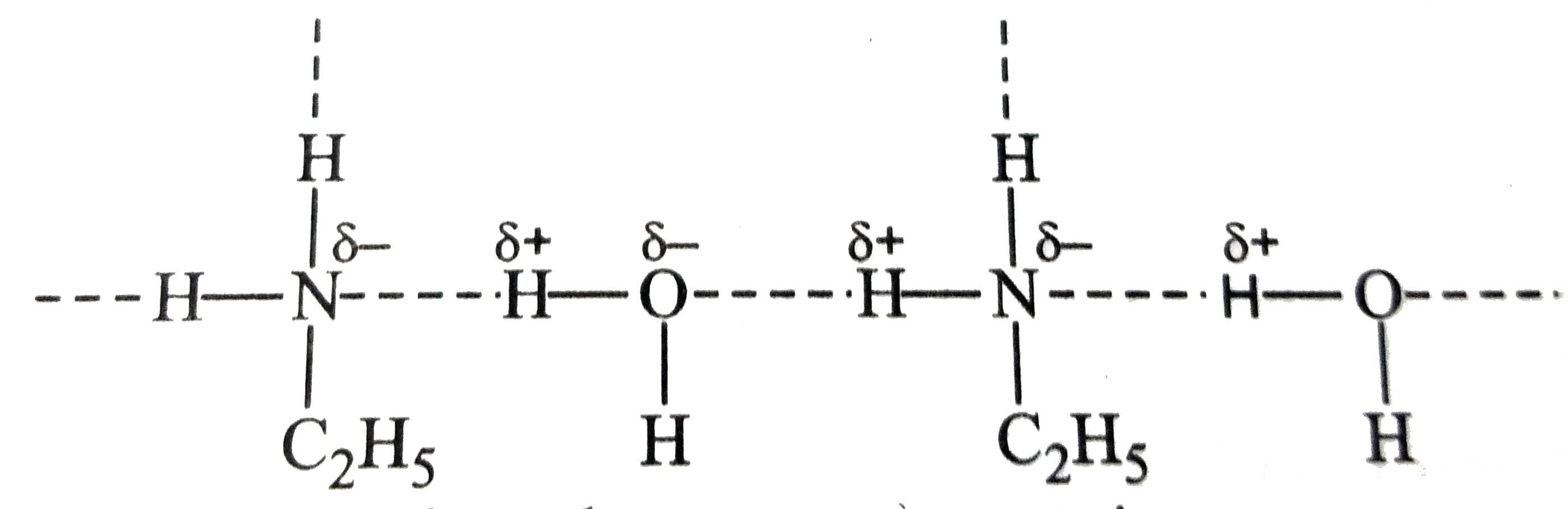 However, in aniline, due to the large hydrophobic part, i.e., hydrocarbon part, the extent of H-bonding decreases considerable and hence aniline is insoluble in water. (iii) Methylamine being more basic than water, saccepts a proton from water liberating `OH^(-)` ions.  These `OH^(-)` ions combines with `Fe^(3+)` ions present in `H_(2)O` to form brown ppt. of hydrated ferric oxide. `FeCl_(3) to Fe^(3+)+3Cl^(-)` `2Fe^(3+)+6OH^(-) to underset("Hydrated ferric oxide (Brown ppt.)")(2Fe(OH)_(3)" or "Fe_(2)O_(3).3H_(2)O)` (iv) Nitration is usually carried out with a mixture of conc.`HNO_(3)` + conc. `H_(2)SO_(4)` (nitrating mixture). In presence of these acids, most of aniline gets protonated to form anilinium ION. Therefore, in presence of acids, the reaction mixture consists of aniline ion. Now `-NH_(2)` group in aniline is o, p-directing and activating while the `-overset(+)(N)H_(3)` group in anilinium ion is m-directing and deactivating , the nitration of anilinium ion gives m-nitroaniline. In actual practice, approx. a 1:1 mixture of p-nitroaniline and m-nitroaniline is obtained. 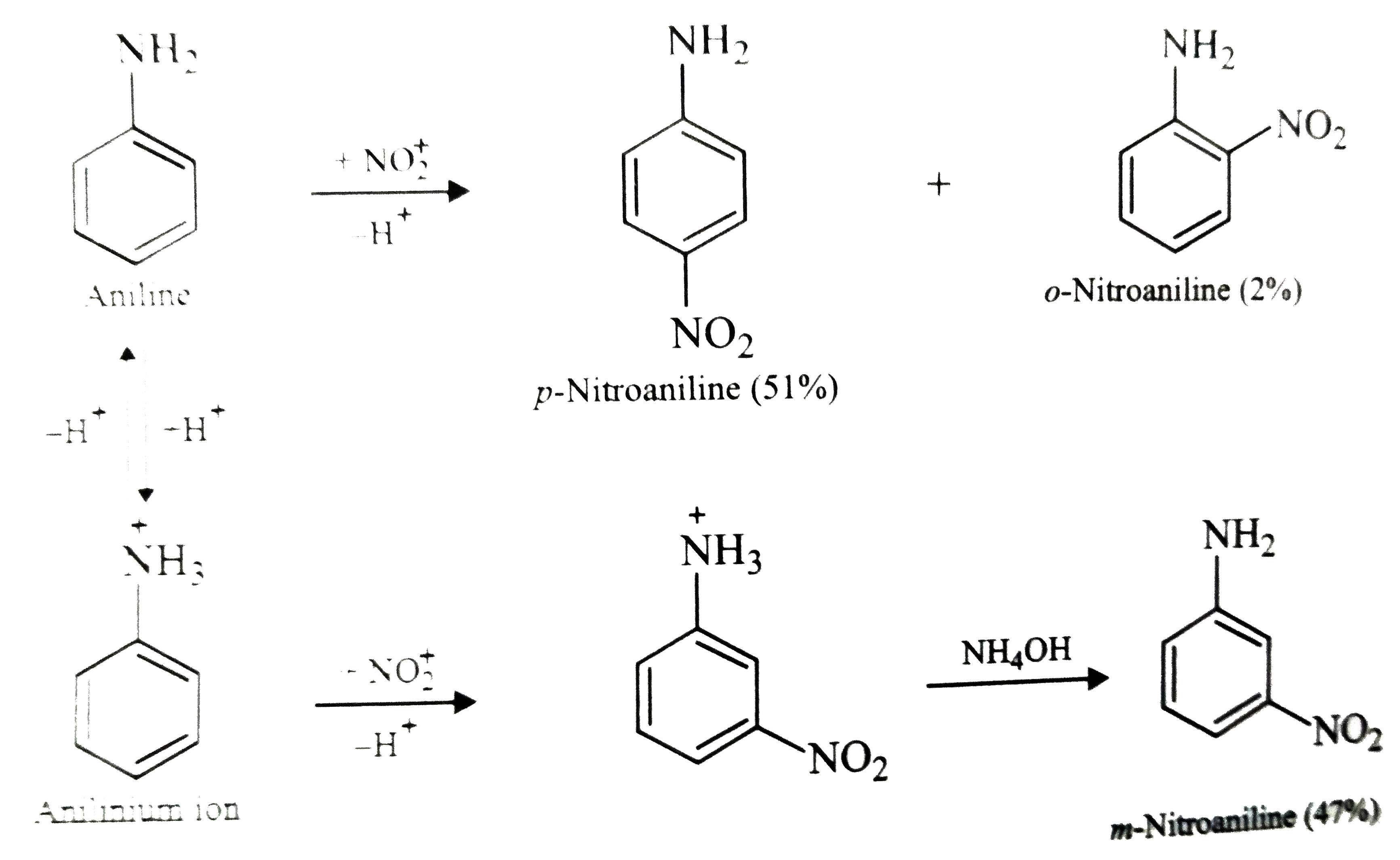 Thus, nitration of aniline gives a substantial AMOUNT of m-nitroaniline due to protonation of the amino group. (v) Aniline being a Lewis base reacts with Lewis acid `AlCl_(3)` to form a salt. 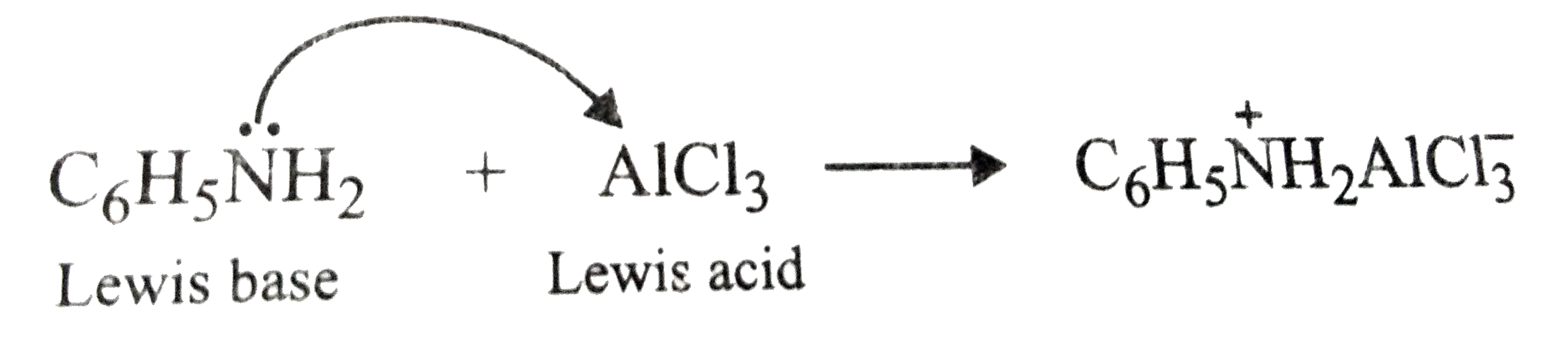 Due to the presence of a positive charge on N atom in the salt, the group `-overset(+)(N)H_(3)AlCl_(3)^(-)` acts as a strongly deactivating group. As a result, it reduces the electron density in the benzene ring and hence aniline does not undergo F.C. (alkylation or acylation) reaction. (vi) The diazonium salts of aromatic amines are more stable than those of aliphatic amines due to dispersal of the positive charge on the benzene ring as shown below: 
|
|
| 44. |
Account for the following : (i) Phenol has a smaller dipole moment than methanol. (ii) Phenol goes electrophilic substitution reactions. |
|
Answer» Solution :(i) Due to – ve CHARGE on oxygen in delocalized by resonance. (II) Due to GREATER ELECTRON density than benzene. |
|
| 45. |
Account for the following, (i) Phenol has a smaller dipole moment than methanol, (ii) Phenols do not give protonation reaction readily. |
|
Answer» Solution :(i) Phenol are only sparingly soluble in water. Actually they form only negligible hydrogen bonding with water since the SIAE of the phenyl group is large and it almost masks the polar character of -OH group. So phenol has a smaller dipole moment. `.....OVERSET(delta^(+))H- underset(CH_(3))underset(|)overset(delta^(-))O..........overset(delta^(+))underset(H)underset(|)H - overset(delta^(-))O........overset(delta^(+))O-underset(H)underset(|)overset(delta^(-))underset(H)underset(|)O` (ii) But methanol is soluble in water due to formation of hydrogen bonding with water and it resutls in higher dipole moment. In phenol, there is `+ve` charge on oxygen, THEREFORE it does not UNDERGO protonation easily. 
|
|
| 46. |
Account for the following : (i) Phenol has a smaller dipole moment than CH_(3)OH. (ii) Phenol do not give protonation reactions readily. |
|
Answer» SOLUTION :(i) Because phenol has electron attracting benzene ring. (ii) RESONANCE and +ve charge oxygen does not have TENDENCY to ACCEPT a PROTON. |
|
| 47. |
Account for the following: (i) Phenol does not get protonated readily, (ii) Phenol, benzene diazonium chloride, NaOH solution gives red dye. |
Answer» Solution :(i) In Phenol, there is `+ve` charge on the oxygen atom, THEREFORE it does not undergo protonation easily.  (II) When phenol, benzene dizaonium CHLORIDE and NaOH solution are mixed, COUPLING reaction take and the product formed is red dye. 
|
|
| 48. |
Account for the following : (i) PCl_(5) is more covalent than PCl_(3). (ii) Iron on reaction with HCl forms FeCl_(2) and not FeCl_(3). (iii) The two O-O bond lengths is the ozone molecule are equal. |
|
Answer» Solution :(i) Because `+5` oxidation STATE is more COVALENT than `+3`/ HIGH charge to size ratio/high polarizing power. (II) Because `HCl` is a mild oxidising agnet/formation of HYDROGEN gas prevents the formation of `FeCl_(3)`. (iii) Because of resonance in `O_(3)` molecule. |
|
| 49. |
Account for the following : (i) Oxidizing power in the series : VO^(2+) ltCr_(2)O_(7)^(2-)ltMnO_(4)^(-) (ii) Actinoid contraction is greater from element to element than lanthanoid contraction. (iii) Oxoanion of a metal show higher oxidation states. |
|
Answer» Solution :(i) This is due to increasing stabilityof the lower SPECIES to which they are reduced. (ii) This is due to POOR shielding effect of 5f electrons of actinoids than 4f electrons of LANTHANOIDS. (iii)This is due to high electronegativity and multiple bond formation with METAL by OXYGEN. |
|
| 50. |
Account for the following : (i) PCl_(5) can act as an oxidising agent but not as a reducing agent. (ii) Halogens are coloured. |
|
Answer» Solution :(i) `PCl_(5)` can act as an oxidising agent but not as reducing agent : Oxidation STATES shown by phosphorus is `+3 and +5`. Its valence shell has 5 electrons. Hence it can oxidise others and itself gets reduced by accepting electrons and get converted into `PCl_(3)`, but cannot show more than `+5` oxidation state. (ii) Halogens are COLOURED : The colour of halogen is due to absorption of visible light by their molecules resulting in the excitation of outer ELECTRON to higher energy levels. e.g., Fluorine being smaller in size abosrbs violet light and APPEARS pale yellow. |
|