

Saved Bookmarks
This section includes 7 InterviewSolutions, each offering curated multiple-choice questions to sharpen your Current Affairs knowledge and support exam preparation. Choose a topic below to get started.
| 1. |
(A): The enthalpy of neutralisation of a strong acid by a strong base is a constant. (R) : The net reaction that takes place is the same. |
|
Answer» Both A and R are true R is the CORRECT EXPLANATION. |
|
| 2. |
Assertion(A ): The enthalpies of elements in their standard states are taken as zero Reason (R ): It is impossible to determine the absolute enthalpy of any substance |
|
Answer» Both A and R are true R is the CORRECT explanation. |
|
| 3. |
Assertion (A) : The energy of ultraviolet radiation is greater than the energy of infrared radiation Reason (R) : The velocity of ultraviolet radiation is greater than the velocity of infrared radiation |
|
Answer» Both A and R are true and R is the CORRECT explanation of A |
|
| 4. |
(A) : The energy of electrons is largely determined by its principal quantum number. (R) : The principal quantum number is a measure of most probable distance of finding the electron around the nucleus |
|
Answer» Both (A) and (R) are TRUE and (R) is the correct explanation of (A) |
|
| 5. |
(A) : The energy of electron is largely determined by its principal quantm number. (R) : The principal quantum number is a measure of most probable distance of finding the arond the nucleus |
|
Answer» Both (A) and (R) are TRUE and (R) is the correct EXPLANATION of (A) |
|
| 6. |
(A) : The electronic configuration of Cr is [Ar]3d^(5)4s^(1) but not [Ar]3d^(4)4s^(2) (R) : Lowering energy with configuration [Ar]3d^(5) 4s^(1) is more than that with configuration [Ar]3d^(4)4s^(2) |
|
Answer» Both (A) and (R) are TRUE and (R) is the CORRECT EXPLANATION of (A) |
|
| 7. |
(a) The electronicin Bohr's orbit is negative. How will you account for it ? (b) The ionisation energy of hydrogen atom is 13.6 eV. What will be the energy of the first orbit of He^(+) and Li^(2+) ions are ? |
|
Answer» |
|
| 8. |
(A): The dipole moment value of NH_3 is greater than zero (B): In NH_3 bond angle is approximately 104^@ |
|
Answer» Both (A) and (R) are TRUE and (R) is the CORRECT EXPLANATION of (A) |
|
| 9. |
(A): The dipolemoment value of NH_3 is greater than zero (R) : In NH_3 bond angle is approximately 104^@ |
|
Answer» Both (A) and (R) are true and (R) is the CORRECT explanation of (A) |
|
| 10. |
(A): The difference in the successive oxidation states exhibited by transition elements is unity only. (R) : d-Orbitals of transition elements are incompletely filled. |
|
Answer» Both A and R are TRUE and R is the correct explanation |
|
| 11. |
(A): The carbon -carbon bond lengths in benzene molecule are 1.54 A^@ and 1.34A^@ (R): Benzene has delocalised p - bonds |
|
Answer» Both A and R are TRUE and R is CORRECT EXPLANATION of A |
|
| 12. |
A: The boiling point of H_2O_2 cannot be dtermined experimentally by distillation.R : H_2O_2 decomposes into H_2 and O_2 below itsboilingpoint |
|
Answer» both A and R are true, R is not the correct explanation to A |
|
| 13. |
(A): The atomic size of gallium is less than expected (R): In gallium the 3^(10) delectrons do not shield effectively |
|
Answer» A and R are TRUE, R EXPLAINS A |
|
| 14. |
A tetravalent element forms monoxide and dioxide with oxygen. When air is passed over heated element (1273 K), producer gas is obtained. Monoxide of the element is a powerful reducing agent and reduces ferric oxide to iron. Identify the element and write formulas of its monoxide and dioxide. Write chemical equations for the formation of producer gas and reduction of ferric oxide with the monoxide. |
|
Answer» Solution :Producer gas is a mixture of `CO_((g))`and `N_(2(g))` . Carbon is tetravalent and gives MONOXIDE (CO) and dioxide `(CO_2)` with oxygen `2C_((s)) + ubrace(O_(2(g)) + 4N_(2(g)))_"Air"overset"1273 K"to ubrace(2CO_((g)) + 4N_(2(g)))_"Producer gas"` The carbon monoxide a strong reducing agents and REDUCES FERRIC oxide to iron. `Fe_2O_(3(s)) + 3CO_((g)) OVERSETDELTATO 2Fe_((s)) + 3CO_(2(g))` |
|
| 15. |
A tetravalentelement formsmonoxide and disoxidewit oxygen. When air is passed over heated element (1273 K). Producer gas is obtained. Monoxide of the lement is a powerful reducing agent and reduces ferric oxide to iron. The element and write formulas of its monoxideand dioxide. Write chemicalequationsfor the formationof producera gas and reduction if ferric oxidewith the monoxide. |
|
Answer» Solution :Since producer gas is amixtureof CO and `N_(2)`, therefore , thetetravalentelementis carbonand its monoxideand dioxideare CO and `CO_(2)` respectively. `2C(s) + ubrace(O_(2)(g)+4N_(2)(g))_("Air") overset(1273K)rarrubrace(2CO(g)+4N_(2)(g))_("Producer gas")` The monoxide of CARBON , is a strongreducing agent and reduces ferric OXIDE to iron. `Fe_(2)O_(3)(s) + 3CO(g) overset(Delta)rarr 2 Fe(s) + 3O_(2)(g)`. |
|
| 16. |
A tetravalent element forms monoxide and dioxide with oxygen. When air is passed over heated element (1273k), producer gas is obtained. Monoxide of the element is a powerful reducing agent and reduces ferric oxide to iron. Identify the element and write formulas of its monoxide and dioxide. write chemical equations for the formation of producer gas and reduction of ferric oxide with the monoxide. |
|
Answer» Solution :Producer gas is a mixture of CO and `N_(2)`, THEREFORE the tetravalent element is carbon and its monoxide and dioxide are CO and `CO_(2)` respectively `2C(s)+underset("AIR")(underbrace(O_(2)(s)+4N_(2)(g)))OVERSET(1273K)(rarr)underset("Producer gas")(underbrace(2CO(g)+4N_(2)(g)))` The carbon monoxide is a strong reducing agent and reduces FERRIC oxide to iron `Fe_(2)O_(3)(s)+3CO(g)overset(Delta)(rarr)2Fe(s)+3CO_(2)(g)`. |
|
| 17. |
A tertiary alcohol H upon acid- catalyzed dehydration gives a product I. Ozonolysis of to compounds J and K. Compound J upon reaction with KOH gives benzly alcohol and a compound L, whereas K on reaction with KOH gives only M. The structures of compound J,K and L respectively , are |
|
Answer» `PhCOCH_(3),PhCH_(2)COCH_(3)`and`PhCH_(2)COO^(-)K^(+)` `underset((J))(Ph-CHO)overset(OH^(-))underset(("CANNIZARO reaction"))to underset((L))(Ph-CH_(2)OH+Ph-COO^(-)K^(+)` |
|
| 18. |
A tertiary alcohol H upon acid- catalyzed dehydration gives a product I. Ozonolysis of to compounds J and K. Compound J upon reaction with KOH gives benzly alcohol and a compound L, whereas K on reaction with KOH gives only M. The structure of compound I is |
|
Answer»
`underset((J))(Ph-CHO)overset(OH^(-))underset(("CANNIZARO reaction"))to underset((L))(Ph-CH_(2)OH+Ph-COO^(-)K^(+)` |
|
| 19. |
A tennis ball of mass 6.0 xx 10^(-2) kg is moving with a speed of 62 ms^(-1). Calculate the wavelength associated with this moving tennis ball. Will the movement of this ball exhibit a wave character? Explain. |
| Answer» SOLUTION :`1.8 xx 10^(-34)m`. No because the WAVELENGTH is too SMALL to be observed | |
| 20. |
(A) : Temporary hardness can be removed by boiling hard water (R) : On boiling hard water bicarbonates of calcium and magnesium are converted to insoluble carbonates |
|
Answer» Both A and R are TRUE, and R is CORRECT EXPLANATION of A |
|
| 21. |
A tank contains a mixture of 52.5g of oxygen and 65.1g of CO_(2) at 300K the total presuure in the tank is 9.21atm. Calculate the partial pressure (in atm) of each gas in the mixture? |
|
Answer» <P> SOLUTION :`m_(o_(2))=52.5g` `P_(O_(2))=?` T=300K`m_(CO_(2))=65.1g` `P_(CO_(2))=?` `P=9.21atm` 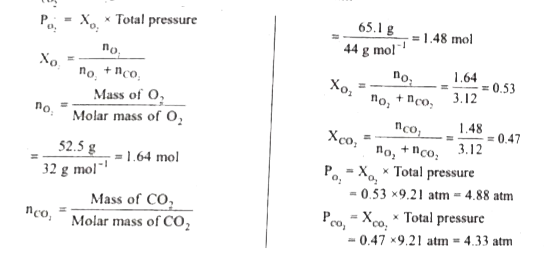
|
|
| 22. |
A tandard hydrogen electrode has zero electrode potential because |
|
Answer» HYDROGEN is easiest ot oxidize |
|
| 23. |
(a). Take 1 L of a mixture of CO and CO_(2) Pass this mixture through a tube containing red hot charcoal. The volume now becomes 1.6 L. The volumes are measured under the same conditions. Find the composition of the mixture by volume. (b). A compound contains 28 percent of nitrogen 72 percent of ametal by weight. Three atoms of the metal combine with two atoms of N. find the atomic weight of the metal. |
|
Answer» Solution :(a). Let the volume of CO in the mixture be V. The volume of `CO_(2)` in the mixture is `(1-V)` `CO_(2)+Cto2CO` `(1-V)LCO_(2)` forms `2(1-V)LCO`. Total CO, `V+2(1-V)=1.6` or `V=0.4` `CO=0.4L` `CO_(2)=1-V=0.6L` (b). 28 g of nitrogen combines with 72 g of metal. three atoms of metal. Three atoms of metal combine with two atoms of nitrogen. This means the valency of metal is 2. " Eq of "`N=(28)/((14)/(3))=(1)/(6)` " Eq of "metal `=(72)/((M)/(2))=(144)/(M)` `THEREFORE(1)/(6)=(144)/(M)impliesM=(144)/(6)=24g` |
|
| 24. |
A system which can exchange energy with the surrounding but not matter is called |
|
Answer» A heterogeneous system |
|
| 25. |
A system undergoes a process in which DeltaU = + 300 J while absorbing 400 J of heat energy and undergoing an expansion against 0.5 bar. What is the change in the volume (in L)? |
|
Answer» 4 `300 = 400 -0.5 xxDeltaVxx100` `DELTAV = 2L` |
|
| 26. |
A system undergoes two cyclic process 1 and 2. Process 1 is reversible and process 2 is irreversible. The correct statement relating to the two processes is |
|
Answer» `Delta S` (for PROCESS 1) = 0, while `Delta S` (for process 2) `NE 0` |
|
| 27. |
A system receives 224 Joule heat and does work of 156 Joule. Calculate the change in internal energy. |
| Answer» SOLUTION :68 JOULE | |
| 28. |
A system receives 100 Joule heat and does work of 50 Joule. Calculate the change in the internal energy? |
|
Answer» `-150` JOULE |
|
| 29. |
A system receives 100 calory heat at that time 50 calory work is done by system. Calculate the change in internal energy. |
| Answer» SOLUTION :50 CALORY | |
| 30. |
A system is taken from state A to B through three different paths 1,2 and 3. The work done is maximum is : |
|
Answer» PROCESS 1 |
|
| 31. |
A system is provided with 50 J of heat and the work done on the system is 10J .What is the change in internal energy of the system in joules ? |
|
Answer» 60 |
|
| 32. |
A system is changed from initial state to finalstate in such amanner that DeltaH=q . If the same change from initialstate to final statewere made bydifferent path , whichof the following statementsare correct? |
|
Answer» `DeltaH`REMAINS the same |
|
| 33. |
A system consisting of one mole of an ideal diatomic gas absorbs 200J of heat and does 50J of work on surroundings. What is the change in temperature if vibrational modes of motion are inactive? |
|
Answer» `(150J mol^(-1))/(8.314 xx (5)/(2))` |
|
| 34. |
A system has internal energy equal to E_1, 450 J of heat is taken out of it and 600 J of work is done on it. The final energy of the system will be |
|
Answer» `(E_1+ 150)` |
|
| 35. |
A systemcontains 1 mole of a monoatomic ideal gas . Now1 mole ofa diatomic non-reacting idealgasisaddedinto the systemat constantvolume and temperature. Due to addition diatomicgas ,Choosethe incorrectstatement, regarding the new system : |
|
Answer» ENTHALPY of systemwillincrease |
|
| 36. |
A system absorbs 600J of energy and does work equivalent to 400J J of energy. The internal energy changes |
|
Answer» 1000J |
|
| 38. |
A system absorbs 100J of heat at constant volume and its temperature raises from 300K to 320K, Calculate the change in internal energy. |
| Answer» Solution :At CONSTANT VOLUME, work done is zero. Hence CHANGE in INTERNAL energy, `Delta E =q= 100 J` | |
| 39. |
A system absorbs 50 kJ heat and does 20 kJ of work. What is the net change in the internal energy of the system ? |
|
Answer» INCREASE by 30 kJ |
|
| 40. |
A system absorbs 10kJ of heat at constant volume and its temperature rises from 27^(0)C " to " 37^(0)C. The DE of reaction is |
| Answer» Answer :B | |
| 41. |
A system absorbs 10kJ of heat at constant volume and its temperature rises from 27^(@)C " to" 37^(@)C. The Delta E of reaction is |
| Answer» ANSWER :B | |
| 42. |
A synthetic mixture of nitrogen and Argon has a density of 1.4 g L^(-1) at 0^@C. Calculate the average molecular weight. Find out the volume percentage of nitrogen in the mixture. |
|
Answer» Solution :Molecular weight (M) can be obtained from density (d) as, `M=(dRT)/(P )` Average molecular weight of the mixture =` (1.4 xx 0.0821 xx 273 )/(1) = 31.4` If the % VOLUME of `N_2 ` is .x. ` 31.4 = ( x xx 28+(100-x)40)/( 100 )implies12 x = 840 orx=70` The volume PERCENTAGE of `N_2` in the mixture = 70 |
|
| 43. |
A symmetrical organic compound of C_(4)H_(11)N give yellow oily layer on treatement with HNO_(2) then find the structure of the compound. |
|
Answer» |
|
| 44. |
A swimmer coming out from a pool is covered with a film of water weighing about 18g. How much heat must be supplied to evaporate this water at 298 K? Calculate the internal energy of vaporisation at 100^@C. DeltaH_(vap)^@ for water at 373K = 40.66 kJ mol^(-1) |
|
Answer» Solution :We can represent the PROCESS of EVAPORATION as `H_(2)O_((l)) overset("vaporisation")(rarr)H_2O_((g)) , DELTA = 1 - 0 = 1` `Delta_(vap) E = Delta_(vap)H - pDeltaV =Delta_(vap) H - DeltanRT` (assumig steam BEHAVING as an ideal gas). `Delta_(vap) E = 40.66 kJ mol^(-1) - (1)` `(8.314 xx 10^(-3) KJ K^(-1) mol^(-1))(373 K) = 37.56 kJ mol^(-1)`. |
|
| 45. |
A swimmer coming out from a pool is covered with a film of water weighing about 18g. How much heat must be supplied to evaporate this water at 298 K ? Calculate the internal energy of vaporization at 100°C. Delta_("vap") H^( Theta ) for water at 373K = 40.66 "kJ mol"^(-1) |
|
Answer» Solution :We can represent the process of EVAPORATION as `18g H_(2) O_((l)) overset("vaprisation")(to) 18g H_(2) O_((g))` No. of moles in `18 g, H_(2) O_((l))` is `= (18g)/( 18 "g mol"^(-1) )=1` mol `Delta_("vap") U= Delta_("vap") H^( Theta ) - PDELTAV = Delta_("vap") H^( Theta ) - Deltan_(g) RT` (assuming steam behaving as an ideal gas) `Delta_("vap") H^( Theta ) - Delta n_(g) RT = 40.66 "kJ mol"^(-1) -(1)` `(8.314 "JK"^(-1) "mol"^(-1) ) (373 K) (10^(-3) "kJ J"^(-1))` `Delta_("vap") U^( Theta ) = 40.66 "kJ mol"^(-1) -3.10 "kJ mol"^(-1)` `=37.56 "kJ mol"^(-1)` |
|
| 46. |
A swimmer coming out from a pool is covered a film of water weighing about 18g. How much heat must be supplied to evaporate this water at 298K ? Calculate the internal energy of vaporisation at100^(@)C. Delta_(vap) H^(@) for water at 373K = 40.66 kJ mol^(_1). |
|
Answer» Solution :The process of EVAPORATION is `: 18 H_(2) O(l ) rarr 18 g H_(2)O(g) ` No. of moles of 18 g `H_(2) O = (18g )/(18 g mol^(-1))= 1 mol` `Delta n_(g) = 1-0 =1 mol` `:. Delta _(vap) U^(@) = V_(vap) H^(@) - Delta n_(g) RT = 40.66 k J mol^(-1) - (1 mol ) (8.314 xx 10^(-3) k J K^(-1) mol^(-1) ) ( 298 K) ` `= 40.66 k J mol^(-1)- 3.10 kJ mol^(-1) = 37. 56 kJ mol^(-1)` |
|
| 47. |
A suspension of mangnesium hydroxide in water is called ----- and is used as ----- in medicine |
|
Answer» Milk of LIME, ANTICEPTIC |
|
| 48. |
(A) surfactent molecules form micelles above the critical micelle concentration (CMC). (R) The conductance of solution of surfactant molecules decreases sharply at the (CMC). |
|
Answer» IF both (A) and (r) are correct and (r) is the correct EXPLANATION for (a). |
|
| 49. |
Example of surface active substance A) Cholesterol , B) Alcohol ,( C) Soap |
|
Answer» CHOLESTEROL |
|
| 50. |
(A) sulphate ores are concentrated by froth floation process. (R) Pine oil forms emulsion in water. |
|
Answer» IF both (A) and (R) are CORRECT and (r) is the correct EXPLANATION for (a). |
|


