

Saved Bookmarks
This section includes 7 InterviewSolutions, each offering curated multiple-choice questions to sharpen your Current Affairs knowledge and support exam preparation. Choose a topic below to get started.
| 1. |
A sugar syrup of weight 214.2 g contains 34.2gofsugar(C_(12)H_(22)O_(11)).Calculate(i)molal concentration (ii) mole fraction of sugar in the syrup. |
|
Answer» Solution :Weight of sugar syrup = 214.2 g Weight of sugar present = 34.2 g MOLECULAR mass of sugar `(C_(12)H_(22)O_(11)) = 342` (i) CALCULATION of molality : Number of moles of sugar = `34.2/342 = 0.1` Weight of water `=214.2 - 34.2 = 180 g = 0.18 g` `therefore` Molecular of the solution `=("No. of moles of sugar")/("Weight of water in kg")` `=0.1/0.18 = 0.56 MOL kg^(-1)` Hence, the MOLAL concentration of the given solution is 0.56 m. (ii) Calculation of mole fraction : Number of moles of sugar `(n_(1))=0.1` Number of moles of water `(n_(2)) = 180/18 = 10` Total number of moles in solution `=n_(1) + n_(2) = 0.1 + 10 = 10.1` `therefore` The mole fraction of sugar `=n_(1)/(n_(1)+ n_(2)) = 0.1/10.1 = 9.9 xx 10^(-3)` |
|
| 2. |
A sudden large jump between the value of second and third ionisation energies of elements would be associated with which of the following electronic configurations ? |
|
Answer» `1s^(2) 2s^(2) 2p^(6) 3s^(1)` |
|
| 3. |
A sudden jump between the values of second and third ionisation energies of an element is associated with configuration |
|
Answer» `1s^2 2s^2 2p^63s^1` |
|
| 4. |
A substance which promotes the activity of a catalyst is known as |
|
Answer» initiator |
|
| 5. |
A substance which is not present in nature but added lo atmoshphere due to human activity and causes adverse effect on environment is called |
|
Answer» POLLUTANT |
|
| 6. |
A substance which is not present in nature but added to atmoshphere due to human activity and causes adverse effect on environment is called |
|
Answer» POLLUTANT |
|
| 7. |
A substance which gives brick red flame and breaks down on heating to give oxygen and a brown gas is.... |
|
Answer» magnesium nitrate `2Ca(NO_(3))_(2) to 2CaO+NO_(2)+O_(2)` `NO_(2)` is brown coloured gas. |
|
| 8. |
A substance which gives brick red flame and breaks down on heating to give oxygen and a brown gas is |
|
Answer» CALCIUM carbonate |
|
| 9. |
A substance on analysis, gave the following percentage composition, Na = 43.4%, C = 11.3%, 0 = 45.3% calculate its empirical formula [Na = 23, C = 12, O = 16]. |
| Answer» SOLUTION :`Na_2CO_3` | |
| 10. |
A substance on analysis, gave the following percentage composition, Na = 43.4%, C = 11.3%, 0 = 43.3% calculate its empirical formula [Na = 23, C = 12, O = 16]. |
| Answer» SOLUTION :`Na_2CO_3` | |
| 11. |
A substance of crude copper is boiled in H_(2)SO_(4) till all the copper has reacted. The impurites are inert to acid. The SO_(2) liberated in the reactionis passed into 100mL of 0.4M acidified KMnO_(3). The solution of KMnO_(4)after passage of SO_(2) is allowed to react withoxalic acid and requireds 23.6mL of 1.2M oxalic acid. IF the purity of copper is 90% what was the weight of sample? |
|
Answer» |
|
| 12. |
A substance is expanded in adiabatic process from 2 L to 5 L against constant pressure of 1 bar then internal energy change will be : |
|
Answer» 3 BAR-L |
|
| 13. |
A substance A_(x)B_(y) crystallizes in a face centred cubic (FCC) lattice in which atoms 'A' occupy each corner of the cube and atoms 'B' occupy the centres of each face of the cube. Identify the correct composition of the substance A_(x)B_(y) |
|
Answer» `AB_(3)` |
|
| 14. |
A substance A_(x) B_(y) crystallises in a face centred cubic (FCC) lattice in which atoms 'A' occupy each corner of the cube and atoms 'B' occupy the centres of each face of the cube. Identify the correct composition of the substance A_(x)B_(y). |
|
Answer» `AB_(3)` Number of B atoms per unit cell = `6times1/2=3` Composition of solid = `AB_(3)` |
|
| 15. |
A substance absorbs CO_2 and violently reacts with water. The substance is |
| Answer» SOLUTION :`CaO` | |
| 16. |
Chemical A is used for water softening to remove temporary hardness. A reacts with sodium carbonate to generate caustic soda. When carbondioxide is bubbled through A, it turns cloudy. What is the chemical formula of A? |
|
Answer» `CaCO_(3)` |
|
| 17. |
A substanceA hasthe followingvariationofvapour presesure with temperaturefor itssolid stateandliquildstate . Indentify the optionswhich are correct : Date: For solidA:log_(10) P=4-(200)/(T) For liquindA : log_(10)P=3.48-(1500)/(T)whereP isin mm of Hg and T in K. |
|
Answer» Enthalpy of vapourisationand enthalpyof fusion will betemperatureindependent. |
|
| 18. |
A substance A has a normal melting point of 250 K of 250 K and normal boiling point 300 K. Using this information and other information given below calculate DeltaS_("sublimation" ) " at " 250 K["in cal"//"K-mole"] Information -1:Entropy of vapourisation at 300 K is 21 cal/K-mole Information-2 : Latest heat of fusion at 250 K is 2.5 kcal/mole Information -3: C_(p) is liquidA and gaseousA is 20 cal//"K mole" "and"10 "cal"//K-"mole" Information -4: In (6)/(3)=0.18 [Round off your answer to nearest integer.] |
|
Answer» |
|
| 19. |
A student was given a sample of colourless solution contaning three cations and was asked to identify the cations: student carried out a series of reactions as given below. White precipitate A is not soluble in: |
|
Answer» `NH_(3)` `A rarr` Insoluble in `HCI`, `BaSO_(4)darr +H_(2)SO_(2) ("conc") rarr BA^(2+) +2HSO_(4)^(-)` |
|
| 20. |
A student was given a sample of colourless solution contaning three cations and was asked to identify the cations: student carried out a series of reactions as given below. Which of the following statement is correct? |
|
Answer» Precipitate C gives Rinmann's green test. `A rarr` Insoluble in `HCI`, `BaSO_(4)darr +H_(2)SO_(2) ("CONC") rarr Ba^(2+) +2HSO_(4)^(-)` |
|
| 21. |
A student was given a sample of colourless solution contaning three cations and was asked to identify the cations: student carried out a series of reactions as given below. Precipitates A,B and C are respectively: |
|
Answer» `AI(OH)_(3),BaSO_(4)` and `AgCI` `A rarr` Insoluble in `HCI`, `BaSO_(4)darr +H_(2)SO_(2) ("CONC") rarr Ba^(2+) +2HSO_(4)^(-)` |
|
| 22. |
A student was asked by his teacher to verify the law of conservation of mass in the laboratory. He prepared 5 % aqueous solutions of NaCl and Na_(2)SO_(4). He mixied 10 mL of both these solutions in a conical flask. He weighed the flask on a balance. He then stirred the flask with a rod and weighed it after sometime. There was no change in mass. Read this narration and answer the following question (i) Was the student able to verify the law of conservation of mass ? (ii) If not, what was the mixtake committed by him ? (iii) In your opinion, what he should have done ? (iv) What is the value associated with it ? |
|
Answer» Solution :(i) No. he could not verify the LAW of conservation of mass INSPITE of the fact that there was no change in mass. (ii) No chemical reaction TAKES place between NaCl and `Na_(2)SO_(4)`. This means that no reaction actually took place in the flask (iii) He should have performed the EXPERIMENT by using aqueous solutions of `BaCl_(2) and Na_(2)SO_(4)`. A chemical reaction takes place in this case and white precipitate of `BaSO_(4)` is FORMED. (iv) In order to support or verify the law of conservation of mass in laboratory, one must select those substances which actually react chemically. Moreover, all chemical reactions involving gaseous species must be carried in close containers. |
|
| 23. |
A student was asked by his teacher to separate an impure sample of sulphur containing sand as the impurity. He tried to purify it with the help of sublimation. But he was not successful. Particles of sulphur of sulphur could not be separated completely from sand. (i) Why did the sublimation process succeed ? (ii) Suggest an alternate method to affect the separation. (iii) What is the value based information associated with this ? |
|
Answer» Solution :(i) Sulphur is not of volatile nature. Upon heating it melts. Therefore, SUBLIMATION process could not succeed. (ii) The student should have dissolved the IMPURE sample in carbon disulphide. It is a LIQUID in which sulphur completely dissolves while iron does not. From the solution, can be recovered with the help of crystallization process. (iii) The process of sublimation is useful only if one of the constituents present in the MIXTURE can sublime while the others do not undergo sublimation. |
|
| 24. |
A student wants to prepared a saturated solution of Ag^(+) ion. He has got only three samples AgCI(K_(SP)=1.8xx10^(-10)). Which compound he should use to have maximum [Ag^(+)]? |
|
Answer» AgCI `=1.34xx10^(-5)M` `S_(Ag^(+))=S_(AgBr)=sqrt(K_(SP))=sqrt(5.0xx10^(-13))` `=7.07xx10^(-7)M` `S_(Ag_(2)CrO_(4))=3sqrt((K_(SP))/(4))= 3sqrt((2.4xx10^(-12))/(4))` `= 0.8xx10^(-4)M` Also `S_(Ag^(+))=2xxS_(Ag_(2)CrO_(4))` `= 0.8xx10^(-4)xx2=1.6xx10^(-4)M` This will GIVE MAXIMUM value. |
|
| 25. |
A student reported the ionic radii of isocelectronic species X^(3+), Y^(2+) and Z^- as 136 pm 64 pm and 49 pm respectively. Is that order correct ? Comment. |
|
Answer» Solution :`:.` EFFECTIVE NUCLEAR charge is in the order `(Z_(EFF))_(z-)LT(Z_(eff))_X3+` and henceionic RADII should be in the order `r_z gt r_(y2+)gt r_(x3+)` `:.` The correct value are 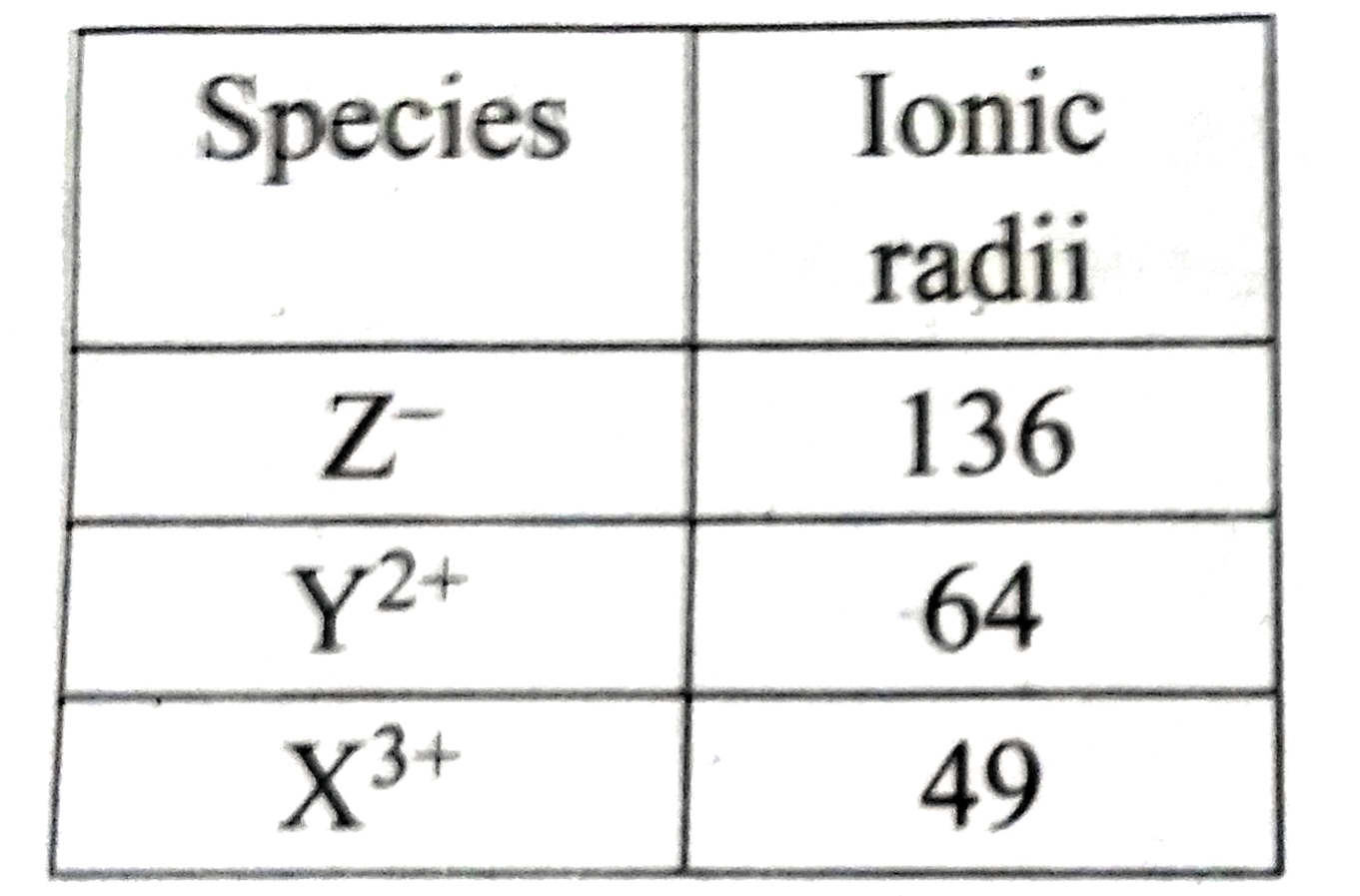
|
|
| 26. |
A student prepared solutions of NaCl, Na_(2)CO_(3) and NH_(4)Cl. He put them separately in three test tubes. He forgot to label them. All solutions were colourless . How should he proceed to know the solutions present in thethree test tubes ? |
| Answer» Solution :He can test with BLUE and red litmus solutions. NaCl solution is NEUTRAL. It will NEITHER TURN blue litmus red nor red litmus blue. `NH_(4)CL` solution is acidic. It will turn blue litmus red but will have no effect on red litmus `Na_(2)CO_(3)` solution is basic. It will turn red litmus blue but will have no effect on blue litmus . | |
| 27. |
A student prepared a sample of silicon chloride by passing chlorine over heated silicon and collecting the condensed silicon chloride in a small specimen tube. He analsed the chloride by dissolving a known mass of it in water and titrating the solution with standard silver nitrates solution. The formula of the silicon chloride as obtained by this method was SiCl_(2.6) as aganist a true formula SiCl_(4). Which of the following possible errors could have resulted in this wrong formula? |
|
Answer» The silicon chloride contained excess dissolved chlorine. |
|
| 28. |
A student performs a titration with different buretts and fins titre value of 25.2 ml, 2.25 ml, 25.0 ml. The number of significant figures in the average titre value i. |
|
Answer» `25.25rarr2` SD after decimal `25.0rarr1` SD after decimal `therefore` Final ANSWER can have 1 SD after decimal and 2 SD before decimal |
|
| 29. |
A student forgot to add the reaction mixture to the round bottomed flask at 27 ^(@)C but instead he/she placed the flask on the flame. After a lapse of time, he realized his mistake, and using a pyrometer he found the temperature of the flask was 477 ^(@)C. What fraction of air would have been expelled out? |
|
Answer» Solution :When an open flask is heated, its volume and pressure may be regarded as CONSTANT. Suppose the NUMBER of moles of air in the flask before and after heating are `n_1 and n_2` RESPECTIVELY. According to the IDEAL gas equation, `PV =n_1 RT_1 = n_1 xx R xx (273+27)` (before heating ) ...(i) and `PV =n_2 RT_2 = n_2 xx R xx (273+477)` (after heating) ...(ii) Dividing eq. (i) by (ii), we have `1 = (n_1 xx 300)/(n_2 xx 750)` `:."" n_2 = 300/750 xx n_1 = 2/5 n_1` Hence, number of moles of air expelled on heating `=n_1 - n_2 =n_1 - 2/5 n_1 = 3/5 n_1` THEREFORE, the fraction of air expelled `=(3/5 n_1)/n_1=3/5` |
|
| 30. |
A student forgot to add the reaction mixture to the round bottomed flask at 27^(@)C but instead he/she placed the flask on the flame. After a lapse of time, he realized his mistake, and using a pyrometer he found the temperature of the flask was 477^(@)C. What fraction of air would have been expelled out ? |
|
Answer» Solution :Here vessel is not changed hence the pressure remain CONSTANT as atmoshperic pressure. Initial TEMPERATURE `= 27^(@)C = (27+273)=300 K=T_(1)` Let Initial volume of gas (Vessel) `= V dm^(3)` Tempe. at the end `= (477^(@)C+273^(@)C)=750 K = T_(2)` The volume of the gas in vessel `= V_(2)` As per Charle.s law `(V_(1))/(T_(1))=(V_(2))/(T_(2))` `therefore V_(2)=(V dm^(3)xx750K)/(300 K)=2.5V dm^(3)` The air expelled out `= (V_(2)-V_(1))=(2.5 V-V)dm^(3)` `= 1.5 V` Fraction of the air expelled out `(1.5V)/(2.5V)=(3)/(5)=0.6` |
|
| 31. |
A student forgot to add the reaction mixture to the round bottomed flask at 27^(@)C but instead, he/she placed the flask on the flame. After a lapse of time, he realized his mistake, and using a pyrometer, he found the temperature of the flask was 477^(@)C. What fraction of air would have been expelled out ? |
|
Answer» SOLUTION :Suppose VOLUME of vessel =V `cm^(3)`,i.e.,volume of air in the flask at `27^(@)C=V cm^(3)`. `(V_(1))/(T_(1))=(V_(2))/(T_(2)),""i.e.,""(v)/(300)=(V_(2))/(750)"or"V_(2)=2.5" V"` `:. """Volume expelled"=2.5" V"-V=1.5" V"` `:. """Fraction of air expelled" `=(1.5" V")/(2.5" V")=(3)/(5)` |
|
| 32. |
A studend gets fingerprints on a cuvette before using it to determine the concentration of a coloured species using its known extinction coefficient. What is the effect on the absorbance and reported concentration ? |
|
Answer» `{:("ABSORBANCE",,"Reported concentration"),("INCREASED",,"too LAW"):}` |
|
| 33. |
A stronger hydrogen bonding is present in |
|
Answer» Ethanol |
|
| 34. |
A strong current of trivalent gaseous boron passed through a germanium crystaldecreases the density of the crystal due to part replacement of germanium by boron and due to interstital vacancies created by missing Ge atoms . In one such experiment , 1g of germanium is taken and the boron atoms are found to be 150 ppm by weight , when the density of the Ge crystal decreases by 4 % . calculate the percentage of missing vacancies due to germination , which are filled up by boron atoms . (Awof Ge = 72.6 and B = 11 ) (assume volume constant ) |
|
Answer» `23%` `therefore 1-(x xx(72.6)/(N_(A)))+(y xx(11)/(N_(A)))=0.96` `0.04=(x xx(72.6)/(N_(A)))-(y xx (11)/(N_(A)))` `y=((150N_(A))/(10^(6)xx11)xx0.96)` or `(yxx11)/(N_(A))=((150xx0.96)/(10^(6)))` `thereforex=((0.04+1.44xx10^(-4))N_(A))/(72.6)=(0.04N_(A))/(72.6)` `therefore(y)/(x)=(150N_(A)xx0.96xx72.6)/(10^(6)xx11xx0.04N_(A))=2.376xx10^(-2)` `therefore (y)/(x)xx100=2.376xx10^(-2)xx100=2.376%` |
|
| 35. |
A strong argument in favour of the particle nature of cathode rays is that they |
|
Answer» produce fluorescence |
|
| 36. |
A strong argument for the particle nature of cathode rays is: |
|
Answer» they can PROPAGATE in vacuum |
|
| 37. |
(A) Strength of acidic character of oxyacids lies in the following sequence: HClO_(4) gt HBrO_(4) gt HIO_(4) (R) Greater is the oxidation state of a halogen, more is the acidic character of its oxyacid. |
|
Answer» Both (R) and (A) are TRUE and reason is the CORRECT EXPLANATION of assertion. |
|
| 38. |
A stream of electrons from a heated filament was passed between two charged plates kept at a potential difference of V esu. If e and m are charge and mass of the electron respectively, then the value of h//lamda (where lamda is the wavelength associated with the electron wave) is given by |
|
Answer» `me V` `KE = (1)/(2)mv^(2)` so that `v = sqrt((2KE)/(m)) " But " KE = eV` `:. v = sqrt((2EV)/(m)) :. (h)/(lamda) = mv = m sqrt((2eV)/(m)) = sqrt(2meV)` |
|
| 39. |
A stream of electrons from a heated filament was passed between two charged plates kept at a potential difference V esu. If e and m are charge and mass of an electron, respectively, then the value of h//lambda (where lambda is wavelength associated with electron wave) is given by |
|
Answer» `sqrt(2meV)` `rarr e XX v` `therefore lambda=(h)/sqrt(2xxK>Exxm)` `(h)/(lambda)=sqrt(2eVm)` |
|
| 40. |
A straight glass tube has two inlets X and Y at the two ends. The length of the tube is 200 cm. HCl gas through inlet X and NH_3gas through inlet Y are allowed to enter the tube at the same time. White fumes first appear at a point Pinside the tube. Find the distance of P from X. |
|
Answer» Solution :This PROBLEM can easily be understood with the help of the following figure. White fumes appear at point P due to the formation of `NH_4Cl`according to the equation  `NH_3 (g) + HCl(g) to NH_4 CI(g)` At point P, HCl gas and `NH_3` gas meet together and react to form fumes of `NH_4 CL`. SUPPOSE the distance of point P from the inlet X is x cm. `:.`The distance travelled by HCl gas = x cm and, the distance travelled by `NH_3 " gas " = (200 - x) cm`. The time TAKEN by HCl gas to reach point P will be the same as the time taken by `NH_3` to reach point P. Let this time be equal to t. Rate of diffusion of HCl gas `(r_1) = (" distance travelled ")/("time") =X/t` Rate of diffusion of `NH_3 " gas " (r_2) (200-x)/t` MOLECULAR mass of `HCl (M_1) = 36.5` Molecular mass of `NH_3 (M_2) = 17` According to Graham.s law of diffusion, `r_1/r_1 =sqrt(M_2/M_1)` `:.(x//t)/((200 - x)//t)= sqrt(17/(36.5))` or `x/(200-x) = 0.6825 " or " x = 81.13 cm` Hence, white fumes appear at a distance of 81.13 cm from the inlet X. |
|
| 41. |
A steel sample is to be analysed fo rCr and Mn simultaneously. By suitable treatment the Cr is oxidised to Cr_(2)O_(7)^(2-) andthe Mn to MnO_(4)^(-) . A 10.00g sample of steel is used to produce250.0mL of a solution containing Cr_(2)O_(7)^(2-) and MnO_(4)^(-) (a) A 10.00mL portion of this solution is added to a BaCl_(2) solutionand by proper adjument of theacidity, the chromimum is completeleyprecipitated as 0.0549g BaCrO_(4). (b) A second 10.00mL portion of this soltuion requires exactily 15.95mL of 0.0750M standard Fe^(2+) solution for its titaration(in acid solution). Calculatethe % of Cr in the steel sample. (Cr = 52, Mn = 55, Ba = 137) |
|
Answer» |
|
| 42. |
A steel sample is to be analysed fo rCr and Mn simultaneously. By suitable treatment the Cr is oxidised to Cr_(2)O_(7)^(2-) andthe Mn to MnO_(4)^(-) . A 10.00g sample of steel is used to produce250.0mL of a solution containingCr_(2)O_(7)^(2-) and MnO_(4)^(-).10 mL of this solution is added to BaCl_(2) solution and by prooper adjumentof the pH, the chromium is completely precipitate as BaCrO_(4) (0.0549g). The second 10 mL solution protion requires exactly 15.95 mL of 0.0750 M standardfor complete reduction of this solution. Calculate %ofMn and Cr in this sample. |
|
Answer» |
|
| 43. |
A steel cylinder of 8 litres capacity contain hydrogen gas at 12atm pressure. At the same temperature how many cycle tubes of 4 litres capacity at 2 atm can be filled up with this gas. |
|
Answer» 12 |
|
| 44. |
A steel box is 2.5 m in length, 1.8 m in breadth and 1.2 m in height. Find its volume in litres. |
|
Answer» Solution :The VOLUME of the box is GIVEN by Volume = length x breadth x height `= 2.5 m xx 1.8 m xx 1.2 m = 5.4 m^3` 1 LITRE (L) = `10^(-3) m^3` `1 m^3 = 10^3` L Hence, the conversion factor would be: `1=(10^(3) L)/(1 m^(3))` Volume of box `=5.4 m^(3) xx 1 = 5.4 m^(3) xx (10^(3) L)/(1 m^(3))` `=5.4 xx 10^(3) L` |
|
| 45. |
A state of equilibrium is reached when |
|
Answer» The rate of FORWARD reaction is GREATER than the rate of the reverse reaction |
|
| 46. |
(a) State Mendeleev's periodic law. (b) Describe about the merits of Mendeleev's periodic table. |
|
Answer» Solution :(a) Mendeleev.s periodic law: Mendeleev.s periodic law states that the physical and chemical properties of ELEMENTS are a periodic function of their atomic weights. (b) Merits of Mendeleev.s periodic table: (i) The COMPARATIVE studies of elements were made easier. (ii) The table shows the relationship in properties of elements in a GROUP. (iii) The table HELPED to correct the atomic masses of some elements later on. At the time on Mendeleev, the atomic weight of Au and Pt were known as 196.2 and 196.7 respectively. However, Mendeleev placed Au (196.2) after Pt (196.7) saying that atomic weight of A is incorrect, which was later on found to be 197. (IV) At the time of Mendeleev, about 70 elements were known and thus blank spaces we for unknown elements which helped further discoveries. Both Gallium (Ga) in III group and Germanium (Ge) in IV group. were unknown at that time by Mendeleev predicted their existence and properties. He referred the predicted elements as eka-aluminium and eka-silicon. After discovery of the actual elements, their properties were found to match closely to those predicted by Mendeleev. |
|
| 47. |
(a) State Heisenbergs uncertainty principle. Give its mathematical expression. Also give its significance. (b) Calculate the uncertainity in the position of a dust particle with mass equal to 1 mg if the uncertainity in its velocity is 5.5 xx 10^(-20) ms^(-1) . |
|
Answer» |
|
| 48. |
(a) Statede Broglie equation .Write its significance . (b) A beam of helium atoms moves with a velocityof2.0 xx 10^(3) ms^(-1) . Find the wavelength of the particle constitutingthe beam . (h=6.626 xx 10^(-34) Js ) |
|
Answer» |
|
| 49. |
A standing wave in a string 35 cm long has a total of six nodes including those at the ends. Hence, wavelength of the standing wave is |
Answer» Solution :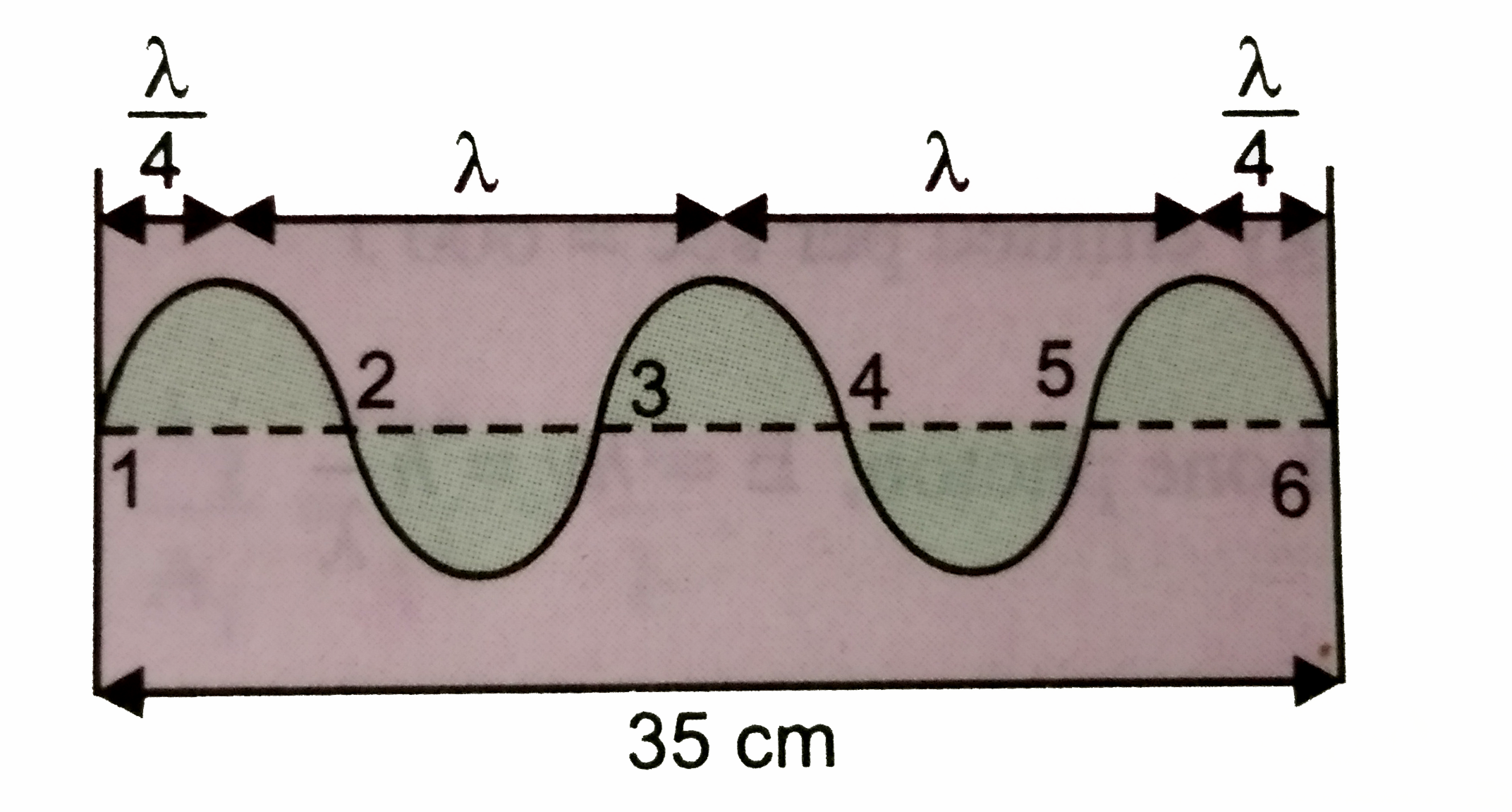 `2.5 LAMDA = 35 cm or lamda = (35)/(2.5) = 14 cm` |
|