Saved Bookmarks
This section includes 7 InterviewSolutions, each offering curated multiple-choice questions to sharpen your Current Affairs knowledge and support exam preparation. Choose a topic below to get started.
| 1. |
Benzaldehyde cannot be prepared by: |
|
Answer» Benzaldehyde cannot be prepared by: |
|
| 2. |
XHCO3 and YCO3 Are two pure substancesof equal molar masses decomposing as shown 2XHCO3===>H2O +CO2 +X2CO3 YCO3===>YO + CO2 16.8g of XHCO3 gave 6.2 g of mixture of water and carbon dioxide While 16.8g ofYCO3 gave 8.8g of carbon dioxide.identify the substances. |
| Answer» XHCO3 and YCO3 Are two pure substancesof equal molar masses decomposing as shown 2XHCO3===>H2O +CO2 +X2CO3 YCO3===>YO + CO2 16.8g of XHCO3 gave 6.2 g of mixture of water and carbon dioxide While 16.8g ofYCO3 gave 8.8g of carbon dioxide.identify the substances. | |
| 3. |
How can Xenon form compounds with Fluorine ? |
| Answer» How can Xenon form compounds with Fluorine ? | |
| 4. |
The following data are obtained when dinitrogen and dioxygen react together to form different compounds: Mass of dinitrogen Mass of dioxygen(i) 14 g 16 g(ii) 14 g 32 g(iii) 28 g 32 g(iv) 28 g 80 g(a) Which law of chemical combination is obeyed by the above experimental data?Give its statement.(b) Fill in the blanks in the following conversions:(i) 1 km = ...................... mm = ...................... pm(ii) 1 mg = ...................... kg = ...................... ng(iii) 1 mL = ...................... L = ...................... dm3 |
|
Answer» The following data are obtained when dinitrogen and dioxygen react together to form different compounds: Mass of dinitrogen Mass of dioxygen (i) 14 g 16 g (ii) 14 g 32 g (iii) 28 g 32 g (iv) 28 g 80 g (a) Which law of chemical combination is obeyed by the above experimental data?Give its statement. (b) Fill in the blanks in the following conversions: (i) 1 km = ...................... mm = ...................... pm (ii) 1 mg = ...................... kg = ...................... ng (iii) 1 mL = ...................... L = ...................... dm3 |
|
| 5. |
.In a reaction A+B2 -------AB2, identify the reaction having B as a limiting reagent. 1. 300 atoms of A +300 molecules of B2. 300 atoms of A and 300 atoms of B3. 300 atoms of A and 400 molecules of B4. 300 atoms of A and 600 atoms of BHow to solve this ? |
|
Answer» .In a reaction A+B2 -------AB2, identify the reaction having B as a limiting reagent. 1. 300 atoms of A +300 molecules of B 2. 300 atoms of A and 300 atoms of B 3. 300 atoms of A and 400 molecules of B 4. 300 atoms of A and 600 atoms of B How to solve this ? |
|
| 6. |
Which relation of Moseley shows that atomic number (z) is fundamental property of an element? |
|
Answer» Which relation of Moseley shows that atomic number (z) is fundamental property of an element? |
|
| 7. |
14. In a regular octahedral molecule MX6 the no. Of X-M-X bonds at 180 degree is |
| Answer» 14. In a regular octahedral molecule MX6 the no. Of X-M-X bonds at 180 degree is | |
| 8. |
14. One mole of hydrogen gas at temperature T is mixed with one mole of helium gas at temperature 2T in an insulated vessel.The equilibrium temperature of the gas mixture will be |
| Answer» 14. One mole of hydrogen gas at temperature T is mixed with one mole of helium gas at temperature 2T in an insulated vessel.The equilibrium temperature of the gas mixture will be | |
| 9. |
Difference between the following in tabular form at least 3 points each Cristae and Cisternae |
|
Answer» Difference between the following in tabular form at least 3 points each Cristae and Cisternae |
|
| 10. |
Relative lowering of vapour pressure is a colligative property. But is only lowering of vapour pressure a colligative property? |
| Answer» Relative lowering of vapour pressure is a colligative property. But is only lowering of vapour pressure a colligative property? | |
| 11. |
Give an example of solid solution in which the solute is a gas. |
|
Answer» Give
|
|
| 12. |
In the above figure, initially both the copper plates are of equal size .After some time, what changes do you observe in the size of the plates? |
|
Answer»
In the above figure, initially both the copper plates are of equal size .After some time, what changes do you observe in the size of the plates? |
|
| 13. |
Aluminiumtrifluoride is insoluble in anhydrous HF but dissolves on addition ofNaF. Aluminium trifluoride precipitates out of the resulting solutionwhen gaseous BF3is bubbled through. Give reasons. |
|
Answer» Aluminium |
|
| 14. |
Two solutions of non - electrolyte r mixtured manner. 480ml of 1.5 M frist solutions +520ml of 1.2M second solution. What is the molarity of the final solution? |
| Answer» Two solutions of non - electrolyte r mixtured manner. 480ml of 1.5 M frist solutions +520ml of 1.2M second solution. What is the molarity of the final solution? | |
| 15. |
13. Three particles each of mass 1 gm andcarrying a charge q are suspended from acommon point by insulated mass lessstrings each 100 cm long. If the particlesare in equilibrium and are located at thecorners of an equilateral triangle of side 3cm then charge q in each particle:(A) \pm 3.16 × 10⁻⁹ C (B) \pm 3.16 × 10⁻⁸ C(C) 3.16x 10⁻⁷ C (D) †extsterling3.16 10-6 C2 |
| Answer» 13. Three particles each of mass 1 gm andcarrying a charge q are suspended from acommon point by insulated mass lessstrings each 100 cm long. If the particlesare in equilibrium and are located at thecorners of an equilateral triangle of side 3cm then charge q in each particle:(A) \pm 3.16 × 10⁻⁹ C (B) \pm 3.16 × 10⁻⁸ C(C) 3.16x 10⁻⁷ C (D) †extsterling3.16 10-6 C2 | |
| 16. |
Explain in short how the light gets scattered by air. |
|
Answer» Explain in short how the light gets scattered by air. |
|
| 17. |
For I2+2e−→2I−, standard reduction potential=+0.54 Volt. For 2Br−→Br2+2e−, standard oxidation potential=−1.09 Volt. For Fe→Fe2++2e−, standard oxidation potential=+0.44 Volt. Out of the below given reactions, how many reactions are spontaneous in nature (predict from the above data) ? Br2+2I−→2Br−+I2 Fe+Br2→Fe2++2Br− Fe+I2→Fe2++2I− I2+2Br−→2I−+Br2 |
|
Answer» For I2+2e−→2I−, standard reduction potential=+0.54 Volt. For 2Br−→Br2+2e−, standard oxidation potential=−1.09 Volt. For Fe→Fe2++2e−, standard oxidation potential=+0.44 Volt. Out of the below given reactions, how many reactions are spontaneous in nature (predict from the above data) ? Br2+2I−→2Br−+I2 Fe+Br2→Fe2++2Br− Fe+I2→Fe2++2I− I2+2Br−→2I−+Br2 |
|
| 18. |
what is the meaning of modulus and why is it used? |
| Answer» what is the meaning of modulus and why is it used? | |
| 19. |
45 How many structural isomerism of C9H18 that have six membered ring and trie substituted? |
| Answer» 45 How many structural isomerism of C9H18 that have six membered ring and trie substituted? | |
| 20. |
What is the mass of precipitate formed when 50ml of 16.9% solution of AgNO3 is mixed with 50ml of 5.8% NACl solution? |
| Answer» What is the mass of precipitate formed when 50ml of 16.9% solution of AgNO3 is mixed with 50ml of 5.8% NACl solution? | |
| 21. |
Bohr radius of the first excited state of hydrogen atom is: |
|
Answer» Bohr radius of the first excited state of hydrogen atom is: |
|
| 22. |
50. What is glyoxate cycle |
| Answer» 50. What is glyoxate cycle | |
| 23. |
The hydrogen ion concentration of three monoprotic acids A,B and C are 1×10⁻⁵ mol/L,1×10−3 mol/L and 1×10⁻² mol/L respectively.The correct order of their acidic strength is: |
|
Answer» The hydrogen ion concentration of three monoprotic acids A,B and C are 1×10⁻⁵ mol/L,1×10−3 mol/L and 1×10⁻² mol/L respectively. |
|
| 24. |
When and where is the first soap believed to have been made? |
|
Answer» When and where is the first soap believed to have been made? |
|
| 25. |
Does chemical formula change in chemical changes |
| Answer» Does chemical formula change in chemical changes | |
| 26. |
4. 30 g of KMnO4 sample containing inert impurity is completely reacted with 60 ml of 56 volume of H202 in acidic medium, then what is the percentage purity of KMnO 4? (Molecular weight of KMn04 = 158) |
| Answer» 4. 30 g of KMnO4 sample containing inert impurity is completely reacted with 60 ml of 56 volume of H202 in acidic medium, then what is the percentage purity of KMnO 4? (Molecular weight of KMn04 = 158) | |
| 27. |
66. A first order reaction completes 60% in 20 min. The time required for the completion of 90% of the reaction is ? |
| Answer» 66. A first order reaction completes 60% in 20 min. The time required for the completion of 90% of the reaction is ? | |
| 28. |
Which one of the following reactions is not an example of redox reaction |
|
Answer» Which one of the following reactions is not an example of redox reaction |
|
| 29. |
46. Correct order of bind length in NH3, PH3, AsH3 and SbH3 is |
| Answer» 46. Correct order of bind length in NH3, PH3, AsH3 and SbH3 is | |
| 30. |
For the reaction 2NaN3(s) → 2Na(s) + 3N2 (g), how many moles of sodium azide (NaN3) must react in order to produce 8.75 moles of nitrogen gas? |
|
Answer» For the reaction 2NaN3(s) → 2Na(s) + 3N2 (g), how many moles of sodium azide (NaN3) must react in order to produce 8.75 moles of nitrogen gas? |
|
| 31. |
Degree of hardness of water is expressed in terms of ppm of |
|
Answer» Degree of hardness of water is expressed in terms of ppm of |
|
| 32. |
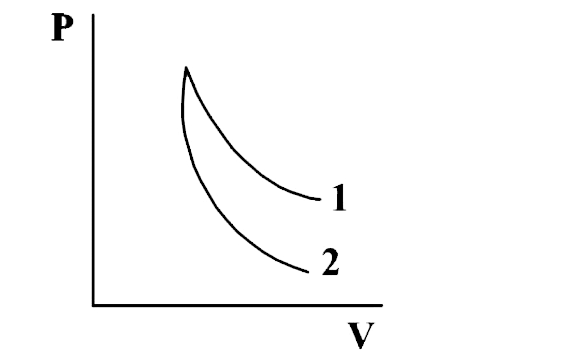
p-V plots for two gases during adiabatic processes are shown in the following figure. Plots 1 and 2 should correspond respectively to |
|
Answer» p-V plots for two gases during adiabatic processes are shown in the following figure. Plots 1 and 2 should correspond respectively to |
|
| 33. |
is there any formula to know that how many terms are there in a finite A.P. |
| Answer» is there any formula to know that how many terms are there in a finite A.P. | |
| 34. |
What will be the pH change when 0.01 moles of CH_3COONa is added in 1 litre 0.02 M CH_3COOH solution ? K_a for CH_3COOH is 1.8 x 10^{-5 } (1) 1.22 (2) 1.82 (3) 1.07 (4) 0.37 |
| Answer» What will be the pH change when 0.01 moles of CH_3COONa is added in 1 litre 0.02 M CH_3COOH solution ? K_a for CH_3COOH is 1.8 x 10^{-5 } (1) 1.22 (2) 1.82 (3) 1.07 (4) 0.37 | |
| 35. |
what is bond order of NO, NO+, NO2 -, NO3 -, CN- ,O2 ,O2-, O2+ ,C2 ? |
| Answer» what is bond order of NO, NO+, NO2 -, NO3 -, CN- ,O2 ,O2-, O2+ ,C2 ? | |
| 36. |
The percentage of tetrahedral void occupied by dimond |
| Answer» The percentage of tetrahedral void occupied by dimond | |
| 37. |
3. Van't Hoff factor of Hg2Cl2 in it's aq. Solution will be (Hg2Cl2 is 80% ionized in the solution) |
| Answer» 3. Van't Hoff factor of Hg2Cl2 in it's aq. Solution will be (Hg2Cl2 is 80% ionized in the solution) | |
| 38. |
Which of the following is a correct statement? |
|
Answer»
Which of the following is a correct statement? |
|
| 39. |
22. How yo calculate bond order and bond length in CN-, NO+, |
| Answer» 22. How yo calculate bond order and bond length in CN-, NO+, | |
| 40. |
If an endothermic reaction is non-spontaneous at freezing point of water and becomes feasible at its boiling point, then: |
|
Answer» If an endothermic reaction is non-spontaneous at freezing point of water and becomes feasible at its boiling point, then: |
|
| 41. |
Let (+) tartaric acid has a specific rotation of + 11.1. Calculate the specific rotation of a mixture of 68% (+) tartaric acid and 32% (-) tartaric acid Report your answer to the closest integer. |
|
Answer» Let (+) tartaric acid has a specific rotation of + 11.1. Calculate the specific rotation of a mixture of 68% (+) tartaric acid and 32% (-) tartaric acid Report your answer to the closest integer. |
|
| 42. |
is normality of solution equals to normality of h+ion when hcl and h2so4 are mixed |
| Answer» is normality of solution equals to normality of h+ion when hcl and h2so4 are mixed | |
| 43. |
What should be the priority carbon chain length or functional group? Because both give different answer |
|
Answer» What should be the priority carbon chain length or functional group? Because both give different answer |
|
| 44. |
The total number of structural isomers formed in the following reaction is: |
|
Answer» The total number of structural isomers formed in the following reaction is: |
|
| 45. |
When compounds with different functional groups are given how do we determine which is more acidic or basic |
| Answer» When compounds with different functional groups are given how do we determine which is more acidic or basic | |
| 46. |
30 mL of hydrogen and 20 mL of oxygen react to give water. What is left at the end of the reaction? |
|
Answer» 30 mL of hydrogen and 20 mL of oxygen react to give water. What is left at the end of the reaction? |
|
| 47. |
Predictthe major product of acid catalysed dehydration of(i) 1-methylcyclohexanol and (ii) butan-1-ol |
|
Answer» Predict (i) (ii) |
|
| 48. |
Why is benzoic weak acid than formic acid instead of having -I effect of benzene ring |
| Answer» Why is benzoic weak acid than formic acid instead of having -I effect of benzene ring | |
| 49. |
38. How much water should be added to 200 cc of seminormal solution of NaOH to make it exactly decinormal a) 200cc b) 400cc c) 800cc d) 600cc |
| Answer» 38. How much water should be added to 200 cc of seminormal solution of NaOH to make it exactly decinormal a) 200cc b) 400cc c) 800cc d) 600cc | |
| 50. |
A sweet smelling compounds formed by reacting acetic acid with ethanol in the presence of sulphuric acid is |
|
Answer» A sweet smelling compounds formed by reacting acetic acid with ethanol in the presence of sulphuric acid is |
|