

Saved Bookmarks
This section includes 7 InterviewSolutions, each offering curated multiple-choice questions to sharpen your Current Affairs knowledge and support exam preparation. Choose a topic below to get started.
| 1. |
Question : Photoreceptor cells are present in …………………… |
|
Answer» BLIND spot |
|
| 2. |
Question :Photophosphorylation in chloroplast is most similar to which of the following mitochondrial reactions ? |
|
Answer» Oxidative phosphorylation |
|
| 3. |
Question : Photophosphorylaton is a process in which |
|
Answer» LIGHT energy is converted into CHEMICAL energy in the from of ATP |
|
| 4. |
Question :Photolysis of water during Photosynthesis occurs with the help of |
|
Answer» PS- II |
|
| 5. |
Question : Photochemical smogs always contain : |
|
Answer» PAN AND `O_2` |
|
| 7. |
Question : Photochemical smong always contains |
|
Answer» ALUMINIUM ions |
|
| 8. |
Question : Photochemical smog pollution does not contain : |
|
Answer» CARBON dioxide |
|
| 9. |
Question : Photochemical smog is the product of .........(A) ozone reaction(B) soil contamination(C) water contamination(D) automobiles |
|
Answer» OZONE reaction |
|
| 10. |
Question : Photochemical reaction of nitrogen oxides with unsaturated hydrocarbons produces |
|
Answer» METHYL isocyanate |
|
| 11. |
Question : Photochemical smog contains Nox and SO_2. |
|
Answer» |
|
| 12. |
Question : Photo synthetically active radiation (PAR) |
| Answer» Answer :A | |
| 13. |
Question : Photo oxidation of chlorophyll-a in the reaction centre is prevented by |
|
Answer» LUTEIN |
|
| 14. |
Question : Photo centres in higher plants are |
|
Answer» `P_(700)` |
|
| 15. |
Question : Photo-oxidation of water results in the formation of: |
|
Answer» `H^+`O and ATP |
|
| 16. |
Question : Phosphorylation during photosynthesis is |
|
Answer» OXIDATIVE phosphorylation and PHOTOPHOSPHORYLATION occurring in light and DARK conditions. |
|
| 17. |
Question : Phosphorylation of glucose during glycolysis is catalyzed by |
|
Answer» Phosphoglucomutase |
|
| 18. |
Question : Phosphorus is the major constituent of A.Biological membranes B. Nucleic acids C. Cellular energy transfer systems D. Proteins |
| Answer» Solution :A,B, & C | |
| 19. |
Question : Phosphorus is present in the rocks in form of |
|
Answer» Phosphorus |
|
| 20. |
Question : Phosphorus is needed by organisms to make |
|
Answer» BONES |
|
| 21. |
Question : Phosphorus has |
|
Answer» imperfact NUTRIENT cycle |
|
| 22. |
Question : Phosphorus cycle : Sedimentary cycle Carbon cycle : _____ |
| Answer» SOLUTION :GASEOUS CYCLE | |
| 23. |
Question : Phosphorus cycle |
Answer» SOLUTION :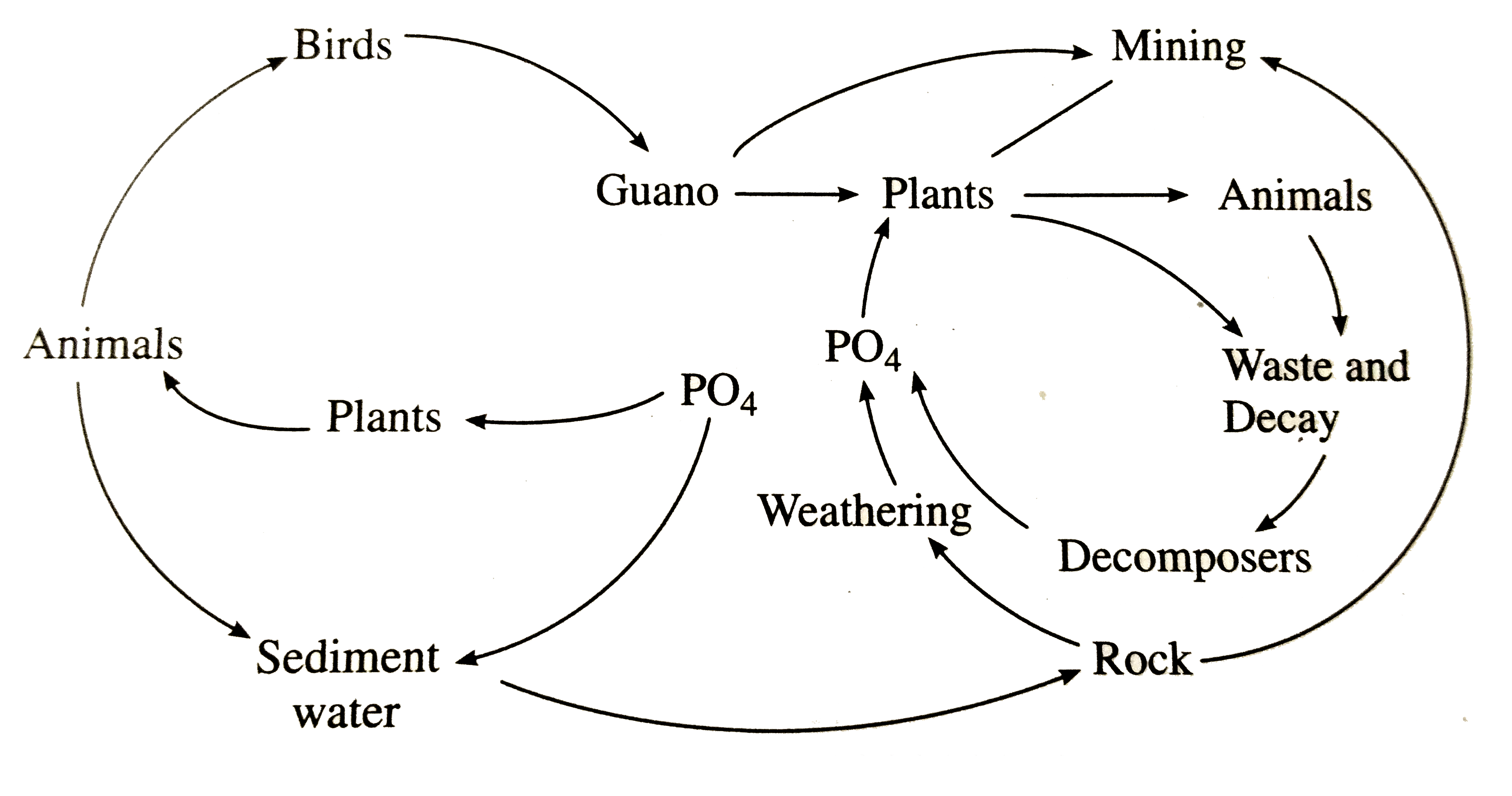
|
|
| 24. |
Question : Phosphorus and nitrogen ions generally get depleted in soil because they usually occur as |
|
Answer» Neural IONS |
|
| 25. |
Question :Phosphoenol pyruvate (PEP) is the primary CO_2acceptor in : |
|
Answer» `C_3`PLANTS |
|
| 26. |
Question : phi_(p) becomes negative in transpiring xylem tissue when |
|
Answer» The water column inside the XYLEM is subjected to NEGATIVE PRESSURE or tension |
|
| 27. |
Question : Phica semilunaris is |
|
Answer» funcational 3rd eye LID |
|
| 28. |
Question : Pheromones are secreted: |
|
Answer» EXTERNALLY as a means of absorption |
|
| 29. |
Question : Pheromones are chemical messengers that help insect in (a) Communication (b) Sending alarm signals (c) Marking trails (d) Attracting males (e) Killing pests |
|
Answer» All EXCEPT (C) & (e) |
|
| 30. |
Question : Pheretima and its close relatives obtain nourishment from |
|
Answer» DECAYING fallen leaves and soil ORGANIC matter |
|
| 31. |
Question : Pheromone is: |
|
Answer» PRODUCT of ENDOCRINE gland |
|
| 32. |
Question : Phenylketonuria, Huntington's disease and sickle-cell anaemia are caused respectively due to disorders associated with |
|
Answer» chromosome 4,chromosome 7 and chromosome 11 |
|
| 33. |
Question : Phenylketonuria (PKU) is inherited disease that is characterised by |
|
Answer» ELIMINATION of gentisic ACID in urine |
|
| 34. |
Question : Phenylketonuria is a genetic disorder due to a defect in metabolism of the following. |
|
Answer» A.Polysaccharides |
|
| 35. |
Question : Phenylketonuria is |
|
Answer» An EXAMPLE of pleiotrophy |
|
| 36. |
Question : Phenylketonuria is a genetic disorder of |
|
Answer» TRISOMIC condition |
|
| 37. |
Question : Phenylketonuria is a genetic disorder due to a defect in metabolism of the following |
|
Answer» Polysaccharides |
|
| 38. |
Question : Fill In The blank : The phenotypic ratio and genotypic ratio of monohybrid test cross is …………………… |
|
Answer» |
|
| 39. |
Question : phenotypic ratio in plant Snapdragon in F_2 is: |
|
Answer» `1:1` |
|
| 40. |
Question : What is the phenomenon of sexual reproduction that involves different strains of thalli? |
|
Answer» |
|
| 41. |
Question : phenotypic and genotypic ratios are equal in |
|
Answer» incomplete dominance |
|
| 42. |
Question : Phenomenon of plasmolysis occurs when: |
|
Answer» CELLS are KEPT in hypertonic solution |
|
| 43. |
Question : Phenomenon of industrial melanism demonstrates |
|
Answer» GEOGRAPHICAL isolation |
|
| 44. |
Question : Phenomenon of industral melanism demonstrates: |
|
Answer» GEOGRAPHICAL ISOLATION |
|
| 45. |
Question :Phenolic inhibitors occur in plants as |
|
Answer» GLYCOSIDES |
|
| 46. |
Question : Phenomenal and rapid increase of population in a short period is called |
|
Answer» NATURAL increase |
|
| 47. |
Question : ...........phase in crucial in Calvin cycle for uninterrupted and continuous cycle . |
|
Answer» CARBOXYLATION PHASE |
|
| 48. |
Question : Phase contrast scanning, light microscope was invented by |
|
Answer» Fritz-Zernike |
|
| 50. |
Question : Phagocytic cells of blood are |
|
Answer» NEUTROPHILS only |
|