

Saved Bookmarks
This section includes 7 InterviewSolutions, each offering curated multiple-choice questions to sharpen your Current Affairs knowledge and support exam preparation. Choose a topic below to get started.
| 1. |
Question : The most abundant lipid in the cell membrane is |
|
Answer» cutin |
|
| 2. |
Question : The most abundant element present in the plants is |
|
Answer» nitrogen |
|
| 3. |
Question : The most abundant enzyme in world |
|
Answer» RuBiCO |
|
| 4. |
Question : The most abundant chemical in living organisms could be |
|
Answer» PROTEIN |
|
| 5. |
Question : The most abundant chemical in living organisms could be (A)Protein (B)Water (C) Sugar (D) Nucleic acid |
|
Answer» protein |
|
| 6. |
Question : The morphology of chromosomes can be best studied during ………………….. Stage of mitosis when they are ………………………….. And arranged along the …………………….. |
| Answer» SOLUTION :METAPHASE, sprieally COILED, equtional PLANE | |
| 7. |
Question : The monomer of the myosin molecule is .............. |
| Answer» SOLUTION :MEROMYOSIN | |
| 8. |
Question : The monograph of Pheretima posthuma is given by |
|
Answer» LAMARCK |
|
| 9. |
Question : The "__________________" molecule is made up of four polynucleotide chains. |
|
Answer» |
|
| 11. |
Question : State whether the following statement is true or false. The modern model of plasma membrane structure was firstdescribed in 1986. A. TrueB. False |
|
Answer» |
|
| 12. |
Question : The mode of respirations in frog that occurs in water is |
|
Answer» buccophayngeal, CUTANEOUS & PULMONARY |
|
| 13. |
Question : The mode of asexual reproduction in bacteria is by |
|
Answer» FORMATION of gametes |
|
| 14. |
Question : The mode of nutrition in Kingdom Fungi is mainly(a) autotrophic(b) heterotrophic(c) saprophytic(d) parasitic |
|
Answer» autotrophic |
|
| 15. |
Question : The mode of arrangement of sepals or petals in a floral bud is known as aestivation. Draw the various types of aestivation possible for a typical pentamerous flower. |
|
Answer» Solution :The mode of arrangement of SEPALS or PETALS in floral BUD with respect to the other members of the same whorl is known as AESTIVATION. For answer see SECTION - A, Q. No. 14 |
|
| 16. |
Question : The mode of arrangement of either sepals or petals of a flower in bud condition is called aestivation. Draw the various types of aestivation. |
Answer» SOLUTION :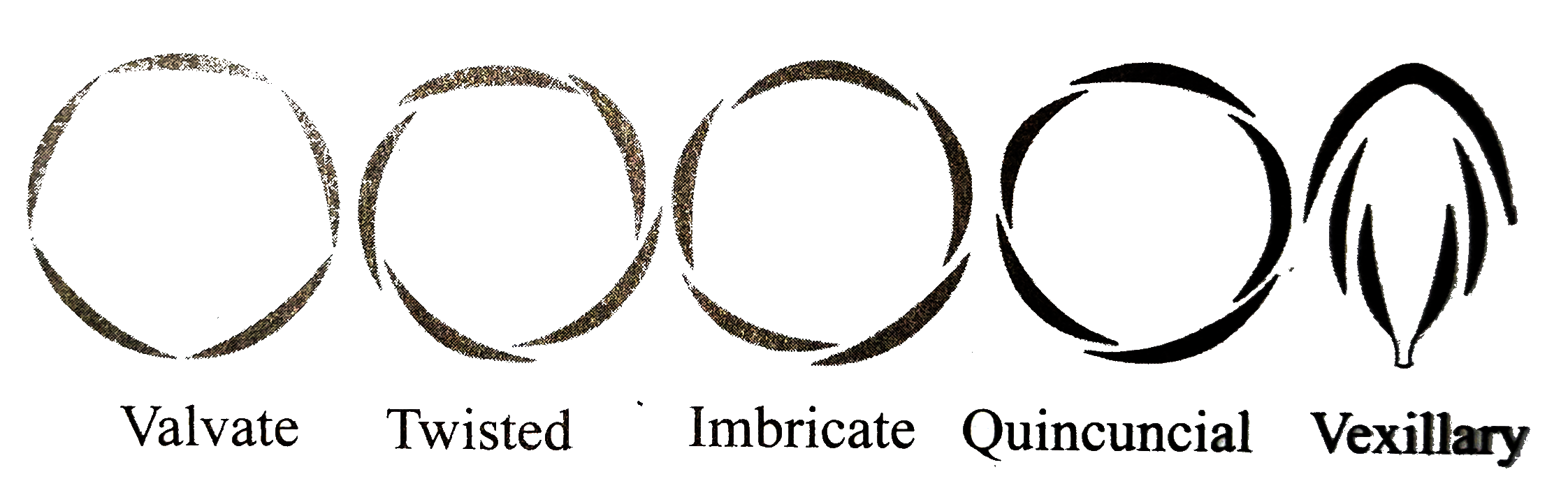
|
|
| 17. |
Question : The mitral valve has _____ cusps while the aortic valve possesses ______ cusps. |
| Answer» SOLUTION : TWO, THREE | |
| 18. |
Question : The mitochondria of muscle cells are called |
|
Answer» sarcoplasm |
|
| 19. |
Question : The minute pores on the body of sponges are called ………………….. . |
|
Answer» oseuliem |
|
| 20. |
Question : The minimum number of meiotic divisions required to produce 400 seeds in apea plant is. |
|
Answer» 200 |
|
| 21. |
Question : The minimum number of mieotic divisions required to produce 200 seeds of a typical angiospermic plant are |
|
Answer» 200 |
|
| 22. |
Question : The minimum and maximum number of hydrogen bonds found in a coil of ds-DNA respectively are |
| Answer» Answer :D | |
| 23. |
Question : The mineral element essential for nitrogen metabolism is: |
| Answer» Answer :C | |
| 24. |
Question : The middle ear of the frog is externally closed by |
|
Answer» MUCUS membrane |
|
| 25. |
Question : The microenvironment for neuronal activity is provided by |
|
Answer» fasciculi |
|
| 26. |
Question : The method of genetic recombination/ parasexuality in bacteria is known as |
|
Answer» CONJUGATION |
|
| 27. |
Question : The method of directly injecting a sperm into ovum in assisted reproductive technology is called |
|
Answer» GIFT |
|
| 28. |
Question : The metazoans without cell walls with eukaryote cells are placed in which Kingdom? |
| Answer» SOLUTION :KINGDOM ANIMALIA. | |
| 29. |
Question : The metabolites which does not show any direct function in growth is called_____metabolite. |
|
Answer» Primary |
|
| 30. |
Question : Metacentric chromosomes are _____ shaped chromosomes. |
|
Answer» L |
|
| 31. |
Question : The metabolic disorders examined by ammiocentesis are |
|
Answer» phenyl KETONURIA |
|
| 32. |
Question : The meristem responsible for extra stelar secondary growth in dicot stem is |
|
Answer» interfascicular cambium |
|
| 33. |
Question : The meristematic tissue developed in the extra-stelar regionis ……….. |
| Answer» SOLUTION :PHELLOGEN | |
| 35. |
Question : The membranes that suspend vertebrate organs in the body cavity are called : |
|
Answer» VISCERAL MUSCLE |
|
| 36. |
Question : The membrane that gives us the ablity to discriminate different pitches of sound is the |
|
Answer» ROUND window |
|
| 37. |
Question : The membrane bound space found in the cytoplasm of a cell is |
|
Answer» CENTROSOME |
|
| 38. |
Question : The membrane less space present nearer to the nucleus in animal cell is |
|
Answer» Spherosome |
|
| 39. |
Question : The membrane around the vacuole is called : |
|
Answer» Tonoplast |
|
| 40. |
Question : The megaspore of a conifer, which is never released from the sporangium, divides by mitosis to produce a : |
|
Answer» MALE gametophyte |
|
| 41. |
Question : The megaspore mother cell in pinus divides........ to form four megaspores. |
| Answer» SOLUTION :meiotically | |
| 42. |
Question : The median dark line on the mid dorsal part of the body of earthworm indicates |
|
Answer» DORSAL pores |
|
| 43. |
Question : The medulla of kidney is divided into a few conical tissue masses called .............. |
| Answer» SOLUTION :RENAL PYRAMIDS | |
| 44. |
Question : The medulla acts as a nerve tract between cortex and the …………………. . |
| Answer» SOLUTION :DIENCEPHALON | |
| 45. |
Question : The mechanism which is involved in zoospore formation in Chlamydomonas is called |
|
Answer» Mitosis |
|
| 46. |
Question : The maximum volume of air that can be moved out during a single breath following a maximal |
| Answer» SOLUTION :VITAL CAPACITY | |
| 47. |
Question : The maximum growth rate occurs in |
|
Answer» STATIONARY PHASE |
|
| 48. |
Question : The maximum growth rate is observed during(a) lag phase(b) log phase(c) stationary phase(d) senescence |
|
Answer» LAG phase |
|
| 49. |
Question : The mature seeds of plants such as gram and peas, possess no endosperm, because : |
|
Answer» these plants are not angiosperms |
|
| 50. |
Question : The mature seeds of plants such as gram and peas , possess no endosperm, because |
|
Answer» These plants are not angiosperms |
|