

Saved Bookmarks
This section includes InterviewSolutions, each offering curated multiple-choice questions to sharpen your knowledge and support exam preparation. Choose a topic below to get started.
| 3301. |
Question : How does blood clotting occur ? |
|
Answer» Solution :Blood clotting is a phenomenon brought aboutby blood plateletswhich prevents excessive loss of blood at the TIME of injuryor leakage from a bloodvessel. Plateletsruptureto releasea SUBSTANCE CALLED THROMBOPLASTIN. 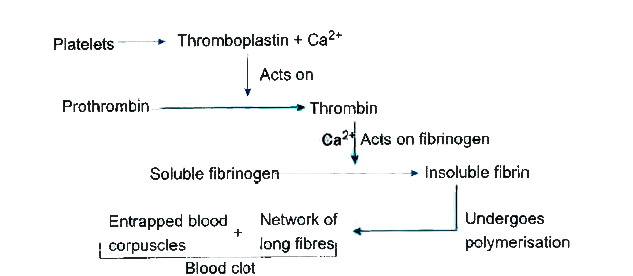
|
|
| 3302. |
Question : How does binary fission differ from multiple fission? |
|
Answer» Solution :Binary FISSION i] Parent.s nucleus divides into two nuclei and MOVES into two daughter cells. ii] Two daughter cells are formed. iii) No protective covering is formed to each of the daughter nuclei, Multiple Fission i) Parent.s nucleus divides into multiple daughter nuclei, each surrounded by cytoplasm. ii] More than two daughter cells are formed. iii] A protective cyst is formed AROUND each of the daughter nuclei. |
|
| 3303. |
Question : How does binary fission differ from multiple fission ? |
Answer» SOLUTION :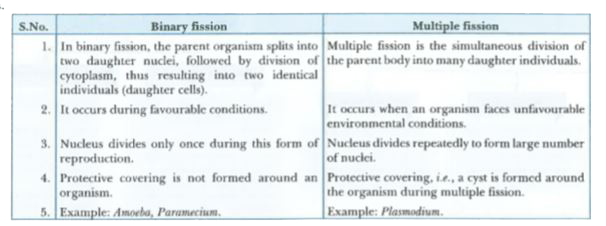
|
|
| 3304. |
Question : How does auxin promote phototropism ? |
| Answer» SOLUTION :Auxin is the hormone which is usually synthesised in the young tip of roots and shoots. When light is coming from ONE SIDE of the plant, it diffuses towards the shady side of the shoot which stimulates the cells to grow longer, resulting in the bending of shoot towards light, THUS auxin promoten phototropism. | |
| 3305. |
Question : How does the embryo get nourishment inside the mother's body? |
| Answer» Solution :Through the placenta. The placenta NOURISHES the developing foetus. Placenta is a vascular membranous ORGAN that CONNECTS the developing foetus to the uterine wall of the mother. It CONTAINS villi on the foetus side of the tissue, which provides a large surface area for glucose and oxygen to pass from mother to the embryo. Also the metabolic wastes and carbon dioxide produced by the foetus is collected by the placenta and disposed. | |
| 3306. |
Question : How does abscisic acid acts as stress hormone in drought condition ? |
| Answer» Solution :ABA CAUSE rapid CLOSURE of stomata, preventing LOSS of water by transpiration. | |
| 3307. |
Question : How does a solenoid behave like a magnet? Can you determine the north and south poles of a current carrying solenoid with the help of a bar magnet? |
| Answer» Solution :When electric current flows through a solenoid, magnetic FIELD is SET up around the solenoid. The pattern of the magnetic field is same as that of the magnetic field of a bar magnet. One end of the solenoid behaves as north pole and the other end of the solenoid behaves as south pole. To determine the north and south poles of a current carrying solenoid with the help of a bar magnet, suspend it with a STRONG thread. Now bring the north pole of a bar magnet towards one end of the solenoic. If the solenoid attracts towards the magnet then the face of the solenoid is south pole. If the bar magnet moves AWAY from the solenoid, then the face of the solenoid is the north pole. | |
| 3308. |
Question : How do you differentiate homologous organs from analogous organs? |
Answer» SOLUTION :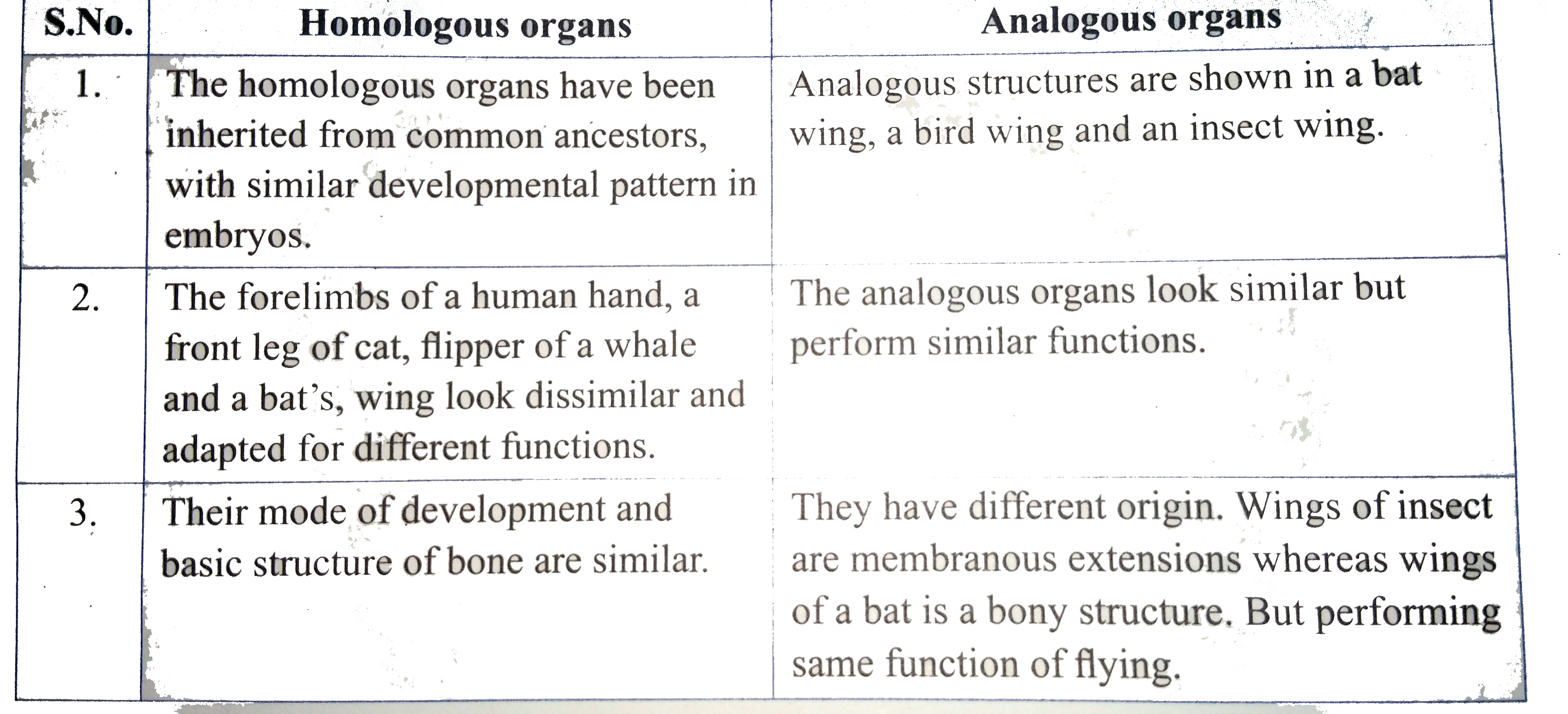
|
|
| 3309. |
Question : How do we know that extinct species ever existed ? |
| Answer» SOLUTION :From fossils, we know that EXTINCT species EVER EXISTED. | |
| 3310. |
Question : How do X and Y chromosomes differ ? |
| Answer» Solution :X is normal SIZED while Y is a SHORT CHROMOSOME. | |
| 3311. |
Question : How does our body respond when adrenaline is secreted into the blood ? |
|
Answer» Solution :(i) Adrenaline is carried to target organs/heart. (ii) Heart beats faster, supply of more OXYGEN to muscies. (iii) Blood supply to digestive SYSTEM and skin reduced. (IV) Breathing rate INCREASES. (v)Blood supply diverted to skeletal muscles. (vi) Animal body becomes ready to DEAL with the situation. |
|
| 3312. |
Question : How do we see beautiful colours in Autumn and enjoy the fall? |
| Answer» Solution :Chlorophyll gives green colour to PLANTS. During winter, there is not enough light for photosynthesis. So they use food, which are stored in summer. As the green chlorophyll disappears or fades away, we begin to see yellow, orange and RED colour. We cannot see them in summer, because they are covered by green chlorophyll. But in autumn or fall season glucose TRAPPED in the leaves, after photosynthesis stops. Sunlight and cool NIGHTS of Autumn cause the leaves turn this glucose into a red colour. It is the combination of all these things, that make the beautiful colours, we enjoy in the fall. | |
| 3313. |
Question : How do we know that two different individual organisms belong to the same species ? |
| Answer» Solution :Due to similarities AMONG organisms it is clear that they BELONG to the same SPECIES. | |
| 3314. |
Question : How do we know how old a fossil is? |
| Answer» SOLUTION :Age of fossils can be estimated by the depth of the layer of rocks in which they are FOUND. Age of fossils can also be DETECTED from the RATIO of ISOTOPES in the fossils containing rocks. | |
| 3315. |
Question : How do we detect the smell of an agarbatti (incense stick)'? |
| Answer» Solution :When the smell of the incense stick REACHES our nose then the olefactory RECEPTORS present in our nose detects it and sends this information to forebrain in the form of eletrical SIGNALS forebrain, interprets this information as the smell of incense stick where it is already STORED. | |
| 3316. |
Question : How do variations occur in an offspring? |
| Answer» SOLUTION :Dissimilarities between members of the same species is called VARIATIONS. Two offsprings of the same PARENTS show certain variations. Variations occur due to sex chromosomes. Variations arising in germplasm (genes) of the organism are HERITABLE. Mother and father contribute to the gene pattern of the offsprings through their chromosomes, in which recombination occurs at the time of gametogenesis. In zygote FORMATION, gene pattern of both parents come together, that causes some variations between parents and offsprings and amongst offsprings also. | |
| 3317. |
Question : How do transfer of germ cells occur between two individuals for sexual reproduction ? |
|
Answer» SOLUTION :The sexual mode of reproduction involves fusion of germ cells from TWO individuals. This can happen by either of following: (1) The external release of poller grains from anther of flowering plants and gametes from the males or external FERTILISATION of male and female gametes as in frogs. (2) It can happen by two individuals joining their bodies together for internal transfer of germ cells for fusion, e.g., internal fertilisation as seen in many animals. The actual transfer of male germ cells into female BODY in case of internal fertilisation needs special organs for the sexual act, such as PENIS. |
|
| 3318. |
Question : How do the shoot and and roots of a plant respond to the pull of earth's gravity ? |
| Answer» Solution :ROOTS grow DOWNWARDS, towards gravity while SHOOT usually grow upwards and AWAY from earht. | |
| 3319. |
Question : How do the interactions take place in the biotie and abiotic factors of ecosystem? |
|
Answer» Solution :(i) Biotic factors of the ecosystem use abiotic components for the MANIFESTATION of their life processes. (ii) Similarly, biotic factors RELEASE some materials as excretory products from their bodies to the ENVIRONMENT and also release materials after their death. (iii) Due to these continuous reactions, the abiotic components ot the ecosystem keepon fluctuating. (iv) In any ecosystem, the existence of biotic components is entirely dependent on the abiotic components. (v) In this way, there are continuous INTERACTIONS between biotic and abiotic factors of the environment. |
|
| 3320. |
Question : How do the guard cells regulate opening and closing of stomatai pores? |
| Answer» Solution :The swelling of GUARD cells due to absorption of water causes opening of stomatai PORES while shrinking of guard cells closes the pores. Opening and CLOSING of stomata occurs due to turgor CHANGES in guard cells. When guard cells are turgid, stomatai pore is OPEN while in flaccid conditions, the stomatai aperture closes. | |
| 3321. |
Question : How do the guard cells regulate opening and closing of stomatal pore ? |
| Answer» Solution :OPENING and closing of stomata occursdue to turgor changes in GUARD cells. Moreover guardcells havedifferentially thickened walls i.e.,outer walls are thin and INNER walls are thick. Absorption of water causes guardcells to swellupand get curved out resultingin the openingof stomatalporewhereasduring flacidconditions, shrinking of guardcells TAKES places thatcausesclosureof stomatal pore . | |
| 3322. |
Question : How do plants respond to external stimuli ? |
| Answer» SOLUTION :PLANTS which hormones and respond to external stimuli, by growing TOWARDS soureces of water and light, which they need to survive. A tropism is a growth in response to a stimulus and an auxin is a PLANT hormone produced in the stem tips and ROOTS, which controls the direction of growth. | |
| 3323. |
Question : How do proteins control the characteristics ? Explain with suitable example. |
|
Answer» Solution :Cellular DNA is the information source for making proteins in the cell. `rarr` Gene is a section of DNA that provides information for specific protein. `rarr` Such protein may act as an enzyme. Enzyme stimulates spe reaction organism. `rarr` The product that is formed in the reaction imparts specific characteristic. `rarr` Example : Tallness is a characteristic or trait of garden pea plant. `rarr` Plant height DEPENDS on the amount of a particular plant hormone synthesized, which in turn trigger the growth. `rarr` The amount of the plant hormone synthesized depends UPON the efficiency of the PROCESS for synthesising respective enzyme. `rarr` If specific enzyme/protein works efficiently, more hormone is released and the plant becomes tall. `rarr` If the gene for tallness is altered, the enzyme is less EFFICIENT, the amount of hormone formed will also be less. Consequently making plant short. Thus, genes control CHARACTERISTICS or traits via synthesis of proteins. |
|
| 3324. |
Question : Howdo plants absorb water?Explain. |
|
Answer» Solution :There are millions of root hairs on the tip of the root, which absorb water and minerals by diffusion. Diffusion takes place across cell membranes. Root hairs are thin walled, slender, extension of Epidermal cell, that increases the SURFACE area of absorption. Active transport utilises energy to pump molecules against a concentration gradient. Active transport is carried out by membrane bound proteins. These proteins use energy to carry substances across the cell membrane. The cell wall of root hair is permeable and allows the water and minerals to enter. The cell membrane is semi permeable. So it allows MOVEMENT of water molecules from the region of higher concentration to the region of lower concentration. Once the water enters the root hairs, the concentration of water molecules in the root hair cells become more than that of Cortex. So the water from the root hair moves to the cortical cells by osmosis and then reaches the xylem. DUE to transpiration, the water is lost from the leaves and pressure is created at the top to pull more water from the xylem to the mesophyll cells, by the process of Transpiration pull. This extends UPTO the roots causing the roots to absorb more water from soil to ensure the continuous flow of water from the roots to the leaves. |
|
| 3325. |
Question : How do organisms, whether reproduced asexually or sexually maintain a constant chromosome number through several generations? Explain with the help of suitable example. |
|
Answer» Solution :During asexual reproduction organisms undergo only mitotic divisions. The DNA in the chromosomes) of the cells involved are COPIED and then equally divided among the two daughter cells formed. Thus, chromosome number remains unchanged. In sexual reproduction, organisms PRODUCE GAMETES through MEIOSIS, which is called reductional division, in which the original number of chromosomes becomes half. These two gametes combine to form the zygote and the original number of chromosomes is restored. For example, in humans, the parents (FATHER and mother) each have 46 or 23 pairs of chromosomes. In the gametes, the sperm has half the number of chromosomes, i.e., 23 and the egg also has 23 chromosomes. When the sperm and the egg fuse, the zygote has 46 or 23 pairs of chromosomes. Thus, the chromosome number remains constant. |
|
| 3326. |
Question : How do organisms create exact copies of themselves through reproduction ? |
|
Answer» Solution :Organisms of same species look similar because their body designs are similar. Reproduction at its most basic level will involve making copies of the blueprints of body design. The chromosomes in the nucleus of a cell CONTAIN information for INHERITANCE of features from parents to next generation in the form of DNA (Deoxyribo Nucleic Acid) molecules. The DNA present in the cell nucleus is the source of information for protein synthesis. The types of protein synthesised in cell are responsible for characters that are formed. Organisms of same species have specific DNA and this DNA is inherited to next generation through reproduction. According to the information on DNA, proteins are made. So, organisms create EXACT copies of themselves with some VARIATIONS. |
|
| 3327. |
Question : How do nerve impulses travel in our body ? |
| Answer» Solution :The information acquired at the END of the dendritic TIP of a nerve cell, setl off a chemical REACTION that creates an electrical impulse, which travels to the cell body, then ALONG the axon to its end, releases some chemicals, across the synapses. | |
| 3328. |
Question : How do Mendel's experiments show that traits may be dominant or recessive? explain it with the help ofa cross. |
|
Answer» Solution :When two pure bred parents with different traits for a CHARACTER is CROSSED, they always give rise to a Fl hybrid in which phenotypically the dominant trait is expressed. . When this hybrid is self fertilised, 75% of the F2 generation will have a trait which is dominant and a mere 25% will have the recessive trait. Eg: Crossing of HOMOZYGOUS tall plants with short plants give heterozygous tall plants (hybrid) in the Fl generation. 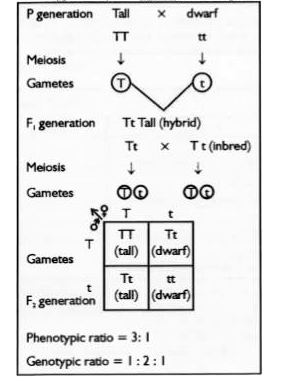 This shows that tallness is a dominant trait in pea plants. When these hybrid plants are self fertilised, they give rise to tall and short plants in the PHENOTYPIC ratio of 3:1. So trait for shortness is considered recessive. |
|
| 3329. |
Question : How do Mendel's experiments show that traits are inherited independentlyy? |
|
Answer» Solution :When a PEA plant with round green seeds was crossed with a pea plant with WRINKLED yellow seeds, the F1 progeny were all plants with round, yellow seeds. It means round and yellow seeds are dominant traits while wrinkled green seeds are recessive traits. When the F1 plants were self-pollinated and F2 progeny GENERATED, there were four types of plants: (i) Round yellow seeds (ii) Round green seeds (III) Wrinkled yellow seeds (IV) Wrinkled green seeds 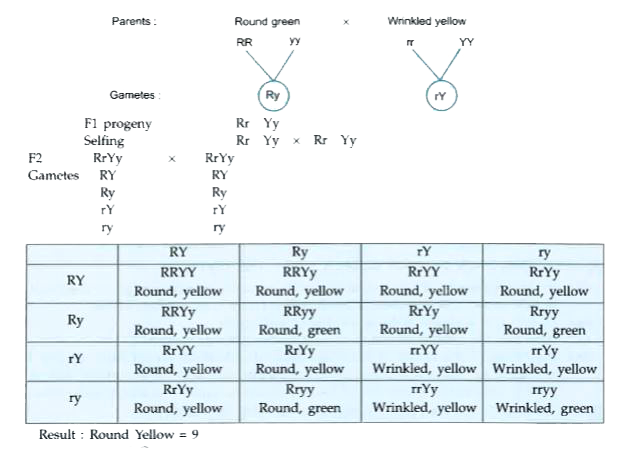 Result: Round Yellow = 9 Round Green =3 Wrinkled Yellow = 3 Wrinkled Green = 1 |
|
| 3330. |
Question : How do Mendel's experiments show that traits may be dominant or recessive ? |
Answer» Solution :Given 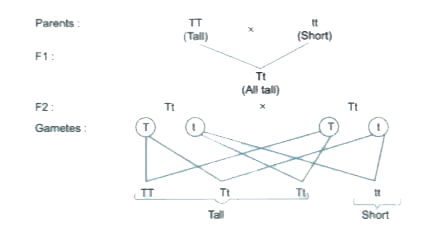 It is clear that in `F_(1)`, when the GENOTYPE of tall plant Tt, they appear tall. This clearly means that when both the genes are present the EFFECT is that of only .T., which is dominant. The recessive trait is unable to express itself in presence of a dominant TREAT. According to Law of Dominance, a SINGLE copy of dominant trait is enough for its expression. |
|
| 3331. |
Question : How do Mendel's experiments show that traits are inherited independently ? Depict with the help of a cross. |
| Answer» Solution :See N.C.E.R.T. QUESTION Number 2, PAGE Number 147 of the textbook. | |
| 3332. |
Question : How does Mendel's experiment show that traits are inherited independently? |
|
Answer» Solution :Dihybrid cross involves contrasting forms of two characters. When plants that PRODUCE round and yellow seeds (RRYY) were CROSSED with wrinkled and green seed PRODUCING plants (rryy), the resultant Fl offspring has always been round and yellow seed producing plants(HYBRID- RrYy). When this hybrid is SELF fertilized, the offsprings with new trait combination were produced: Round yellow, round green, wrinkled yellow and wrinkled green. This is possible only if the traits are independently inherited. If they were not independently inherited, then the F2 offsprings would also be either round and yellow or wrinkled and green. This clearly shows that each trait is expressed independent of each other. |
|
| 3333. |
Question :How do Mendel's experiments show that traits are inherited independently? |
Answer» Solution :When Mendel first CROSSED pure-bred PEA plants having round-yellow seeds with pure-bred pea plants having wrinkled green seeds, he found that only round-yellow seeds were produced in the first generation. No wrinkled green seeds were OBTAINED in the F generation. From this, it was concluded that round shape and yellow colour of the seeds were dominant traits over the wrinkled shape and green colour of the seeds.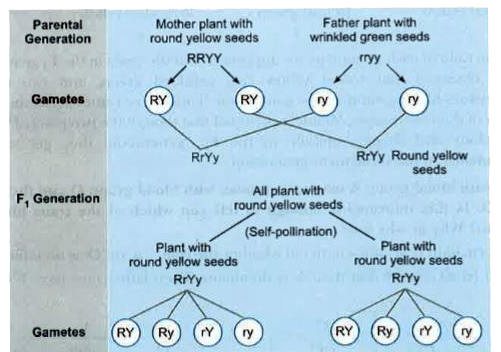 When the `F_1` generation pea plants having round yellow seeds were cross-bred by self-pollination, then four types of seeds having different combinations of shape and colour were obtained in second generation `(F_2)`. These were round yellow, round green, wrinkled yellow and wrinkled green seeds. Such a cross is known as dihybrid cross as two sets of corresponding characters are considered. 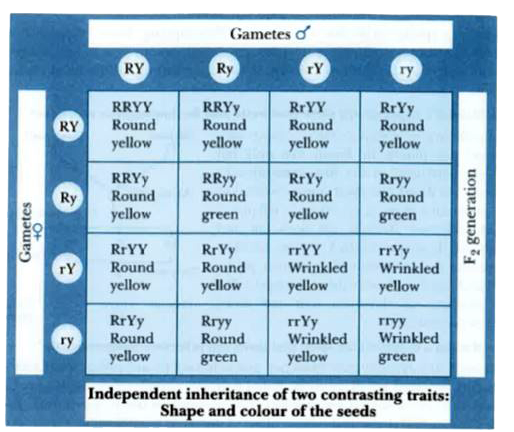 Thus, the RATIO of each PHENOTYPE (or appearance) of the seeds in the F, generation is 9:3: 3:1. Mendel observed that round yellow and wrinkled green, and two new combinations of characteristics had appeared in the generation. These were round green and wrinkled yellow. On the basis of this observation, Mendel concluded that though the two pairs of original characteristics (seed colour and shape) combine in the `F_1` generation, they get separated and behave independently in the subsequent generation. |
|
| 3334. |
Question : How do Mendel's experiments show that traits are inherited independently ? |
|
Answer» Solution :Mendel performed dihybrid experiment on pea plants. A tall plant with ROUND seeds was crossed with a short plant with wrinkled seeds. `F_(1)` progeny plants were all tall with round seeds. `F_(1)` progeny are used to generate `F_(2)` progeny by self-pollination. Along with PARENTAL combinations, `F_(2)` progeny showed new combinations too. Some of them were tall with wrinkled seeds while some others were short with round seeds. It means factors (genes) CONTROLLING for SEED shape and height of plant recombine to form new combinations in `F_(2)` offsprings. THUS, tall/short trait and the round seed/wrinkled seeds trait are inherited independently. |
|
| 3335. |
Question : How do Mendel's experiments show that the (a) traits may be dominant or recessive, (b) traits are inherited independently? |
|
Answer» Solution :(a) When Mendel cross POLLINATED pure tall pea plants with pure dwarf pea plants, only tall plants were obtained in `F_1` generation. On self pollinating the `F_1` progeny, both tall and dwarf plants appeared in `F_2` generation in the ratio 3:1. Appearance of tall character in both the `F_1` and `F_2` shows that it is a dominant character. The absence of dwarf character in `F_1` generation and its reappearance in `F_2` shows dwarfness is the recessive character. (b) When Mendel first crossed pure-breed pea plants having round-yellow seeds with pure-breed pea plants having wrinkled-GREEN seeds, he found that only round-yellow seeds were PRODUCED in the first-generation. No wrinkled-green seeds were obtained in the `F_1` generation. From this, it was concluded that round shape and yellow colour of the seeds were dominant traits over the wrinkled shape and green colour of the seeds. When the `F_1` generation pea plants having round-yellow seeds were cross-bred by self-pollination, then four types of seeds having different combinations of shape and colour were obtained in second generation `(F_2)`. These were round-yellow, round-green, wrinkled-yellow and wrinkled-green seeds. Such a cross is known as dihybrid cross as two sets of corresponding characters are considered. Mendel observed that along with round-yellow and wrinkled-green, two new combinations of CHARACTERISTICS, round-green and wrinkled-yellow, had appeared in the `F_2` generation. On the BASIS of this observation, Mendel concluded that though the two pairs of original characteristics (seed colour and shape) combine in the `F_1` generation, they get separated and behave independently in the subsequent generation. |
|
| 3336. |
Question : How do Mendel's experiments show that a] traits may be dominant or recessive? b] inheritance of two traits is independent of each other? |
|
Answer» Solution :a) When Mendel crossed pure breeding tall pea plants with pure breeding dwarf pea plants, only tall pea plants were obtained in `F_1` generation. The short trait disappeared in the `F_1` generation. This shows that tall trait is dominant while the short trait is recessive. b] In Dihybrid CROSS, where two pairs of characters with two contrasting FORMS each were considered (round and green with wrinkled, YELLOW), the traits were expressed INDEPENDENT of each other resulting in offsprings with new combination of traits (wrinkled yellow, round yellow, wrinkled green) in F2 generation. |
|
| 3337. |
Question : How do Mendel's experiments show that traits are inherited independently? |
|
Answer» Solution :(i) When a cross was made between a tall pea plant with round seeds and a short pea plant with wrinkled seeds, the `F_(1)` progeny PLANTS are all tall with round seeds. This indicates that tallness and round seeds are the dominant traits. (ii) When the `F_(1)` plants are self pollinated, the `F_(2)` progeny consisted of some tall plants with round seeds and some short plants with wrinkled seeds which are the parental traits. (iii) There were also some new combinations like tall plants with wrinkled seeds and short plants with round seeds. (iv) Thus it MAY be CONCLUDED that tall and short traits and round and wrinkled seed traits have been inherited independently. OR A flow chart DEPICTING the same. 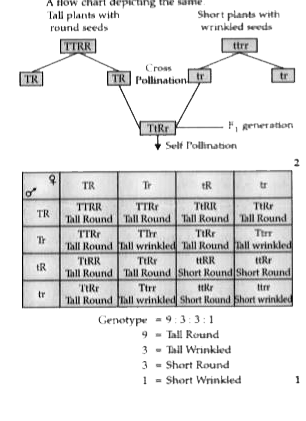
|
|
| 3338. |
Question : How do germ cells make a single set of genes from the normal two copies in all other cells of body ? |
| Answer» SOLUTION :In meiosis, GERM CELLS undergo reduction division forming a SINGLE SET of genes from the normal two copies in all other cells of body. | |
| 3339. |
Question : How do fossils form layer by layer ? |
|
Answer» Solution :Fossils are seen layer by layer as FOLLOWS : Some invertebrates on the sea-bed die, and are buried in the sand from about 100 millions years ago. More sand accumulates and gradually a sand-stone is formed under pressure. Millions of years later, when dinosaurs living in the area die, then their bodies got buried in this mud too. This mud is also compressed into rock, upper layers of rock containing the invertebrate fossils from earlier TIMES.  Millions of years later, the bodies of HORSE- like creatures dying in that area are fossilised in rocks above these earlier rocks. Much later, by erosion of soil or by water currets some of the rock weathers and EXPOSES the horse-like fossils. As we dig deeper, we will find older and older fossils. |
|
| 3340. |
Question : How do chromosomes take part in the formation of male and female child? |
| Answer» Solution :FERTILIZATION of the EGG (22+X) with a SPERM [22+X] will produce a female child [44+XX] The fertilization of the egg (22+X) with a sperm [22+Y] will give RISE to a male child [44+XY] | |
| 3341. |
Question : How do carbohydrates, proteins and fats get digested in human beings ? |
| Answer» Solution :`{:("Food Component","Organ/Enzyme","Digestion"),("1. Carbohydrates","(a) Mouth "to."SALIVARY amylase","(a) STARCH" to."Maltose"),(,"(b) Small intestine"to."Pancreatic","(b) Maltose"to."Sucrose"),(,"amylase"to."Intestinal amylase","Sucrose"to."Glucose"),("2.Proteins","(a) Stomach" to."Pepsin","(a) Proteins"to."Dipeptides"),(,"(b) Small intestine"to."Trypsin","(b) Dipeptides "to."Amino acids"),("3. Fats","(a) Small intestine"to.,),(,"(i) Bile(from LIVER)","(i) Fats "to."MICELLES"),(,,"(emulsification)"),(,"(ii) Lipase from small intestine","(ii) Emulsified fats" to."fatty acids + GLYCEROL"):}` | |
| 3342. |
Question : How do butterflies contribute to environmental balance? |
|
Answer» Solution :(i) Butterflies pollinate different types of flowering plants, thus helping in the reproduction of plants. (ii) Butterflies play an important role in FOOD chain as PREY for birds, bats and other insectivorous animlas. (iii) By feeding on leaves, butterflies can help to control some of the unwanted plants found in the garden. (iv) Butterflies have been widely used by ecologists as model organisms to study the impact of climate change. (v) By WATCHING how butterfiles react AD adjust to environmental changes, scientists can determine the effects of various actions on the ENVIRONMENT as a whole. |
|
| 3343. |
Question : How do auxins promotes the growth of a tendrill arounda support ? Describe in brief. |
| Answer» Solution :Auxins produced in the shoot tip move downwrds in the plant. These auxins CAUSE cell elongation in the growing TISSUES. In the tendrils, auxins move away from the pont of contct with the supporting object. More growth occurs on the SIDE away from the support. As a result of unequal growth on the two sides, the TENDRIL coils around the support. | |
| 3344. |
Question : How do auxins promotes the growth of tendril around a support ? |
| Answer» SOLUTION :When a tendril is in contact with support more AUXIN diffuses towards the side of tendril away from the support. This concentration of auxin STIMULATES cells to grow LONGER on the side of tendril which is away from support. | |
| 3345. |
Question : How do auxins help in bending of stem towards light ? Explain. |
| Answer» Solution :When GROWING plants detect light,HORMONE celled auxin, synthesized at the shoot tip helps the cells to grow longer. When light is coming from one side of the plant, auxin DIFFUSES towards the shady side of the shoot which is away from light. THUS, plant appears to BEND towards light. | |
| 3346. |
Question : How do autotrophs obtain CO_(2) and N_(2)to make their food ? |
| Answer» SOLUTION :AUTOTROPHS OBTAIN `CO_2` from ATMOSPHERE and `N_2` from the SOIL. | |
| 3347. |
Question : How did Mendeleev arrange the elements? He left empty places in his periodic table. Why? Explain the limitations of Mendeleev classification |
|
Answer» Solution :a) MENDELEEV REALIZED that the physical and chemical properties of elements were related to their atomic mass in a "periodic way and ARRANGED them so that groups of elements with similar properties fell into vertical columns in his table. b) Gaps were left for undiscovered elements in the Mendeleev.s periodic table. C) LIMITATIONS of Mendeleev classification : * Position of hydrogen was not justified. * Increasing order of atomic mass could not be maintained. * Isotopes have similar chemical properties but different atomic masses, they cannot be given separate places. * Mendeleev could not explain the cause of periodicty. |
|
| 3348. |
Question : How did Mendel explain that it is possible that a trait is inherited but not expressed in an organism ? |
|
Answer» Solution :Gregor JOHANN Mendel, through consistent studies on garden pea arrived at LAWS of INHERITANCE. He used plants that were pure breeding for a trait and considered contrasting characters like - tall and short plant size, round and wrinkled SEEDS, white and violet flowers etc. In his experiments, he crossed plants with contrasting characters, studied the progeny of first generation (F1) and second generation (F2) and calculated ratios of plants with contrasting characters that were original parental type or different. For example, he crossed a tall pea plant witha dwarf pea plant. He found that in first generation (F1) all the plants produced were tall. THUS, F1 generation can be shown as -  Since F1 plants are all Tall and genotypically are Tt, they have inherited .t from one which is not parent expressed, as it results in dwarf plants. |
|
| 3349. |
Question : How do Mendel's experiments show that traits may be dominant or recessive? |
|
Answer» SOLUTION :Through his monohybrid cross, Mendel SHOWED that the traits may be dominant or recessive. He crossed true-breeding tall (TT) and dwarf (tt) pea plants. The SEEDS formed as a result of fertilisation were grown. They form the first filial or F, generation. All the `F_1` plants obtained were tall. Not a single dwarf plant was produced. Mendel self-pollinated the `F_1`plants to obtain the next generation of offsprings- `F_2` generation. To his surprise, he observed that not all the F, generation plants were tall. One FOURTH of the plants were short while the rest were tall. Hence, Mendel CONCLUDED that: a] The F, tall plants were not true breeding, they were carrying traits of both short and tall, but only the tall traits got expressed. b] The factor for the tall trait was dominant over the dwarf trait thereby masking the dwarf trait from getting expressed. c] Hence, "The traits may be dominant or recessive" This was the interpretation of Mendel on observing the results of his experiments. |
|
| 3350. |
Question : How were farmers able to obtain present day cabbage, cauliflower and broccoli from wild cabbage? |
|
Answer» Solution :Humans cultivated wild cabbage as a FOOD plant, and generated different vegetables from it by selection: • In order to maximize the amount of food they got from it, they planted seeds from plants that grew more leaves, and after many generations, produced a larger leafy version of wild mustard called as kale or collard greens. • LATER farmers wanted very short distances between leaves. Hence they selected the variants of the plant that produced enlarged leaf BUDS in particular. After many generations, this led to plants with huge heads of tightly rolled leaves that we would call cabbage. • Elsewhere, farmers selected for enlarged flowering structures (creating broccoli for arrested flower development and cauliflower for sterile flowers) • SWOLLEN and enlarged stems (kohlrabi), • Many small heads (brussels sprouts). |
|