

Saved Bookmarks
| 1. |
What will happen if the price prevailing in the market is (i) Above the equilibrium price? (ii) Below the equilibrium price? or How price and quantity are determined in the market when number of firms are fixed ? Or How is equilibrium price of a commodity determined? (Use diagram). or Explain why equilibrium price is determined at the level of output at which its demand is equal to its supply. Or How will equilibrium price be reached when there is excess demand/ excess supply? Explain with diagram. Or With the help of a suitable diagram, explain the process of determination of equilibrium price of a commodity under perfectly competitive market. Or Market for a good is in equilibrium. Explain the chain of reactions in the market if the price is (i) higher than equilibrium price and(ii) lower than |
|
Answer» Solution :(i) Market equilibrium refers to that point which has come to be established under a given condition of demand and supply and has a tendency to stick to that level, i.e. where Demand = Supply. (ii) If due to some disturbance we divert from our position the economic forces will work in such a manner that it could be driven back to its original position, i.e., where Demand = Supply. In short it is the position of rest. (iii)It can be explained with the help of following schedule and diagram: (a) In the below schedule market equilibrium is determined at Price 3 where Market demand is equal to Market Supply. At price 1 and 2, there is excess demand, which leads to rise in price, resulting tendencyis expansion in supply. (b)In the given diagram, price is measured on vertical axis, whereas quantity demanded and supply is measured on horizontal axis. Suppose that INITIALLY the price in the market is `P_(1)` . At this price, the consumer demand `P_(1)`B and the producer supply `P_(1)`A, i.e. Consumers want more than what the producer are willing to supply. There is excess demand equal to AB. So, price cannot stay on` P_(1)` as excess demand will create competition among the BUYERS and push the price up till we reach equilibrium. Due to rise in price from ` P_(1)` to P,there is upward MOVEMENT along the supply curve (expansion in supply) from Ato E and upward movement along the demand curve (CONTRACTION in demand) from B to E. SIMILARLY, at price `P_(2)` the quantity demanded P,K is less than the quantity supplied `P_(2)` L. There is excess supply, equal to KL, which will create competition among the sellers and lower the price. The price will keep falling as long as there is an excess supply. Due to fall in price from `P_(2)` to P there is downward movement along the supply curve (contraction in supply) from L to E and downward curve (expansion in demand) from K to E. The situation of zero excess demand and zero excess supply defines market equilibrium (E). Alternatively, it is defined by the equality between quantity demanded and quantity supplied. The price P is called equilibrium price and quantity Q is called equilibrium quantity. 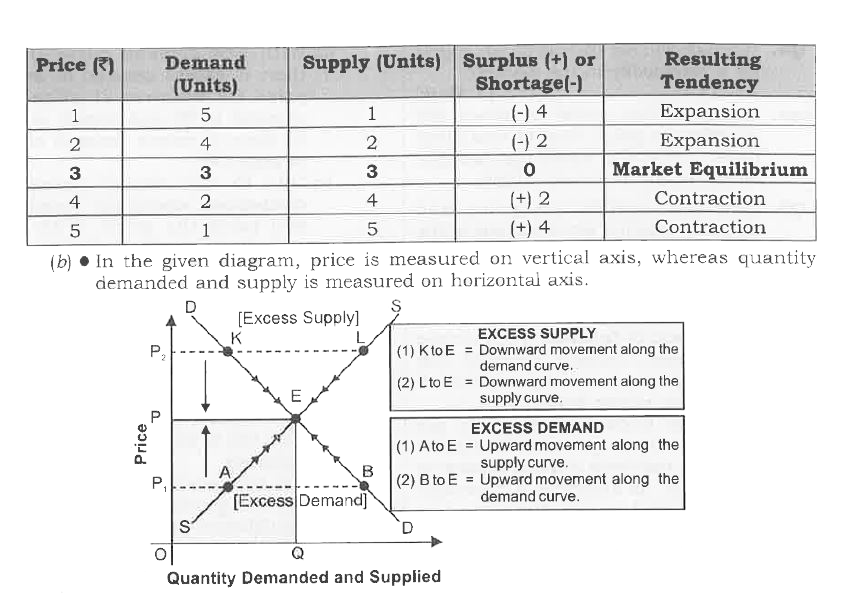
|
|