

Saved Bookmarks
| 1. |
Total internal reflection of light ray from cylindrical optical fiber An optical fiber consists of a cylindrical core of unknown refractive index kept in air. A ray of light is incident on the flat face of the core so that it gets totally reflected at the curved surface (Fig.34-19). What is the possible refractive index if the ray is totally reflected at any angle of incidence phi from air ? |
|
Answer» Solution :When a ray refracts from air to glass, total internal reflection cannot occur. However, when this ray strikes curved surface of the fiber, the incidence is from denser to rarer medium. If n is such that total internal reflection occurs at this point, it will continue to occur as the ray strikes the curved surface repetedly at the same angle. Calculation : LET us assume that the ray is INCIDENT at an angle `phi` from air and is refracted into the cylinder at an angle `theta`. It is then again incident on the air cylinder boundary at the curved surface as shown in Fig. 34-19 . The condition is that the ray should undergo total internal reflection at the face. For this the angle of incidence here should be greater than critical angle. `90^(@)-theta gt theta_(c )` Since sine is an increasing function, taking sine of both sides will not CHANGE the inequality. `sin(90^(@)-theta) gt sin theta_(c )=(1)/(n)(nsintheta_(c )=1xxsin90^(@))` `costheta ge (1)/(n)` Again, applying Snell.s law at flat face, we get `1xxsinphi=nxxsintheta` Squaring and adding , we get `n^(2)sin^(2)theta+n^(2)cos^(2)theta ge 1+sin^(2)phi` `n^(2) ge 1 +sin^(2) phi` But the maximum value of `sin phi` is `1` when the angle of incidence is `90^(@)`. For this condition, `n^(2) ge 2` or `n ge sqrt(2)` Learn : Interestingly this yields `mu ge 1.41`. Thus, even ordinary glass can be used in optical fiber. But for practical reasons, this core is coated with a cylindrical SHELL called cladding. If cladding has refractive index of `mu_(1)`, the condition on `mu_(2)` is `mu_(2) ge sqrt(mu_(1)^(2)+1)` 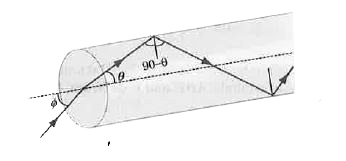
|
|