

Saved Bookmarks
| 1. |
The energy levels of a hypothetical atom are shown in Fig.12.13. Which of the shown transitions will result in the emission of a photon of wavelength 275 nm ? Which of these transitions correspond to emission of radiation of (i) maximum and (ii) minimum wavelength ? |
|
Answer» Solution :If a lightphoton of wavelenght`lambda = 275 NM = 2.75 xx 10^(-7)` m is emitted , thenenergyof photon `E= (hc)/(lambda) J = (hc)/( lambda xx 1.60 xx 10^(-19)) eV` ` = (6.63 xx 10^(-34) xx 3 xx 10^(8))/(2.75 xx 10^(-7) xx 1.60 xx 10^(-19)) eV = 4.5 eV` 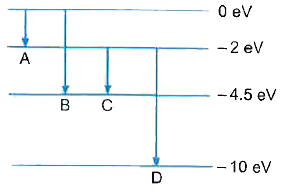 From the energy level diagram given, we find that a light photon of energy 4.5 eV can be emitted only when electron transition TAKES from 0 eV energy level to -4.5 eV energy level because then `E_(1)-E_(2) = 0 - (-4.5) = + 4.5 eV.` Hence, transition B will result in the emission of a photon of WAVELENGTH 275 nm. (i) For emission of radiation of maximum wavelength the energy of emitted photon should be minimum. Obviously, the transition A corresponds to emission of maximum wavelength radiation because energy in this transition [0 eV -(-2 eV) = 2 eV] is minimum. (ii) For emission of radiation of minimum wavelength the energy of emitted photon should be maximum. Obviously, the transition D corresponds to emission of minimum wavelength radiation because energy in this transition [(-2 eV)-(-10 eV) = 8 eV] is maximum. |
|