Saved Bookmarks
| 1. |
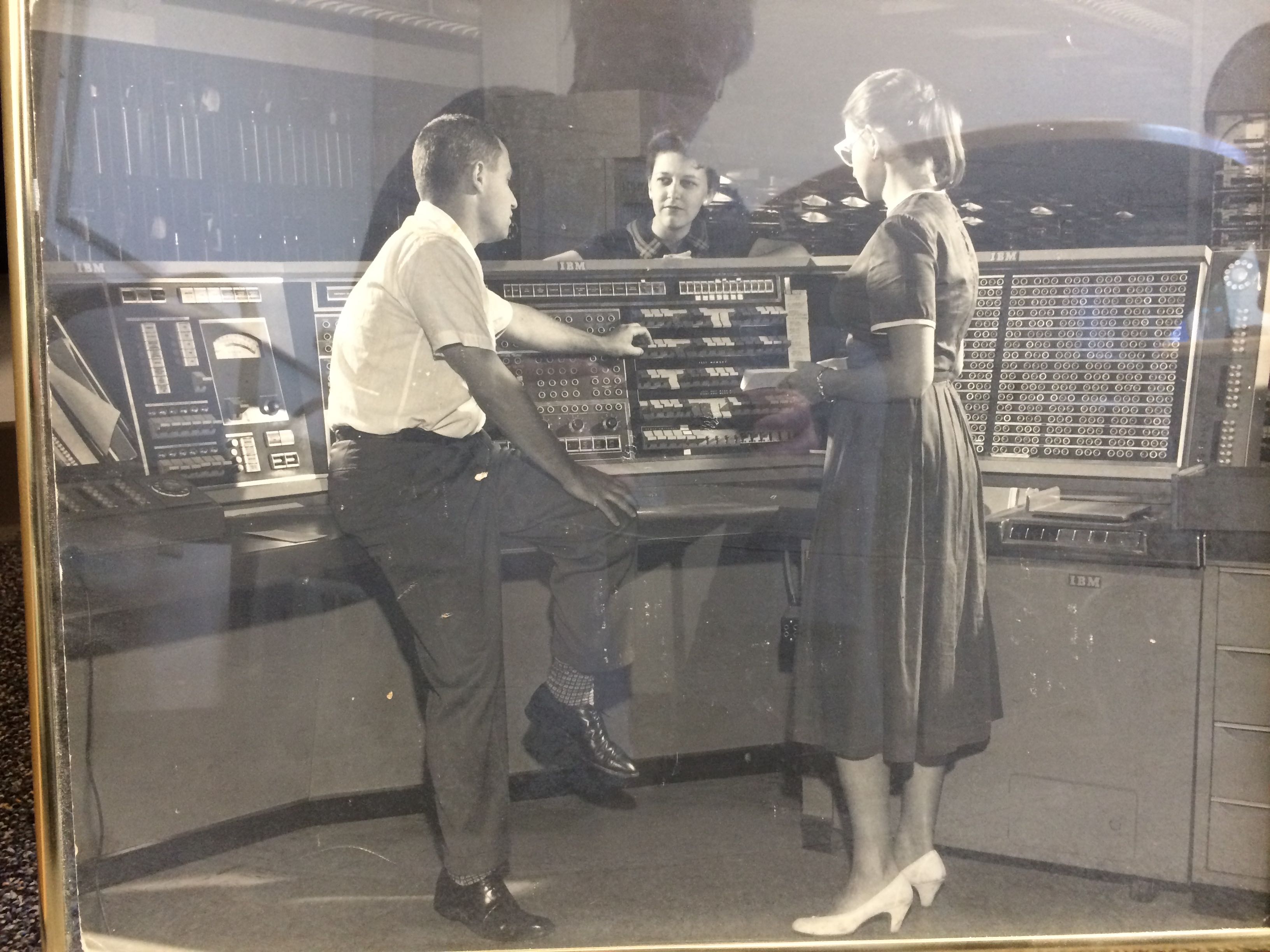
Solve : Can anyone identify this computer? |
|
Answer» Clearly this is an old IBM computer but I can't figure out exactly what model it is. I'm wondering if someone might recognize it. I believe the gentleman in the photo is Jules Schwartz of JOVIAL fame. Why not ask IBM and include the pic ? ? Awesome idea.... They might be interested in that picture if they dont have one of it. Also to mention that... some systems back then deviated from standard build. They would be build to order, so it might be a variant of 704 or 709 etc. Whatever a company or organization with LOTS OF MONEY needed, a system could be specially engineered and built for it since money talks. Computers and Mainframes were not mass produced back then. They were great big monsters with lots of relays and tubes and a very hungry electrical power need. I havent looked into population reports of systems back in the 50s, but if I was to make an educated GUESS, i would think that there might be only a few hundred of these monster computers tops. The US Government for Defense having greater portion of them. And only the giant banks and engineering firms being the rest of the population + the larger colleges that had the funding or donation of such great monster computer/mainframes. I read in a BOOK once that one computer used so much electricity and due to relay logic, ( de-energized relays dont consume power but energigized relays do ), and so it caused an unusually heavy power demand at times if more relays were energized than de-energized and so it made peoples lights flicker as the line voltage would dip from excessive current needs. When I worked for Allen-Bradley / Rockwell Automation there were some customers that wanted their own specific product and so they had a variant of a standard Intel i960 micro controller with specific firmware for their needs as well as board mods to make the controller to their spec needs. Money Talks and odd builds become of it. Part Numbers would be almost the same as the standard product but have a DIFFERENT number or letter in part number to identify it as what it is. These were low production for specific customer. Where as the IMC S-Class CONTROLLERS they made tens of thousands of them with other flavors that were standard options and some options quickly implemented by swapping firmware and installing or removing such as an Axis-Link or RIO Card. Never knew you worked for A/B Rockwell.... Quote Never knew you worked for A/B Rockwell.... May 1995 to October 2001 as an ET for Service Department and Production Test & Repair for mostly IMC S-Class & 1394 Crusader ... smaller production boards were PWM A3, PWM C, PWM D, MAX Boards, SAM Boards, Resolvers, Transducers, Picopath CNC Plasma Cutter controls, Micrologix PLC. IMC S-Class Controllers = http://literature.rockwellautomation.com/idc/groups/literature/documents/td/4100-td023_-en-p.pdf The PWM C and PWM D's were the most fun I think to service because when they failed on 48VDC or 90VDC when switching a large motor from clockwise to counter clockwise at 100% speed it made a load pop and shower of sparks like a roman candle blowing a hole the diameter of a 22 bullet through the heavy duty power MOSFETs like the one pictured in which there were I think 6 of them mounted to the board and angle aluminum heatsink and the analog components like 1/4 watt resistors and diodes catch fire, and the lovely smell too. We had to run the boards hard after repairing them and sometimes a borderline analog component from the prior failure made its way to the repair and BOOM when full reversal. If you could switch direction of the large DC motor and not blow it then it was good to go. I brought in a piece of plexyglass from home and stood back when testing these. Very rarely did they blow because I was good at fixing them, but when they did you didnt want to get showered with sparks and slag from the MOSFET failure. [attachment deleted by admin to conserve space] Quote from: DaveLembke on June 17, 2017, 05:35:33 PM 48VDC or 90VDC when switching a large motor from clockwise to counter clockwise at 100% speed it made a load pop and shower of sparksDC motors. Fun. Lots of unruly energy. My dad was an electrical engineer. he told me about the old days, he qualified after WW2 but he saw plenty of old industrial installations from the early days still around. Big open frame motors, 100 HP upwards, 500 V DC, controlled by open starter gear and bare knife switches mounted HIGH on the wall on slate panels operated by a long pole with a hook on the end (so a brief arc wouldn't trouble the operator too much. That was your Health and Safety). Switch men were men in those days! If a switch was opened and an arc persisted they had wooden paddles also on poles and the idea was to try to interrupt the arc with the wooden (non-conductive) blade. This could be tricky because as welders know you don't want to look at an arc if you value your eyesight. The canny guys kept a pair of smoked glass googles handy. Also they would have a lot of incandescent melted copper and brass dripping down while they were fooling around with the paddles which might well catch fire. Sometimes the only thing to do was vacate the switch room and get the main incoming supply breaker opened. Then you might have to wait for the AC-DC rotary converter to run down before the arcing would finally stop. A flashover in a big motor could be dramatic too. He showed me a report on the death of a guy who was walking past the open doorway of a building at the exact moment a flashover occurred in a big motor inside. All his clothes were blown off, he didn't have a mark on him, and the postmortem showed he died of blast injuries to his lungs like a high explosive bomb had detonated. |
|