

Saved Bookmarks
| 1. |
Show that a=(v^2)/r and hence obtain an expression for centripetal force. |
|
Answer» Solution :Let `vecr` and `vecr`, be the position vectors and `vecv` velocities of the OBJECT when it is it point P and P. By definition, velocity at a point is ALONG the tangent at that point in the direction of the motion. Since the path is CIRCULAR, `vecv` is perpendicular to `vecr` and `vecv` is perpendicular to `vecr` Therefore, `/_\vecv` is perpendicular to `/_\vecr`. Average acceleration `(/_\vecv)/(/_\t)` is perpendicular to `/_\vecr` The magnitude of `veca` is, by definition, given by `|veca|=lim_(/_\t to0)(/_\vecv)/(/_\t)` The TRIANGLE formed by the position vectors is similarly to the triangle formed by the velocity vectors. 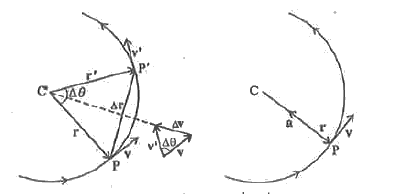 i.e, `(|/_\vecv|)/v=(|/_\vecr|)/r "or"|/_\vecv|=v(|/_\vecr|)r` Therefore, `|veca|=lim_(|/_\vecv)/(/_\t)=lim_(/_\t to0)(v|/_\vecr|)/(r/_\t)=(vecv)/(r)lim_(/_\t to0)(|/_\vecr|)/(/_\t)` If `/_\t` is very small, `/_\theta` will also small. The arc PP' is approximately equal to `|/_\vecr|` i.e., `lim_(/_\t to0)(|/_\vecr|)/(/_\t)=v` Thus, centripetal acceleration `|veca|=v/fv=(v^2)/(r)` and `veca=v/r(dvecr)/(dt)` The centripetal acceleration is always DIRECTED towards the centre. The centripetal force=ma. |
|