

Saved Bookmarks
| 1. |
Obtain the equation of electric field by dipole at a point on equator of dipole. |
|
Answer» Solution :Distance of point P from `+q` and `-q` are same. `r_(+) = r_(-) = sqrt(r^(2) + a^(2))` where, r = distance of P from 0. 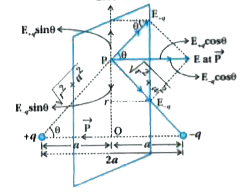 The magnitudes of the electric fields due to the two charges `+q` and `-q` are EQUAL. `vec(E_(+q)) = q/(4pi epsilon_(0)).1/(r^(2) + a^(2)) = (KQ)/(r^(2) + a^(2))`..........(1) `vecE_(-q) =q/(4pi epsilon_(0)).1/(r^(2) + a^(2)) = (kq)/(r^(2) + a^(2))`............(2) The distance of `vecE_(+q)` and `vecE_(-q)` are as shown in figure. The sine components will cancel each other. The total electric field at P. `therefore VECE =-(E_(+q) + E_(-q)) cos thetahatp = -(2kq)/(r^(2) + a^(2)). cos theta hatp`.............(3) (`therefore` from equation (1) and (2)) Perpendicular components to dipole axis of `vecE_(+q)` and `vecE_(-q)` at P are `E_(+q) sin theta` and `E_(-q) sin theta`. They are equal in magnitude and opposite ir direction, so they will cancel the effects of each other. But parallel components to dipole axis of `vecE_(+q)` and `vecE_(-q)`at P are `E_(+q) cos theta`and `E_(-q cos theta)`. And they are in same direction, so they will be added and resultant `vecE` will be in opposite to `hatp` `therefore vecE = -(E_(+q) cos theta + E_(-q).cos theta).hatp` `=-2E_(+q) cos theta hatp``(therefore E_(+q) = E_(-q))` `vecE = -(2kq)/(r^(2) + a^(2)) xx cos theta.hatp`...........(4) (From equation (3)) Now, from figure, `cos theta = a/(r^(2) + a^(2))^(2)`.............(5) `cos theta = a/(r^(2) + a^(2))^(1/2)` `therefore` From equation (4) and (5), `vecE = (-2kq)/(r^(2) + a^(2)) xx a/(r^(2) + a^(2))^(2) hatp`. `therefore vecE =-(2kqa)/(r^(2) + a^(2))^(2).hatp` If `r gt gt a`, then `a^(2)` can be neglected. `therefore vecE = -(2kqa)/r^(3).hatp` But `2qa =p` `vecE = -(kq)/r^(3)hatp` or `vecE =-p/(4piepsilon_(0)r^(3)).hatp` |
|