

Saved Bookmarks
| 1. |
If A(3,4) and B(-5,-2) are the extremities of the base of an isosceles triangle ABC with tan C = 2, then point C can be |
|
Answer» `((3sqrt(5)-1)/(2),-(1+2sqrt(5)))` 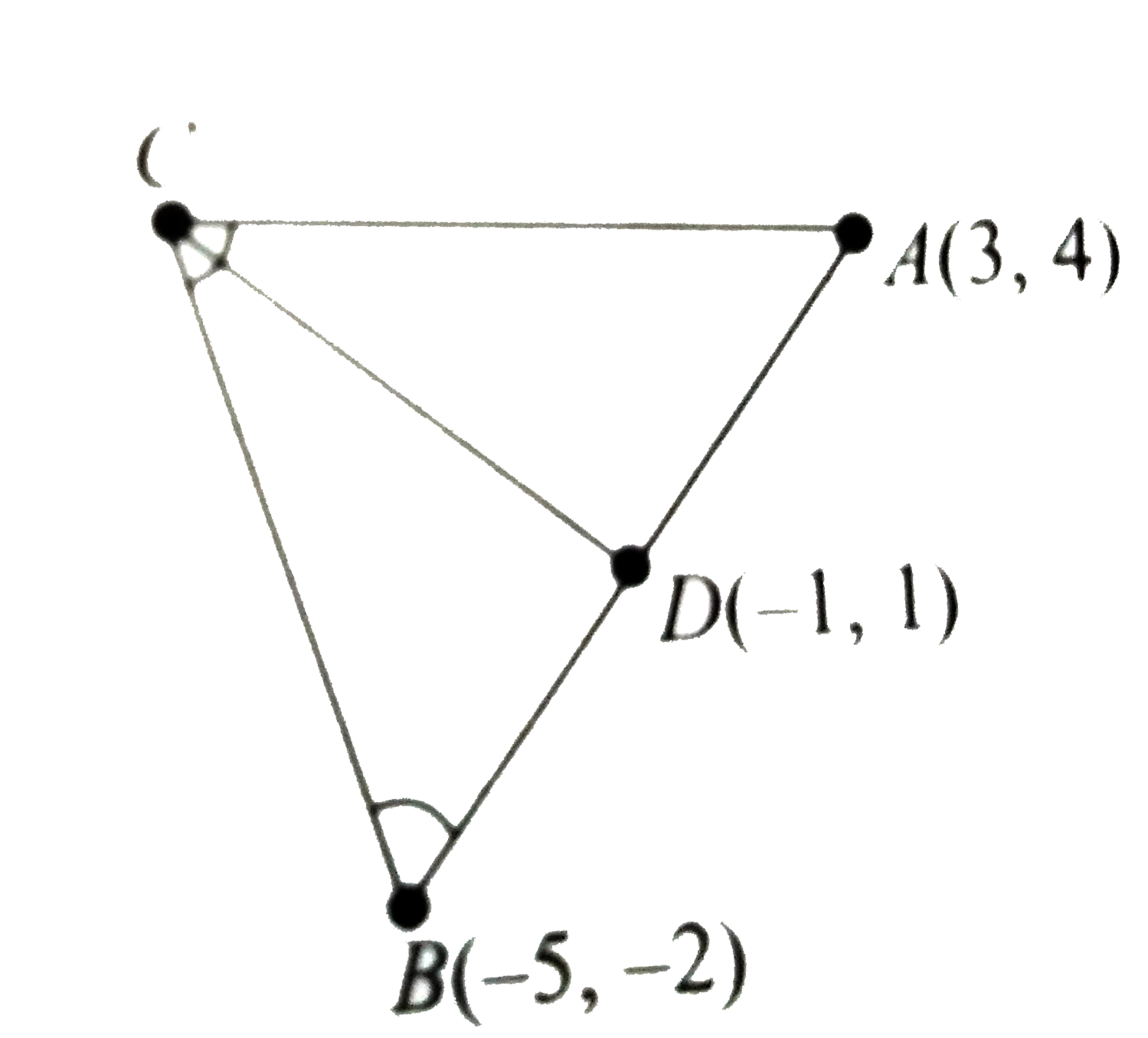 `D(-1,1)` is midpoint of AB. `CD = BD cot.(C)/(2) =5. cot.(C)/(2)` Now, `tan C = 2` `rArr (2tan.(C)/(2))/(1-tan^(-2).(C)/(2)) =2` `rArr tan^(2).(C)/(2) +tan.(C)/(2)-1 =0` `rArr tan.(C)/(2) =(-1+sqrt(5))/(2)` `rArr cot.(C)/(2) =(sqrt(5)+1)/(2)` `rArr CD = 5 ((sqrt(5)+1)/(2)) =(5)/(2) (sqrt(5)+1)` Slope of BD is `3//4`. `:.` Slope of CD is `-4//3 = tan ALPHA` Using parametric FORM of straight line, coordinates of C are given by `(-1+-(5(sqrt(5)+1))/(2)cos alpha,1+-(5(sqrt(5)+1))/(2)sin alpha)` or `(-(5+3sqrt(5))/(2),2sqrt(5)+3)` and `((3sqrt(5)-1)/(2),-(2sqrt(5)+1))` |
|