

Saved Bookmarks
| 1. |
(i) Derive the expression for the specificfor the electricpotentialdue to an electricdipole at a point on its axial line. (ii) Depietthe equivpotentialsurfacesdue to an electricdipole. |
|
Answer» Solution :(i) Expression : Potentialat P due to CHARGE `+Q` and -q. `V_(-q) = (-q)/(4piin_(0)r_(1))` and`V_(+q) = q/(4piin_(0) r_(2))` Potentialat P due to DIPOLE `V = V_(-q) + V_(+q) = (q)/(4piin_(0)) [1/(r_(2))- 1/(r_(1))] "…….." (i)` 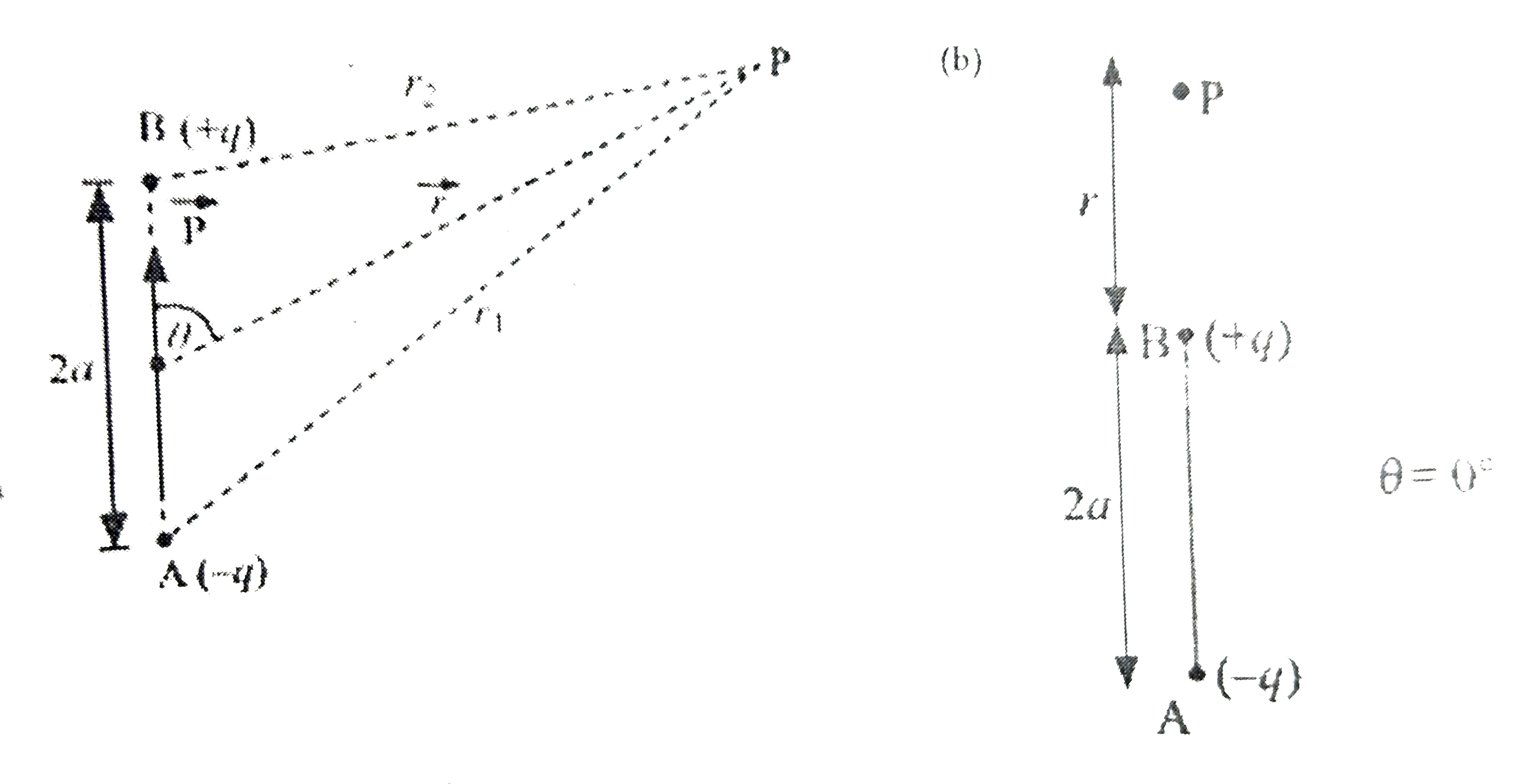 From the figure, `r_(1)^(2) = r^(2) +d + 2ar cos THETA` and, `r_(2)^(2) = r^(2) + a^(2) + 2ar cos(180^(@) - theta) = r^(2) + a^(2) - 2ar cos theta` `rArr r_(1)^(2)= r^(2)[1+(a^(2))/(r^(2)) +(2a)/(r ) costheta] = r^(2)[1+(2a)/(r) costheta]` as `r gt gt a, (a^(2))/(r^(2)) = 0` `rArr r_(1) = r[1+(2a)/(r) cos theta]^(1/2)` So `1/(r_(1)) = 1/r[1+(2a)/(r) cos theta]^(-1/2)` and `1/(r_(2)) = = 1/r [1-(2a)/(r) cos theta]^(-1//2)` Using it for `(i)` `V = (q)/(4piin_(0)r)[1+a/r cos theta - (1- a/r cos theta)]` [Applying Binomial Theorem and neglectinghighest power of `(2a)/(r)` ] Hence, `V = (q)/(4piin_(0)r) [1+q/r cos theta - 1+ a/r cos theta]` `= (qxx2a cos theta)/(4piin_(0)r^(2))` `rArrV = (p cos theta)/(4piin_(0)r^(2)) , {p = q xx 2a = " dipole moment"}` Vaxial `= (pcos theta)/(4piin_(0)r^(2))` ( `:' theta = 0^(@)` on axialline) `= (p)/(4pi in_(0)r^(2))` (ii) `V_("net") = V_(A) + V_(B)= (-kq)/((r^(2)+a^(2))) + (-kq)/((r^(2)+a^(2)) = 0` 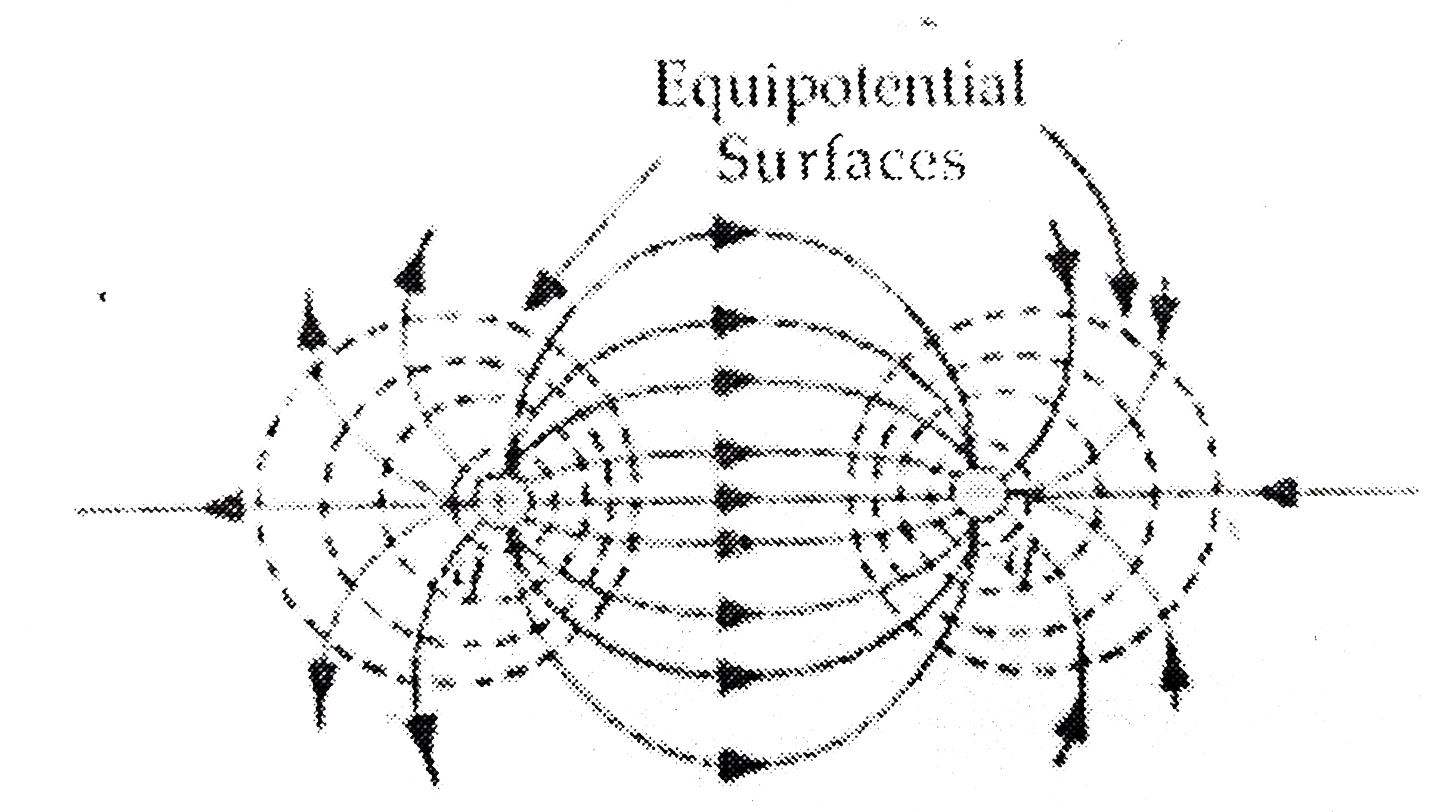
|
|