

Saved Bookmarks
| 1. |
Explain the superposition principle for static electric forces and write its general equation. |
|
Answer» Solution :To find force acting on a charge by other charges, principle of superposition is also used with Coulomb.s law. "When more than one Coulombian forces are acting on a charge, the resultant coulombian force acting on it is equal to the vector sum of the individual forces."  Suppose `q_(1), q_(2)` and `q_3` are charges of a system as shown in figure. Let `r_(1), r_(2)`and `r_3` are their respective position vectors from ORIGIN .O.. If `vecF_(12)` is force acting on `q_(1)`by `q_(2)`, then `vecF_(12) = 1/(4piepsilon_(0)).(q_(1)q_(2))/r_(12)^(2).hatr_(12)`..........(1) And `vecF_(13)` is force acting on `q_(1)` by `q_(3)`, then `vecF_(13) = 1/(4pi epsilon_(0)).(q_(1).q_(2))/r_(13)^(2).vecr_(13)`.........(2) Where `vecr_(12)` is vecor in direction along `q_(2)` to `q_(2)`. `therefore vecr_(12) = vecr_(2)-vecr_(1)` and `vecr_(13)` is vector in direction along `q_(3)` to `q_(1)`. `therefore vecr_(13) = vecr_(3) - vecr_(1)` If `VECF` is force on `q_(1)` by `q_(2)` and `q_(3)`, then `vecF = vecF_(12) + vecF_(13)` `=1/(4pi epsilon_(0)).(q_(1)q_(2))/r_(12)^(2) + 1/(4pi epsilon_(0)).(q_(1).q_(3))/r_(13)^(2).hatr_(13)` Resultant force on a charge due to more thai three charges is shown in figure (b). 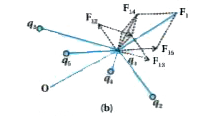 In general, if in system of `q_(1), q_(2), q_(3)`,........... `q_(n)`, force acting on `q_(1)` by other charges. `vecF_(1) = vecF_(12) + vecF_(13) + vecF_(14) +`............ `vecF_(n)` `=1/(4piepsilon_(0)) [ (q_(1).q_(2))/vecr_(12) + (q_(1)q_(3))/r_(13)^(2).r_(13) +....(q_(1)q_(2))/r_(1N)^(2).hatr_(1n)]` `=q_(1)/(4pui epsilon_(0)) sum_(i=2)^(n_(1)).q_(1)/r_(1I)^(2).r_(1i)` {where i=1,2,3,.......n) The vector sum is obtained as usual by the parallelogram law of addition of vectors. All of electrostatics is basically a consequence of Coulomb.s law and superposition principle. |
|