

Saved Bookmarks
| 1. |
Explain the principle on which the working of a potentiometer is based. Why is the use of a potentiometer preferred over that of a voltmeter for measurement of emf of a cell ? |
Answer» SOLUTION :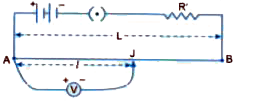 A potentiometer works on the principle that for a constant current flowing through the potentiometer WIRE of uniform cross-section, the fall in potential is directly proportional to length. Let as shown in ADJOINING FIG., a battery of emf `epsi_0` is connected across a potentiometer wire of length L and resistance R and an external series resistance R.. Then constant current flowing through the potentiometer wire is `I = (epsi_0)/((R + R.))` `therefore `Fall in potential along the potentiometer wire ` = IR = (epsi_0 R)/((R+ R.))` and the fall in potential per unit length (i.e., the potential gradient) `k = (epsi_0 R)/((R + R.)L.) ` ,which is a constant. Thus, potential drop across a length l of potentiometer wire V = kl, which is the basic working principle of the potentiometer. For measurement of emf of a cell, a potentiometer is preferred over a VOLTMETER because at the time of taking the reading no current is being drawn from the given cell and the cell is in an open circuit. |
|