

Saved Bookmarks
| 1. |
Eight point charges of magnitude Q are arranged to form the corners of a cube of side L. The arrangement is made in manner such that the nearest neighbour of any charge has the opposite sign. Initially, the charges are held at rest. If the system is let free to move, what happens to the arrangement? Does the cube-shape shrink or expand? Calculate the velocity ct each charge when the side-length of the cube formation changes from L to nL. Assume that the mass of each point charge is m. |
|
Answer» SOLUTION :There are total 28 pairs of charges 12 pairs `to Q` and `-Qto` distance L 12 pairs `to` (Q and Q)or (`-Q` and `-Q`)`to sqrt2L` 4pairs`toQ` and -`Qto` `sqrt3L` `:. U=12(1/(4piepsilon_0))((-Q^2)/L)+12(1/(4piepsilon_0).Q^2/sqrt((2L)))=4(1/(4piepsilon_0)((-Q^2)/sqrt(3L))` `=- Q^2/(piepsilon_0L)((3sqrt6+sqrt2-3sqrt3)/sqrt6)` 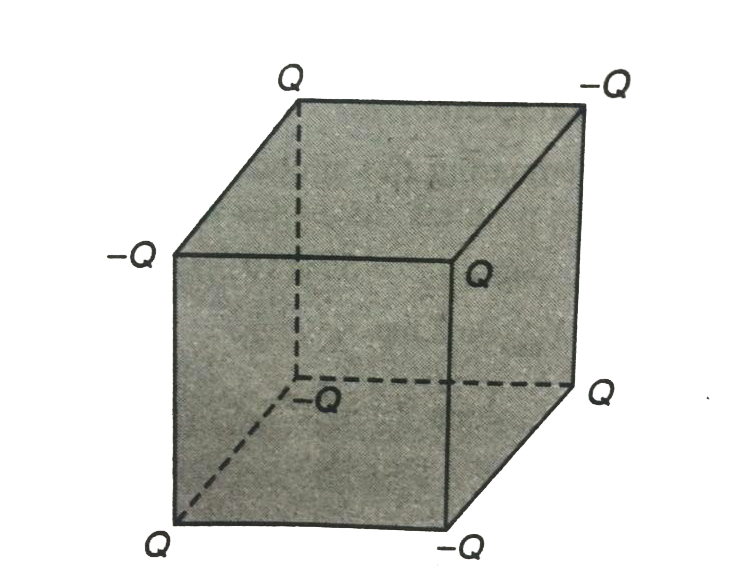 ltbr With decrease in L, potential energy wil decrease. ltbr With decrease in L, potential energy wil decrease. therefore, CUBE should shrink a the CONSERVATIVE forces act in the direction of decresing potential energy. Increase in KE of the system = decrease in PE ltbr. or `8(1/2mv^2)=U_i-U_f` `=Q^2/(piepsilon_0)((3sqrt6+sqrt2-3sqrt3)/sqrt6)(1/(nL)-1/L)` or `v=sqrt((Q^2(1-n)(3sqrt6+sqrt2-3sqrt3)/(4nmpiLepsilon_0sqrt6))` |
|