

Saved Bookmarks
| 1. |
Derive an expression for electrostatic potential due to an electric dipole. |
|
Answer» SOLUTION :(i) AB be the electric dipole ( -q at A tna +q at B). 2a be the distance between -q and +q. .r. be the distance between the point .p. and mid point .O. of AB. `.theta.` be the angle between OP and OB. 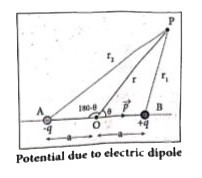 (ii) Let `r_1` be the distance of point P from +q and `r_2` be the distance of point P from -q. Potential at P due to charge +q `= 1/(4 pi epsi_0)q/r_1` Potential at P due to charge -q `=-1/(4piepsi_(0))q/r_2` Total potential at the point p, `V = 1/(4 pi epsi_0 ) q (1/r_1 - 1/r_2)"....(1)"` (iii) By the cosine LAW for triangle BOP. `r_1^2 = r^2 +a^2 - 2ra costheta` `r_1^2 = r^2 (1+a^2/r^2 - (2a)/r cos theta)` Since a a`ltlt`r, term `a^2/r^2` is very small and can be neglected. Therefore `r_1^2=r^2 (1-2a(cos theta)/r)` (or) `r_1 = r(1-(2a)/rcos theta)^(1/2)` `1/r_1 =1/r (1-(2a)/r cos theta)^(1/2)` (iv)Using binamial theorem we get. `1/r_1 = 1/r (1+a/rcostheta)"...(2)"` Similarly applying the cosne law for triangle AOP, `r_2^2 = r^2 -a^2-2racos (180 - theta)` Since cos (`180 - theta`) = `-cos theta` we get `r_2^2 = r^2 + a^2 + 2ra cos theta` Neglecting `a^2/r^2` ( because `r gt gt a` ) `a_2^2 = r^2(1+(2a cos theta)/r)` `r_2 = r(1+(2a cos theta)/r)^(1/2)` Using Binomial theorem we get `1/r_2 = 1/r (1-a (cos theta)/r)"...(3)"` Substituting equation (3) and (2) in equation (1), `V=1/(4piepsi_(0))q(1/r(1+a(cos theta)/r)-1/r (1-a(cos theta)/r))` `V = q/(4piepsi_(0))(1/r(1+a(costheta)/r)-1/r (1-a(cos theta)/r))` `V=1/(4 piepsi_(0))(2aq)/r^2 cos theta` (v) But the electric dipole MOMENT p = 2qa and we get, `V = 1/(4pi epsi_0)((pcos theta)/r^2)` If p `cos theta = vec p * hatr,` where `hatr` is the unit vector from the point O to point P. then `V = 1/(4piepsi_0)(vecp*hatr)/r^2""(r gtgta)"...(4)"` Spacial cases Case (i) If the point P lies on the axial line then `theta = 0`, then `v = 1/(4 pi epsi_(0)) p/r^2 "...(5)"` Case (ii) If the point P lien on the axial line then `theta = 180^@`, then `V = 1/ (4 pi epsi_(0)) p/r^2 "...(6)"` Case (iii) If the point P lies on the equatorial line, then `theta = 90^@`. Hence V = 0...(7) |
|