

Saved Bookmarks
| 1. |
Derive an expression for electric intensity E due to a uniformly charged thin spherical shell at a point outside the shell. |
|
Answer» Solution :Gauss Theorem It states that the TOTAL electric flux through a closed surface is equal to `(I)/(epsi_(0))` times the magnitude of the charge enclosed by the surface (`epsi_(0)` is permittivity of FREE space) i.e., `phi=ointvec(E).VEC(dS)=(q)/(epsi_(0))` where `vec(E)` is the electric field intensity and `vec(dS)` is the AREA vector. Consider a thin sphericalshell of radius R. let q be the charge distributed UNIFORMLY all over the surface of the shell. Imagine a gaussian surface of radius r, fing (a) the intensity at every point of it is the same and directed radially outwards so that angle bewtween `vec(E) and vec(dS)=0^(@)` `therefore oint_(S)vec(E).vec(dS)=oint_(S)EdScos0^(@)=(q)/(epsi_(0))` 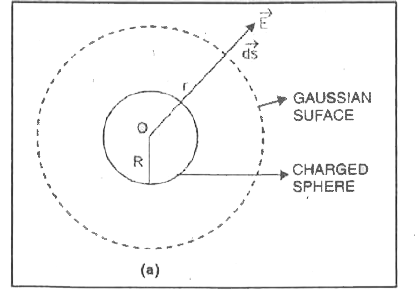 or `Eoint_(S)dS=(q)/(epsi_(0))` or `E4pir^(2)=(q)/(epsi_(0))` or 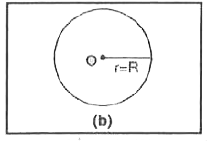 i.e., electric intensity at any pointe outside the spherical shell is such as if whole of charge were concentrated at the centre of the shell. At a point on the hollow sphere, r=R `therefore E=(q)/(4piepsi_(0)R^(2))` If `sigma` is the surface density of charge on the shell, then `q=4piR^(2)sigma` or `E=(4piR^(2)sigma)/(4piepsi_(0)R^(2))=(sigma)/(epsi_(0))` or `E=(sigma)/(epsi_(0))` 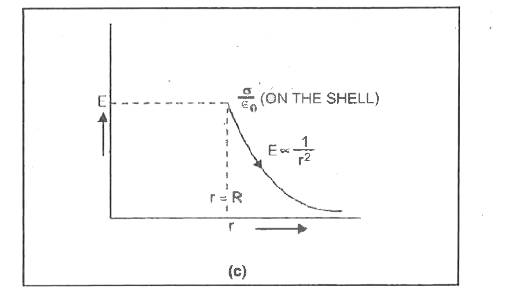 At a point inside. for a point P inside the shell E=0 since q=0 inside the shell. `therefore `Electric field intensity the shell is always zero. The variation ofelectric field intensity E with distance from the centre of a uniformly charged spherical shell is as shown in fig (c). |
|