

Saved Bookmarks
| 1. |
An organic compound (A) with molecular formula, C_(8)H_(8)O forms an orange-red precipitate with 2, 4-DNP reagent and gives yellow precipitate on heating with iodine in the presence of sodium hydroxide. It neither reduces tollens' reagent, nor does it decolourise bromine water or Baeyer's reagent. on drasic oxidation with chromic acid, it gives a carboxylic acid (B) having molecular formula, C_(7)H_(6)O_(2). Identify the compounds (A) and (B) and explain the reaction involved. |
|
Answer» Solution :Step-1. To determine the structures of compounds (A) and (B). (i) Since compound (A), M.F. `C_(8)H_(8)O` forms a 2,4-DNP, it must be either an aldehyde or a ketone. (ii) Since, it does not reduce tollens' reagent or Fehling's solution, (A) is must be a ketone. (iii) Since (A) on treatment with `I_(2)//NaOH`, gives yellow ppt. (iodoform), therefore, it must be a methyl ketone. (iv) D.B.E. for `C_(8)H_(8)O=(8(4-2)+8(1-2)+1(2-2))/(2)+1=5` One of the five sites of UNSATURATION must be due to the keto group, the remaining four may be due to the presence of a benzene ring. the presence of benzene ring is supported by the OBSERVATION that it neither decolourizes bromine water nor Baeyer's reagent. (v) Since drastic oxidatio of A with chromic acid gives compound (B) with M.F. `C_(7)H_(6)O_(2)`, therefore, (B) must be benzoic acid. further, the formation of benzoic acid suggests that compound (A) is a mono-substituted benzene DERIVATIVE. (vi) Thus, compound (A) has a monosubstituted benzene ring, i.e., a `C_(6)H_(5)` ring `CH_(3)CO` group. both these group account for the complete M.F. `(C_(6)H_(5)+COCH_(3)=C_(8)H_(8)O)` of compound (A), therefore, compound (A) is acetophenone or methyl phenyl ketone or 1-phenylethanone. 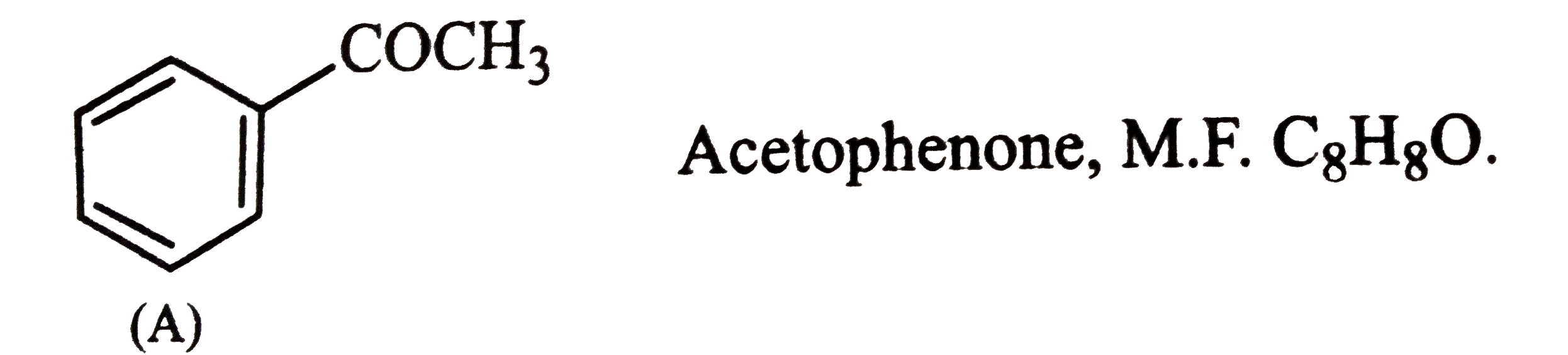 Step.2: To explain all the reactions involved in the question. 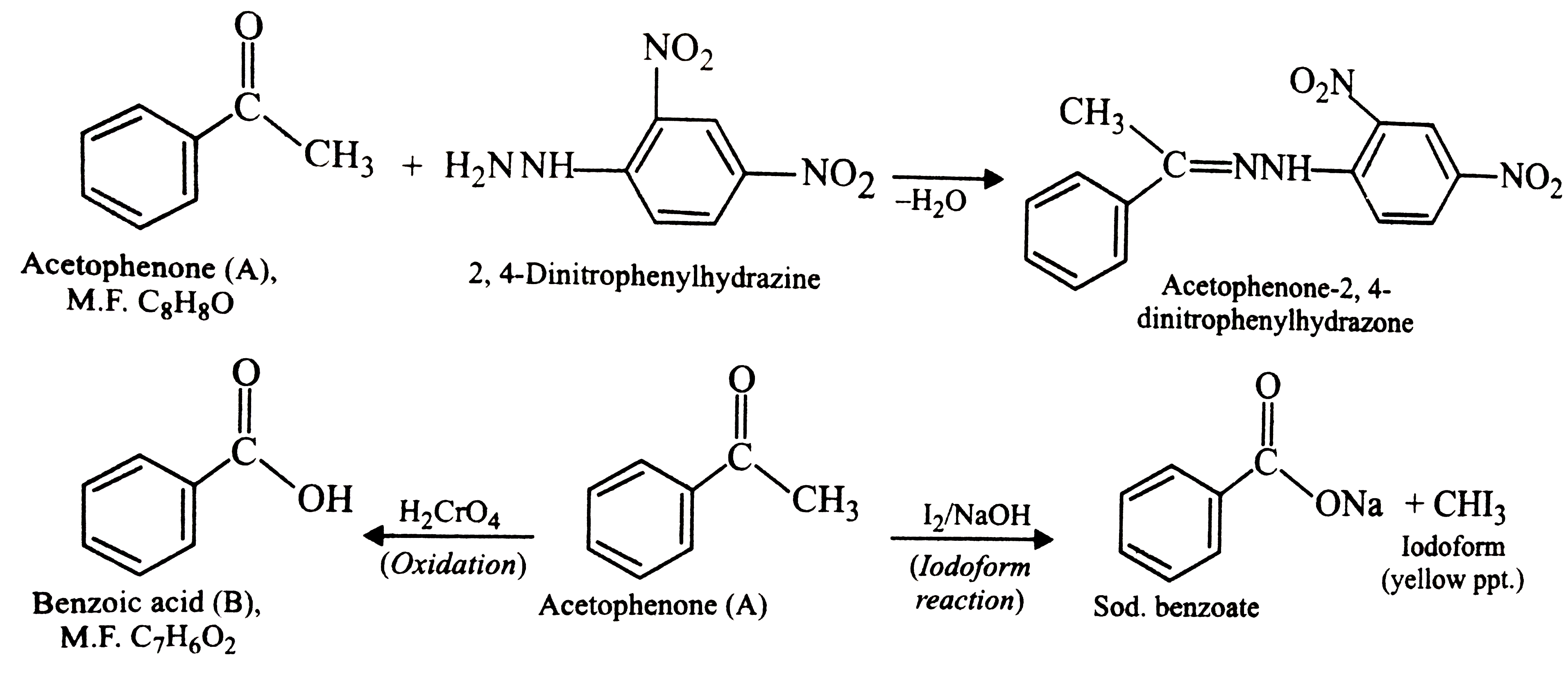
|
|