

Saved Bookmarks
| 1. |
An organic compound (A) on treatement with ethyl alcohol gives a carboxylic acid (B) and compound (C). Hydrolysis of (C) under acidified conditions gives (B) and (D). Oxidation of (D) with KMnO_(4) also gives (B). (B) on heating with Ca(OH)_(2) gives (E) having molecular formula C_(3)H_(8)O. (E) does not give tollens' test and does not reduce Fehling's solution but forms 2,4-dinitrophenylhydrazone. Identify (A), (B), (C), (D) and (E). |
|
Answer» Solution :(i) Since compound (E) with molecular formula `C_(3)H_(6)O` does not reduce Tollens' reagent and Fehling's solution but forms 2,4-dinitrophenylhydrazone, it must be a ketone. But the only possible ktone having the molecular formula `C_(3)H_(6)O` is acetone or propanone. THUS, compound (E) is acetone or (propanone) `CH_(3)COCH_(3)`. (ii) Since acetone (E) is obtained y heating compound (B) with `Ca(OH)_(2)`, therfore, (B) must be acetic acid (ethanoic acid), `CH_(3)COOH`. (iii) Since (D) on oxidation with `KMnO_(4)` gives acetic acid (B), therefore, (D) must be ethyl alcohol (ETHANOL), `CH_(3)CH_(2)OH`. (iv). Since acetic acid (B) and ethyl alcohol (D) are obtaied by treatment of compound (A) with ethyl alcohol, therefore, (C) must be ethyl acetate (ethyl ethanoate), `CH_(3)COOC_(2)H_(5)`. (v). Since ethyl acetate (C) and acetic acid (B) are obtained by treatment of compound (A) with ethyl alcohol, therefore, compound (A) must be acetic anhydride (ethanoic anhydride), `(CH_(3)COO)_(2)O`. (vi) All the reaction involved in this problem can now be explained as follows: 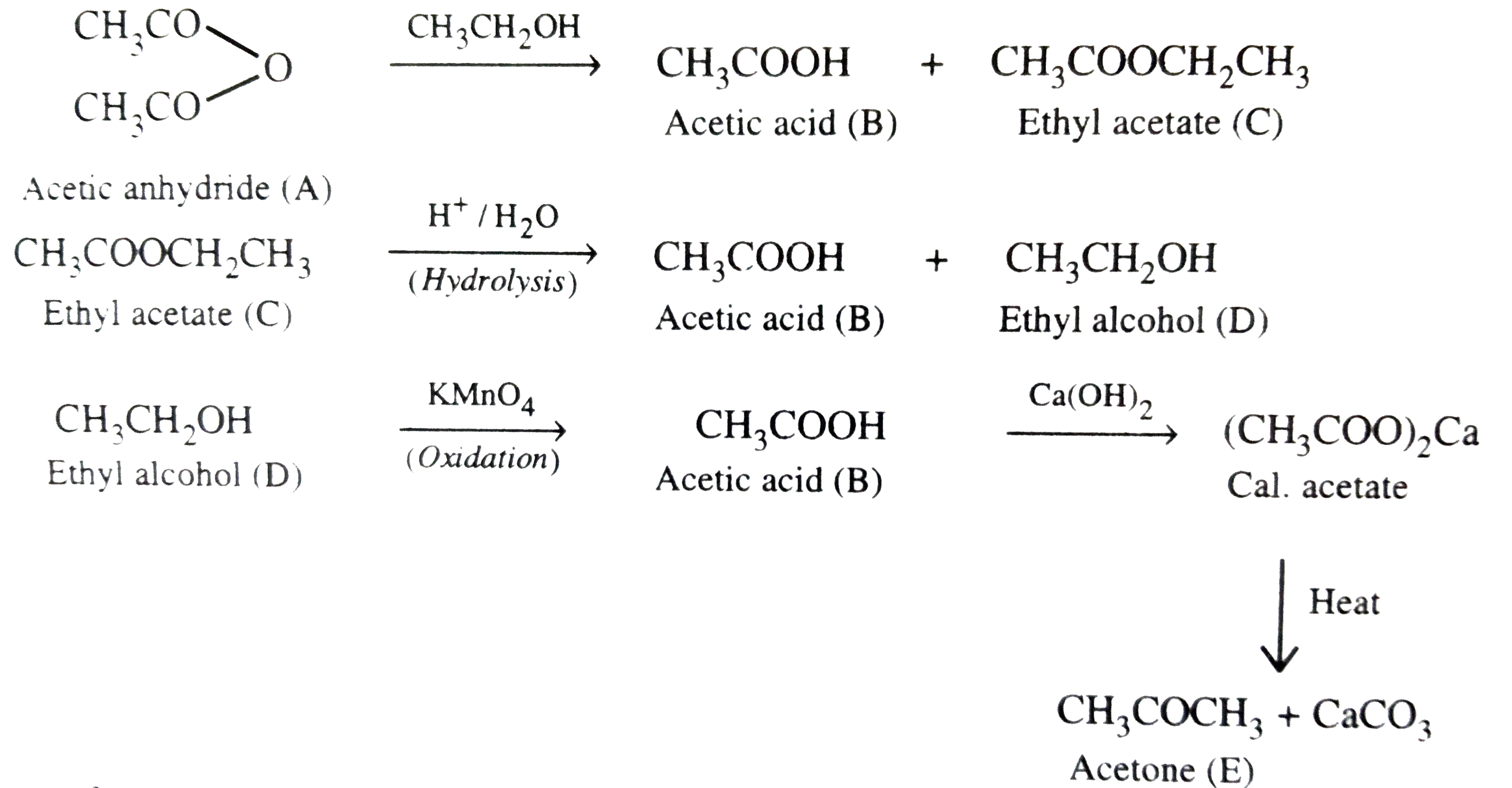 . .
|
|