

Saved Bookmarks
| 1. |
A string with one end fixed on a rigid wall, passing over a fixed frictionless pulley at a distance of 2 m from the wall, has a point mass M of 2 kg attached to it at a distance of 1 m from the wall. A mass in of 0.5 kg is attached to the free end. The system is initially held at rest so that the string is horizontal between wall and pulley and vertical beyond the pulley as shown in Fig. The system is released from the rest from the position as shown. The ratio of velocity of M and m when M strikes the wall is |
|
Answer» `(sqrt(5))/2` `C'B=sqrt(1^(2)+2^(2))=sqrt(5)m` When its INITIAL distance from the pulley was `CB=1m`. It means vertically upward displacement of mass `m` is `(sqrt(5)-1)m`. 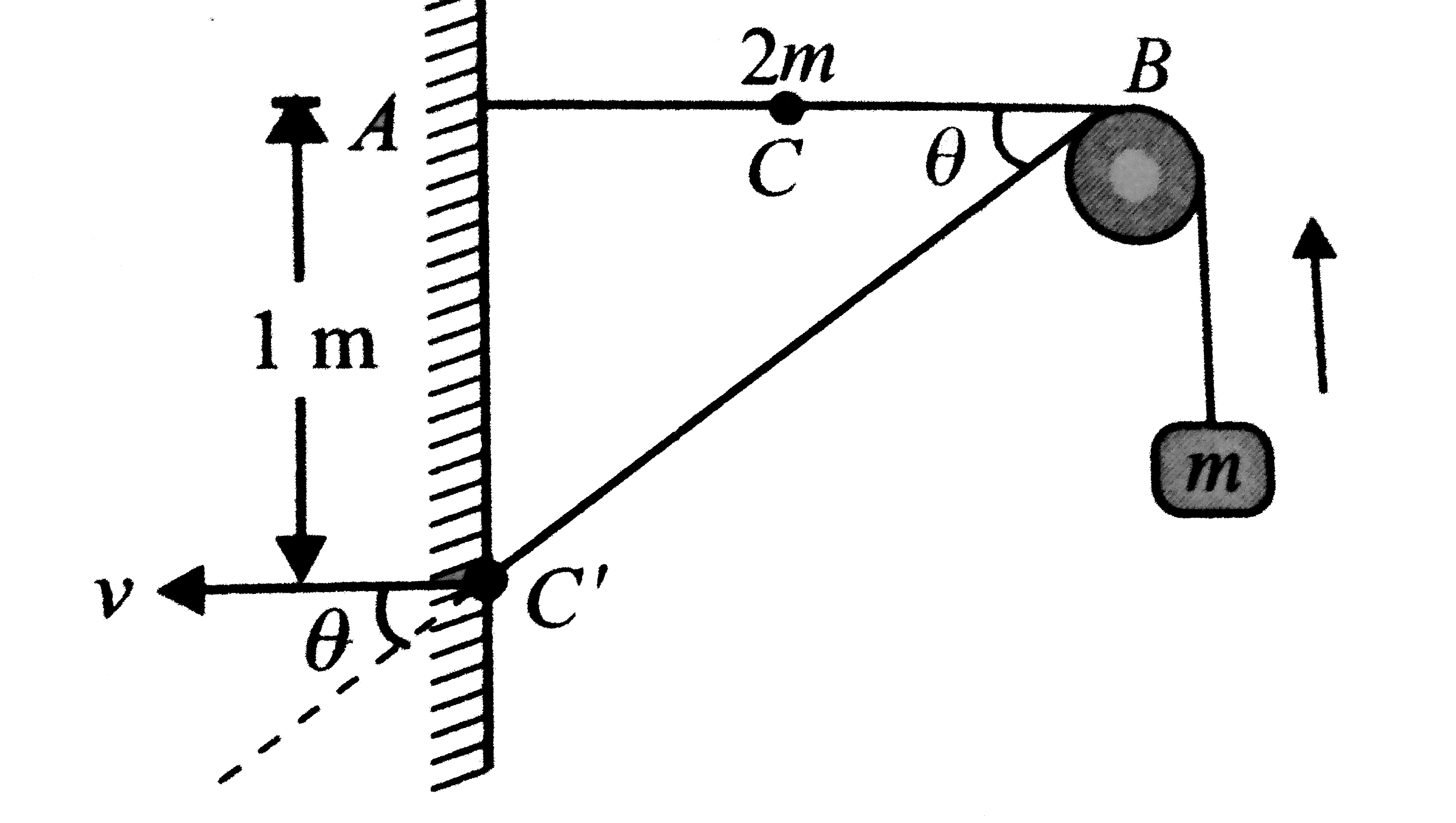 Let `M` strike the wall velocity `v`. Since the string between the two blocks always REMAINS taut, therefore at any instant speed of `m` is EQUAL to that component of velocity of `M` which which is along the string `C'B`. Hence , velocity of `m` when `M` strikes the wall is `vcostheta`, where `costheta=2/sqrt(5)` `:. (v_(M))/(v_(m))=v/(vcostheta)=(sqrt(5))/2` According to law of energy, LOSS of potential energy of `M=`increase in `PE` of `m+KE` of `M+KE` of `m` `Mgxx1=mg(sqrt(5)-1)+1/2Mv^(2)+1/2m(vcostheta)^(2)` `v=5sqrt((5-sqrt(5))/6)m//s` |
|