

Saved Bookmarks
| 1. |
A parallel beamof light falls successively on a thin convex lens of focal length 40 cm and then ono a thini convex lens of focal length 10cm as shown in figure. In figure, the second lens is an equiconcave lens of focal length 10cm and made of a material of refractive index 1.5. In both the cases, the second lens has an aperture equal to 1cm. Q. Now, a liquid of refractive index mu is filled to the right of the second lens in case B such that the area illuminated in both the cases is the same. Determing the refractive index of the liquid. |
|
Answer» 1 `A_(1)=pi(1)^(2)=picm^(2)` In case (b), let x be the diameter of the area illuminated. Then, `(x)/(45)=(1)/(5)rArr x=9cm` `A_(2)=pi((9)/(2))^(2)=(81)/(4)picm^(2)` `(A_(2))/(A_(1))=(81)/(4)` When liquid of refractive index `mu` is filled to the right of this lens, the first surface of the lens (radius of curvature `=10cm)` forms the imag at the OBJECT only. Considering the refraction at the second surface. `(mu)/(oo)-(1.5)/(-10)=(mu-1.5)/(10)` (therefore, same area `rArr upsilonrarroo)` `rArr mu=3` 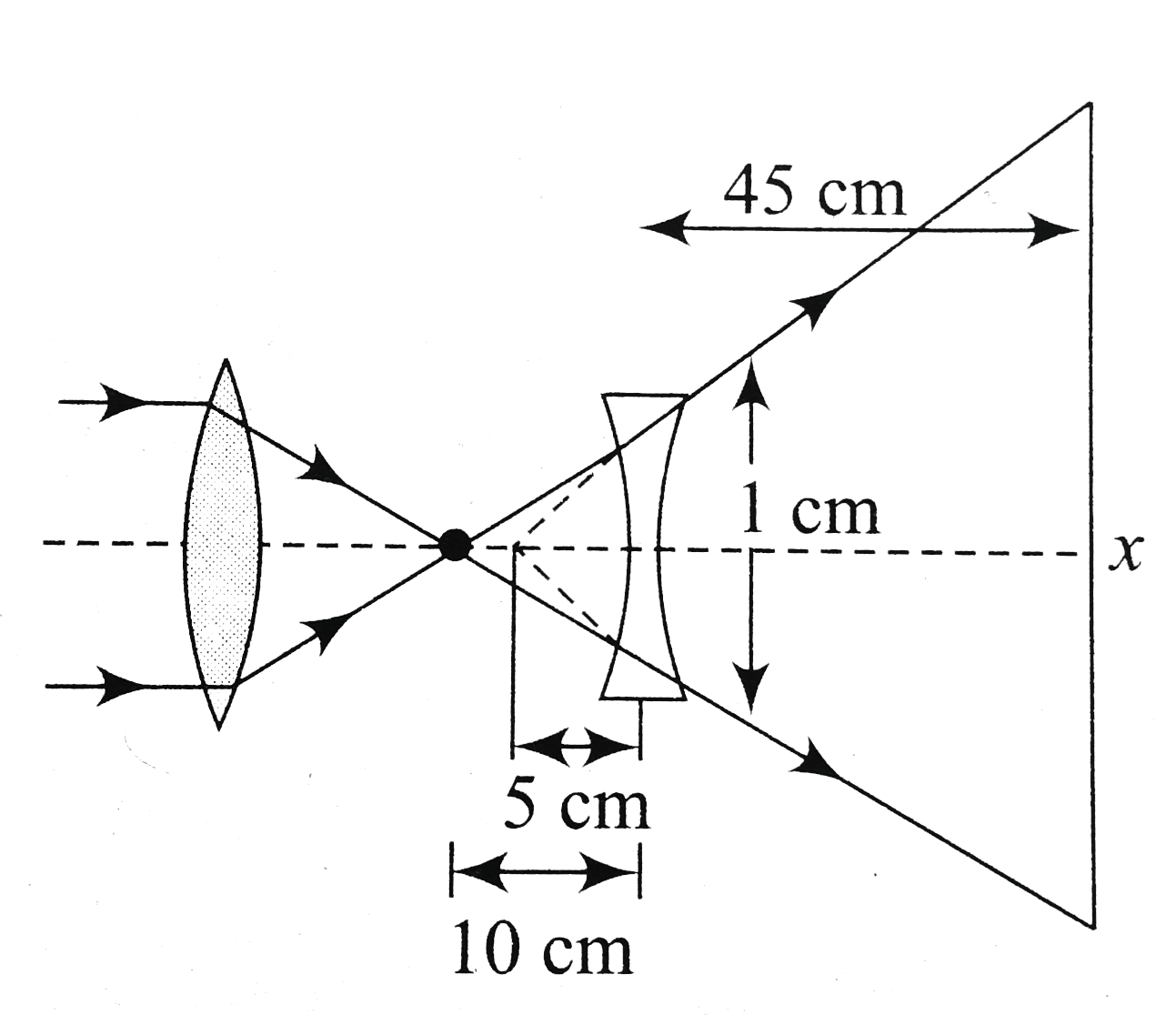
|
|