

Saved Bookmarks
| 1. |
(a) Draw the schematic sketch of a cyclotron. Explain the shape of the path on which charged particle moves when the particle is accelerated by it. (b) To convert a given galvanometer into a voltmeter of ranges 2 V, V and V/2 volt, resistances R_(1),R_(2) and R_(3) ohm respectively, are required to be connected in series with the galvanometer. Obtain the relationship between R_(1), R_(2) and R_(3). |
|
Answer» After describing a semicircular path inside dee `D_(1)`, the particle comes in the gap between the two dees. In the resonance condition, the direction of electric field just gets reversed during this time and particle is again ACCELERATED towards the dee `D_(2)` and its velocity `v_(2)` becomes greater. So, the charged particle describes a semicircular path in dee `D_(2)` whose radius `r_(2)=(mv_(2))/(qB)` is slightly greater than `r_(1)` As time taken by charged particle to cover the semicircular path remains unchanged, same thing happens again and again and particle describes semicircular paths of gradually increasing radii in dees `D_(1)` and `D_(2)` again and again. 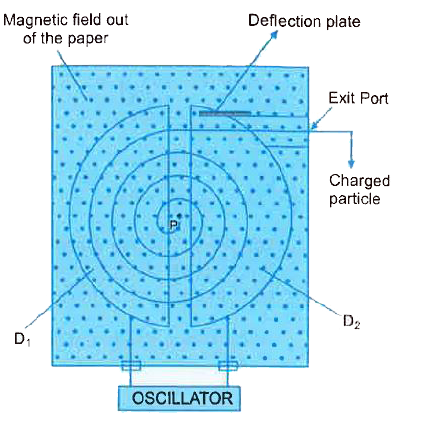 (b) Let us have a GALVANOMETER of resistance `R_(G)` and giving full scale deflection for a current `I_(g)` to CONVERT it into a voltmeter of ranges 2V,V and `V/2` respectively, we are JOINING resistances `R_(1),R_(2)` and `R_(3)` so we have `R_(1)=(2V)/(I_(g))-R_(g)` ...(i) `R_(2)=V/(I_(g))-R_(g)`....(ii) and `R_(3)=(v//2)/(I_(g))-R_(g)` ....(iii) On solving these equations, we get `R_(1)-R_(2)=2R_(3)` or `R_(1)=R_(2)+2R_(3)` |
|