

Saved Bookmarks
| 1. |
(a) Draw a ray diagram for final image formed at distance of distinct vision (D) by a comppound microscope and write expression for its magnifying power. (b) An angular magnification (magnifying power) of 30x is desired for a compound microscope using as objective of focal length 1.25 cm and eye piece of focal length 5 cm. How will you set up the compound microscope? |
|
Answer» Solution :(a) The labelled ray diagram showing image formation in a compound microscope has been shown here. MAGNIFYING POWER of a travelling microscope is given by the relation : `m=(v_(0))/(u_(0))(1+(D)/(f_(e)))=(L)/(f_(0))(1+(D)/(f_(e)))` 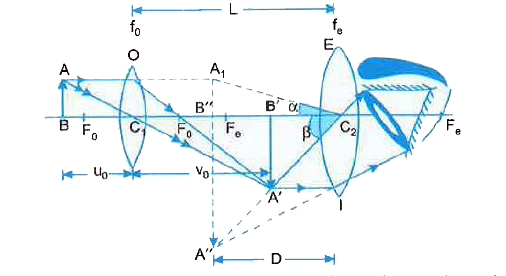 (b) In normal adjustment of microscope, the final image is formed at the least distance of distinct vision i.e., D = 25 cm. In that case, angular magnification of eyepiece `m_(e)=(1+(D)/(f_(e)))=1+(25)/(5)=6""[because f_(e)=+5cm]` As magnification of microscope m = 30 and `m=m_(0)xxm_(e)` `rArr""m_(0)=(m)/(m_(e))=(30)/(6)=5` `therefore""m_(0)=(v_(0))/(u_(0))=5` or `v_(0)=5u_(0)` and as per sign convention `u_(0)` is `-ve` but `v_(0)` is `+ve` and `f_(0)=+1.25cm`. Hence, we have `(1)/(v_(0))-(1)/(u_(0))=(1)/(f_(0)) or (1)/(5u_(0))-(1)/((-u_(0)))=(1)/(1.25) or (6)/(5u_(0))=(1)/(1.25)` `rArr""u_(0)=1.5 cm` and hence `|v_(0)|=|5u_(0)|=7.5cm` Moreover `m_(e)=|(v_(e))/(u_(e))|=(D)/(|u_(e)|)`, hence `|u_(e)|=(D)/(m_(e))=(25)/(6)=4.17cm` `therefore` Separation between the objective and eye-LENS `L=|v_(0)|+|u_(e)|=7.5+4.17=11.67cm` and the object should be placed 1.5 cm from the objective lens to obtain the desired magnification. |
|