

Saved Bookmarks
| 1. |
A consumer consumes only two of goods . For the consumes to be in onlyequilibrium why must Marginal Rate of Substitution between the two goods must be equal to the ratio of prices of these two goods ?It it enough to ensure equilibrium ? |
|
Answer» Solution :(i) To define consumer equilibrium, we use Interference Curve map and the budget line . Two conditions for consumer Equilibrium (a) Necessary CONDITION Marginal Rate of Substitution = Market Rate of Exchange `[(P_x)/(P_y)]` Or , `MRS_(x,y)=P_x//P_y` MRS ( Market Rate of Exchange ) MRE Or `MRS_(x,y) =MRE[(P_x)/P_y]` `"*" ` If `MRS_(x,y) gt MRE [(P_x)/(P_y)]` , At point T in figure It means the consumer.s willingness to pay for commodity X is higher than what makes values for commodity X. So, the consumer should buy more of X and less of Y to get MRS `=P_x/P_y` 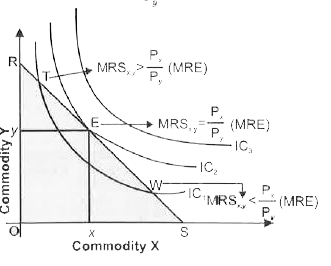 `"*"` If `MRS_(x,y) lt MRE [(P_x)/(P_y)]`, At point W in figure, It means the consumer willingness to pay for commodity X is lesser than what market value for commodity X ,So, consumer should buy less of X and more Y to get MRS = `p_x/p_y` (b) Sufficient Condition `MRS_(x,y)` Diminishing (Convex) at a point of equilibrium i.E., when `MRS_(xy)=MRE[P_x/P_y]` (ii) The consumer will reach equilibrium when the budget line is TANGENTIAL to the higher possible Indifference Curve, i.e. ., where necessary and sufficient condition satisfy . In the above diagram , the consumer will reach equilibrium at point E where budget line RS is tangential to the higher possible `IC_2` (iii) The consumer cannot move to Indifference Curve , i.e. ., `IC _3`as this is beyond this MONEY income. (iv) Even on `IC_2` all the other points except E are beyond his means . (v) Hence , at point E, the consumer is in equilibrium where his satisfaction maximizes, given his income and prices of goods X and Y . In equilibrium at E , the slope of Budget line = the slope of Indifference Curve. Therefore `MRS_(xy)`is equal to the ratio of the PRICE bof two goods `[(P_x)/(P_y)]` . |
|