

Saved Bookmarks
| 1. |
(a) A point object is placed in front of a double convex lens( of refractive index n = n_(2) // n_(1) with respect to air ) with its spherical faces of radii ofcurvature R_(1)and R_(2). Show the path of rays due to refraction at first and subsequently at the second surface to obtain the formation of the real image of the object. Hence obtain the lens-maker's formula for a thin lens. A double convex lens havingboth faces of the same radius of curvature has refractive index 1.55. Find out the radius of curvature of the lens required to get the focal length of 20cm. |
Answer» Solution :(a) 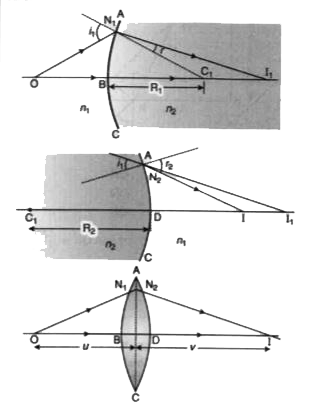 The first refracting surface ABC forms the IMAGE `I_(1)` of the object O. The image `I_(1)` acts as a VIRTUAL object for the second refracting surface ADC, which forms the real image I as shown in the diagram. For refraction at ABC. `(n_(2))/( v_(1)) - ( N _(1))/( u ) = ( n _(2) -n_(1))/( R_(1)) `...(i) For refraction at ADC `( n_(1))/( v )- ( n_(2))/( v_(1)) = ( n _(1) - n_(2))/ (R_(2))`....(ii) Adding equations (i) and (ii) `(n_(1)) /( v) - ( n_(1))/( u ) = ( n _(2) - n_(1)) ((1)/( R_(1)) - ( 1)/( R_(2)))` `(1)/( v) - ( 1)/( u )= (( n_(2) )/( n_(1)) - 1) ((1)/( R_(1))- ( 1)/( R_(2)))` We know, If `u = oo, v = f ` `(1)/( v) - (1)/( u ) = (1)/( f)` `(1)/(f) = (( n_(2))/( n_(1)) - 1) ((1)/( R_(1)) - ( 1)/( R_(2)))` `(1)/( f) = ( MU _(21) - 1) ((1)/( R_(1)) - ( 1)/( R_(2)))` (B) `(1)/(f) = ( mu _(21)-1) ((1)/(R_(1)) - ( 1)/( R_(2)))` `(1)/(20) = ( 1.55-1) ((1)/( R) - (1)/( -R))` `= 0.55 xx (2)/( R )` `R = 0.55 xx 2 xx 20 = 22 cm` |
|